



Koizumi counters China's accusations of Japanese militarism
Jun 01, 2026, 10:51 am


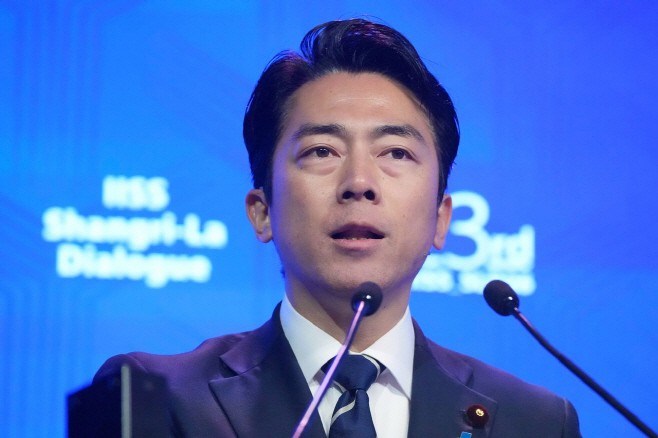 |
| Japanese Defense Minister Shinjiro Koizumi delivers a speech at the Shangri-La Dialogue, an annual Asian national defense and security forum, held in Singapore on May 31. / Photo via Yonhap News |
Japanese Defense Minister Shinjiro Koizumi has publicly fires back at China’s criticism accusing Japan of harboring "new militarism." The Sankei Shimbun and the Asahi Shimbun reported that during his speech at the Asian Security Summit—commonly known as the Shangri-La Dialogue—in Singapore on May 31, Koizumi pointedly remarked without explicitly naming China, "It is absurd for a country that possesses vast stockpiles of nuclear weapons and strategic bombers to label Japan, which has neither, as practicing a new form of militarism." Defending Japan's position, he dismissed Beijing's assertions as "false claims" and stressed that Japan has strictly adhered to international law as a peaceful nation throughout the post-war era.
This rebuttal extends beyond mere diplomatic rhetoric. Beijing has persistently attacked Japan's defense build-up as "new militarism" since November last year, following remarks made in parliament by Prime Minister Sanae Takaichi regarding contingencies in the Taiwan Strait. In response, Defense Minister Koizumi countered with the logic that Japan possesses neither nuclear arsenals nor strategic bombers, and that its defense enhancements are being executed with complete transparency. Conversely, his remarks illuminated China’s opaque military expansion and assertive external activities as matters of grave concern for both Japan and the broader international community.
Simultaneously, Koizumi underscored the necessity of maintaining open dialogue with Beijing. The Chinese Defense Minister was absent from the Shangri-La Dialogue for the second consecutive year, leaving a potential bilateral meeting with Koizumi unrealized. "I sincerely regret that we did not have the opportunity to meet," Koizumi stated, adding, "If China has matters it wishes to address with Japan, I am highly eager to hold a meeting." Even during the Q&A session, when a Chinese official raised questions regarding Japan's historical perceptions, he responded, "It is absolutely vital that we engage in dialogue and communication rather than averting our eyes from difficult issues."
◇ Japan’s Emergence as a Fully Fledged Arms Exporter
Another core pillar of Koizumi's speech focused on expanding Japan's regional security footprint. He outlined strategies to widen defense cooperation with Australia, the United Kingdom, and various Southeast Asian nations, anchored by the foundational U.S.-Japan alliance. Pointing specifically to the widening pathways for defense exports enabled by the revision of the Three Principles on Defense Equipment and Technology transfer this past April, he declared Japan’s "resolute determination to assume a new role in regional defense equipment cooperation." The message signals a paradigm shift from a Japan that historically exercised restraint in arms exports to a nation that actively provisions equipment to allies and partner states.
Tangible actions quickly followed the address. Koizumi held a bilateral meeting on the same day with Philippine Defense Secretary Gilberto Teodoro, confirming plans to fast-track the export of a decommissioned Maritime Self-Defense Force Abukuma-class destroyer. The two sides also agreed to enter discussions for the export of a TC-90 training aircraft. The Abukuma-class destroyer is poised to become the first major defense hardware export case following the regulatory revisions. Furthermore, Japan agreed with Singapore to establish a working group to foster inter-governmental cooperation in defense industrial and technological bases.
The strategic landscape is clearly drawn. Japan justifies its reinforcement of the U.S.-Japan alliance, its expanded network with friendly nations, and its push into arms exports by pointing to China's growing military prowess. China counters by framing these developments as Japanese rearmament and an attempt to destabilize the post-war international order, leveraging historical grievances as its diplomatic weapon. While Japan maintains that its actions represent a transparent defense build-up by a peaceful nation, China counters that it marks the resurrection of militarism.
This evolving dynamic carries direct implications for South Korea. Japan's scaling of arms exports and its tightening security alignment with the U.S., Australia, and the Philippines signify a fundamental restructuring of the Indo-Pacific security architecture. Consequently, Seoul faces the complex challenge of managing trilateral cooperation with the U.S. and Japan, balancing its relations with Beijing, and countering North Korean nuclear and missile threats all at once. Ultimately, what materialized at the Shangri-La Dialogue was not a mere rhetorical dispute between Tokyo and Beijing, but a clear trajectory of Japan stepping forward onto the global stage as a major arms exporter and a principal regional security provider.
Choi Young-jae
Most Read
-
1
Celltrion’s Omlyclo gains ground in major European..

-
2
Trump demands rates fall below 1% as Fed hikes for..

-
3
Trump makes $1 trillion bet ahead of midterm elect..

-
4
Iran resumes ballistic missile production, assembl..

-
5
Samsung Electronics, Mistral AI to jointly develop..

-
6
Trump warns countries not helping U.S. must pay re..

-
7
Apple launches first foldable, 1 million won prici..

PEOPLE






HEADLINE NEWS
- Trump to roll out ‘unprecedented welcome’ for Xi with B-2 bombers, F-22 fighters
- S. Korea, U.S., and Japan form united front on Taiwan and economic coercion..
- Trump administration moves to impose sweeping sanctions on International Cr..
- Xi to make state visit to U.S. Sept. 23-25, dispelling rumors over his heal..

-
Address : In-Young Bldg., 34, Uisadang-daero 1-gil, Yeongdeungpo-gu, Seoul
Copyright by ASIATODAY CO., LTD. All rights resereved