



US and China escalate media warfare by expelling journalists
Jun 01, 2026, 10:05 am


The United States and China are facing a heightened risk of entering an all-out media war, following their ongoing tariff and trade disputes. Should this conflict erupt, relations between the two superpowers—which had recently shown signs of stabilizing following the bilateral summit held on May 14–15—could freeze once again.
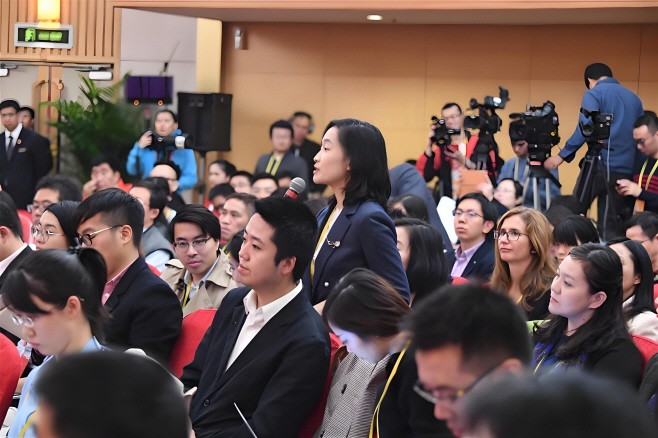 |
| A Chinese-American correspondent from the Associated Press (AP) asks a question during a recent regular press briefing held by the Chinese Ministry of Foreign Affairs. If an all-out media war erupts between the U.S. and China, reporters like him may have to risk the threat of expulsion. / Photo via The Beijing News (Xinjingbao) |
That this risk is highly plausible becomes evident when looking at the recent actions taken by both Washington and Beijing against each other's correspondents. According to Beijing diplomatic sources well-versed in bilateral relations on May 31, China was the first to fire a salvo, expelling New York Times (NYT) correspondent Vivian Wang from Beijing this past February.
Wang, a journalist of Chinese descent, had reportedly fulfilled her duties without issue since she began working in Beijing in 2022. However, the Chinese Ministry of Foreign Affairs abruptly ordered her expulsion. Naturally, there was a catalyst: the decisive factor was a virtual interview conducted last December by NYT columnist Andrew Ross Sorkin with Taiwanese President Lai Ching-te during the Times DealBook Summit. Given that expelling Wang—who was not even involved in the interview—was the most definitive way for Beijing to retaliate, such an assessment is entirely justified.
Furthermore, Sorkin referred to Taiwan as a "country" during the interview, a move Beijing viewed as a severe violation of its sacred "One China" principle, the cornerstone of its cross-strait policy. Compounding this, President Lai delivered a provocative warning during the session, stating, "Taiwan will take all necessary measures to protect itself if China continues its military pressure." Under these circumstances, it would have been more surprising had Beijing remained silent. Sure enough, Wang fell victim to the fallout two months later.
It was hardly surprising, then, that all eyes turned to the reaction of the United States, a nation that prides itself on a stubborn refusal to back down. True to form, it recently came to light that Washington abruptly revoked the visa of a correspondent from China’s state-run Xinhua News Agency in April. The move was unmistakably a retaliatory measure matching the expulsion of Wang.
According to sources, neither side has taken further follow-up actions as of yet. However, the probability of another clash remains exceptionally high, particularly given that the two superpowers clashed over media operations in 2020 during the first Trump administration. At that time, the U.S. instigated the friction by designating state-run outlets, including Xinhua, as foreign missions and capping the number of Chinese journalists permitted to work in the country.
In response, China fired back by expelling a wave of American journalists from the NYT, The Wall Street Journal (WSJ), and The Washington Post (WP). That the potential for a similar all-out media war is tracking high requires no further explanation. It is difficult to shake the feeling that another cloud of conflict is quietly gathering between the U.S. and China.
Hong Sun-do
Most Read
-
1
Celltrion’s Omlyclo gains ground in major European..

-
2
Trump demands rates fall below 1% as Fed hikes for..

-
3
Trump makes $1 trillion bet ahead of midterm elect..

-
4
Iran resumes ballistic missile production, assembl..

-
5
Samsung Electronics, Mistral AI to jointly develop..

-
6
Trump warns countries not helping U.S. must pay re..

-
7
Apple launches first foldable, 1 million won prici..

PEOPLE





HEADLINE NEWS
- Trump to roll out ‘unprecedented welcome’ for Xi with B-2 bombers, F-22 fighters
- S. Korea, U.S., and Japan form united front on Taiwan and economic coercion..
- Trump administration moves to impose sweeping sanctions on International Cr..
- Xi to make state visit to U.S. Sept. 23-25, dispelling rumors over his heal..

-
Address : In-Young Bldg., 34, Uisadang-daero 1-gil, Yeongdeungpo-gu, Seoul
Copyright by ASIATODAY CO., LTD. All rights resereved