



Myanmar mining blast kills 55 in rebel area
Jun 01, 2026, 09:44 am


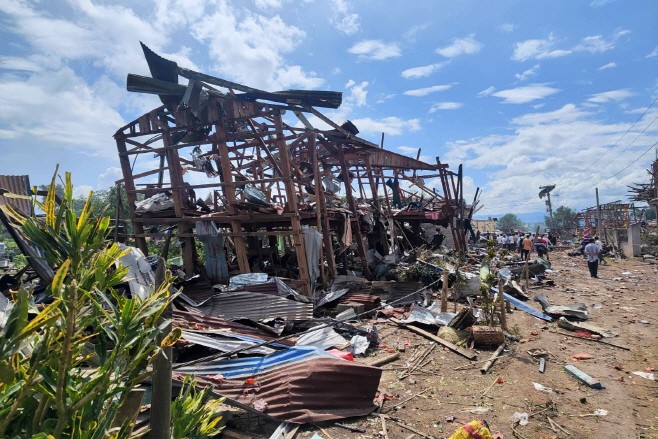 |
| Rescue workers and local residents conduct search operations at the site of a deadly explosion in Namhkam township, Shan State, Myanmar, on May 31 (local time). / Photo via AP, Yonhap News |
An explosion involving mining explosives has claimed dozens of lives, including several children, in a rebel-controlled territory in northern Myanmar. The ethnic armed organization administering the region confirmed that the incident was an accidental detonation of blasting materials stockpiled for mining and quarrying operations.
According to foreign media reports, including AFP and Reuters, on June 1 (local time), the blast occurred at approximately 12:00 PM on May 31 in a village within Namhkam township, located in northern Myanmar's Shan State. Casualties reported by rescue workers indicate a death toll ranging between 46 and 59. One rescue worker stated that 46 individuals, including six children, were killed and over 70 others sustained injuries, while another emergency responder placed the death toll at 59. Meanwhile, the BBC and Shwe Phee Myay, a local news outlet, reported that at least 55 individuals—comprising 25 women and 30 men—had perished.
The force of the explosion collapsed numerous residential structures, and the wounded were evacuated to nearby medical facilities. A rescue worker, speaking on the condition of anonymity due to security concerns, remarked, "There could be more deceased individuals trapped beneath the collapsed homes." Another responder noted that recovered bodies had been transported to a crematorium.
The Ta'ang National Liberation Army (TNLA), the armed group controlling the area, confirmed in a statement that explosives stockpiled for mining and quarrying accidentally detonated around noon. While the TNLA acknowledged that "the explosion caused heavy casualties among residents and destroyed homes," it did not provide a specific casualty count. The group clarified that the explosives belonged to its economic department, adding that an investigation into the precise cause is underway and those found responsible would be held accountable.
The fact that the explosives were under the purview of a rebel economic department highlights the financial infrastructure of Myanmar’s insurgent factions. Multiple armed resistance groups finance their campaigns against the ruling military junta through gemstone and mineral extraction; however, lax safety management results in frequent industrial accidents, such as mine collapses.
Myanmar has been embroiled in an all-out civil war following a military coup in 2021. The junta is currently engaged in multi-front combat against pro-democracy guerrilla forces and powerful ethnic armed organizations. The border regions, in particular, host a dense concentration of ethnic minority factions that have fought the military for autonomy and resource control since the country gained independence from Britain in 1948.
The TNLA is regarded as one of the most formidable ethnic insurgent forces in Myanmar. Formed alongside the Arakan Army (AA) and the Myanmar National Democratic Alliance Army (MNDAA) under the Three Brotherhood Alliance, the group reached a China-brokered ceasefire with the junta in early 2024. However, the TNLA resumed its offensive in June of that year in the Mandalay region adjacent to Shan State, capturing the ruby-mining hub of Mogok by that summer. Following another round of Chinese mediation last October, the group agreed to withdraw from Mogok and currently maintains a ceasefire with the military.
Jeong Ri-na
Most Read
-
1
Celltrion’s Omlyclo gains ground in major European..

-
2
Trump demands rates fall below 1% as Fed hikes for..

-
3
Trump makes $1 trillion bet ahead of midterm elect..

-
4
Iran resumes ballistic missile production, assembl..

-
5
Samsung Electronics, Mistral AI to jointly develop..

-
6
Trump warns countries not helping U.S. must pay re..

-
7
Apple launches first foldable, 1 million won prici..

PEOPLE






HEADLINE NEWS
- Trump to roll out ‘unprecedented welcome’ for Xi with B-2 bombers, F-22 fighters
- S. Korea, U.S., and Japan form united front on Taiwan and economic coercion..
- Trump administration moves to impose sweeping sanctions on International Cr..
- Xi to make state visit to U.S. Sept. 23-25, dispelling rumors over his heal..

-
Address : In-Young Bldg., 34, Uisadang-daero 1-gil, Yeongdeungpo-gu, Seoul
Copyright by ASIATODAY CO., LTD. All rights resereved