



Iran and US in stalemate over ceasefire talks
Jun 01, 2026, 09:10 am


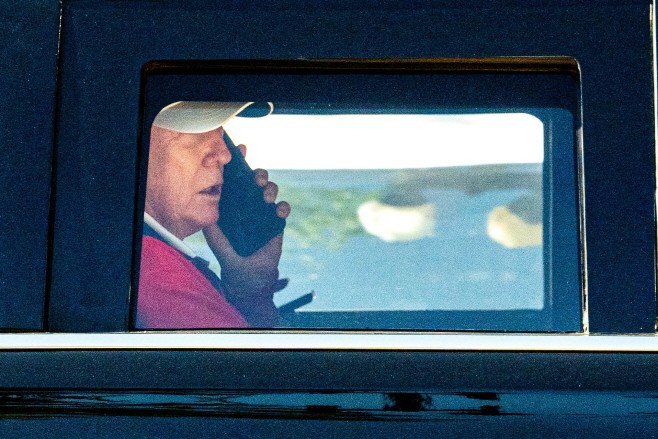 |
| U.S. President Donald Trump speaks on a phone call as he departs the White House on May 31 (local time), en route to the Trump National Golf Club in Sterling, Virginia. / Photo via Reuters, Yonhap News |
The United States and Iran are reportedly engaged in final calibrations over a draft memorandum of understanding (MOU) to end the war, with each side presenting its respective demands.
Iran's Tasnim News Agency reported on May 31 (local time) that Tehran plans to submit a new counter-proposal. This comes in response to U.S. President Donald Trump re-transmitting the draft agreement to the Iranian side after demanding more stringent provisions concerning the disposal of nuclear materials—such as highly enriched uranium (HEU)—and the reopening of the Strait of Hormuz.
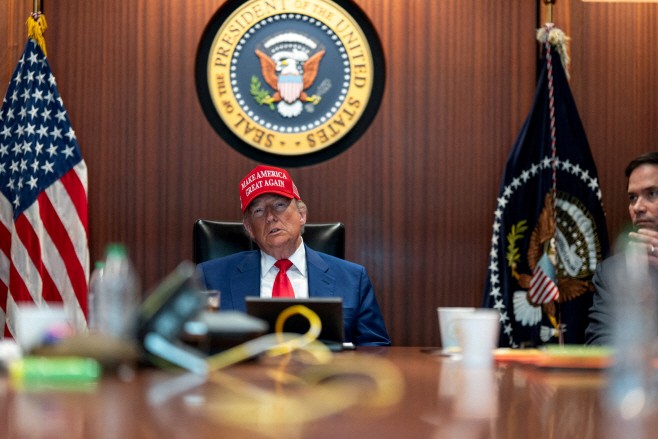 |
| U.S. President Donald Trump chairs a meeting inside the White House Situation Room in Washington, D.C., on June 21, 2025 (local time). / Photo via The White House, Reuters, Yonhap News |
Trump orders revisions on nuclear dispositions and Strait of Hormuz in Situation Room briefing; Bessent states "securing enriched uranium and nuclear ban defines mission accomplished"
In an interview with Fox News, President Trump stated that an agreement with Iran would be reached "slowly but surely." He emphasized, "We are either going to get a great deal, or we are going to go back and finish it militarily. You cannot get a good deal if you are in a rush."
"They said, 'We will not develop nuclear weapons,'" Trump noted. "I asked, 'Well, what if you buy them?' So now the text includes that they will not develop or acquire them in any manner whatsoever."
President Trump anticipated that once an agreement is finalized, the Strait of Hormuz will immediately reopen, triggering a sharp decline in gasoline prices.
Treasury Secretary Scott Bessent echoed this stance during a separate Fox News interview, declaring, "'Mission accomplished' means the Strait of Hormuz is open, we secure the highly enriched uranium, and Iran does not get a nuclear weapon."
"This is the first time in 47 years that Iran has even been willing to discuss not possessing nuclear weapons," Bessent added. "Thanks to President Trump, it is on the negotiating table for the very first time."
Kevin Hassett, Director of the White House National Economic Council (NEC), also noted on ABC that "immense pressure is being applied to Iran to assent to the terms laid out by President Trump." Furthermore, Defense Secretary Pete Hegseth stated at the Asia Security Summit (Shangri-La Dialogue) in Singapore that the United States retains the full operational capacity and stockpiles to resume military campaigns against Iran if circumstances dictate.
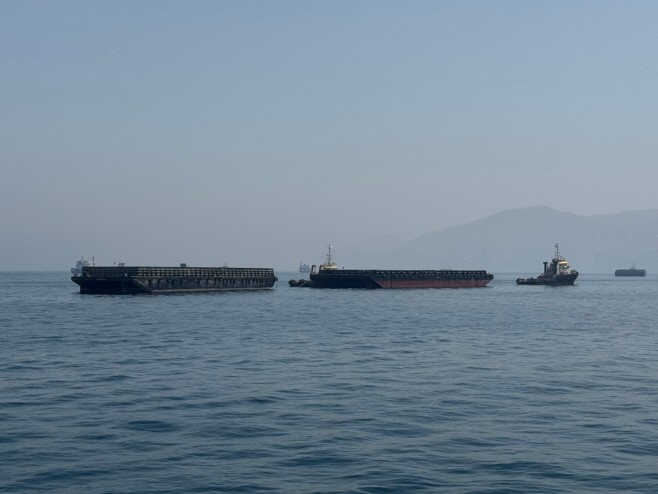 |
| Commercial vessels anchor in the waters of the Strait of Hormuz near Khasab, a small coastal town in northern Oman, on May 29 (local time). / Photo via Xinhua, Yonhap News |
NYT, Axios report "MOU text re-transmitted to Iran"; finalization delayed pending supreme leader's approval and 3-day window for response
The New York Times reported the previous day, citing three officials, that President Trump has tightened the tentative agreement terms embedded in the ceasefire MOU and re-sent the document reflecting those modifications to the Iranian side.
U.S. news outlet Axios, citing multiple senior administration officials, reported that President Trump instructed his team during the meeting to revise provisions regarding the nuclear program and the reopening of the Strait of Hormuz within the draft MOU. A senior U.S. official remarked, "This pertains to the specific methodologies and timing for the United States to secure the nuclear materials," adding that it would take approximately three days to receive a response from Iran.
The NYT noted that the draft MOU has already been submitted to Iranian Supreme Leader Mojtaba Khamenei for ratification, meaning that these textual revisions could once again stall Iran's internal approval processes.
Currently, the draft MOU is understood to include Iran's pledge to renounce the pursuit of nuclear weapons, but lacks concrete concessions beyond that baseline. According to Axios, the draft establishes a 60-day window to negotiate Iran's nuclear commitments and U.S. sanctions relief, setting the disposal of enriched uranium stockpiles and limits on further enrichment as the primary agenda items.
Immediately following the briefing, a White House official stated, "President Trump will only enter into an agreement that favors the United States, satisfies his red lines, and guarantees that Iran can never possess a nuclear weapon."
The NYT further reported that President Trump expressed reservations over a clause within the draft MOU that could trigger the unfreezing of Iranian assets. He has long been a fierce critic of then-President Barack Obama's release of Iranian funds during the 2015 Iran nuclear deal (JCPOA).
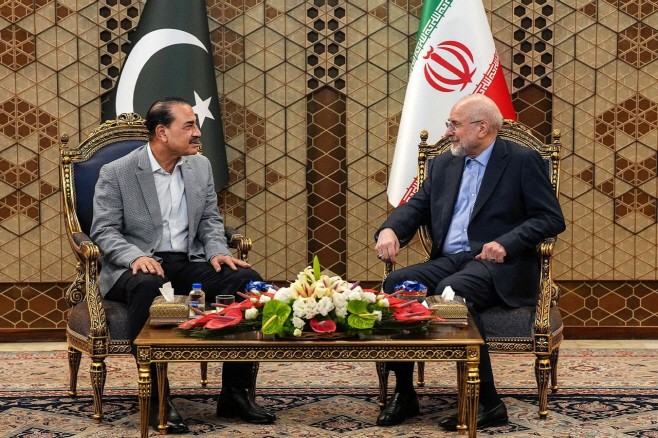 |
| Iranian Parliament Speaker Mohammad Bagher Ghalibaf (right) holds a meeting with General Asim Munir, Chief of Army Staff of Pakistan, in Tehran on May 23 (local time). / Photo via Reuters, Yonhap News |
Iran plans to present counter-proposals; Parliament Speaker Ghalibaf warns "no deal without guaranteed rights," rejects nuclear agenda
In response to President Trump's demands, Tehran is prepared to submit its own set of revisions, Tasnim News Agency reported.
"The exchange of drafts between both sides remains ongoing, and Iran will naturally integrate its own amendments into the agreement text," an informed source stated, emphasizing that "nothing has been finalized at this stage."
The source underscored that "Iran’s benchmark is whether the wording is acceptable to us. Just because the Trump administration applied modifications does not mean Iran will tacitly accept them," adding that "Tehran is also thoroughly prepared for a no-deal scenario."
Iranian Foreign Minister Abbas Araghchi confirmed the ongoing communication channels during an interview with state television, noting, "Dialogue and message exchanges between Iran and the United States are continuing, but no definitive judgments can be made until clear outcomes materialize."
He further urged caution, stating, "Until matters are fully resolved, I believe all narratives, rumors, and speculation circulating at this stage should be disregarded."
Mohammad Bagher Ghalibaf, the Speaker of the Iranian Parliament who is also involved in the negotiations, declared during a state-broadcast legislative session, "We will not ratify any agreement until we are absolutely certain that the rights of the Iranian people are fully protected." Speaker Ghalibaf added, "Our negotiating team trusts neither the words nor the promises of the adversary; tangible results remain our solitary benchmark."
Foreign Ministry Spokesperson Esmaeil Baghaei explicitly drew a line regarding the scope of the current talks on state television, stating, "Our singular focus is on ending the war; nuclear renegotiations are entirely off the table."
Esmaeil Kousari, a member of the Iranian Parliament's National Security and Foreign Policy Committee, echoed this stance on Russia Today (RT), asserting that the nuclear issue has been excluded from the current diplomatic agenda.
Kousari explained that negotiations are strictly centered on preventing a resurgence of hostilities, securing compensation, withdrawing U.S. forces from the region, and lifting the U.S. maritime blockade on Iranian ports and vessels. "We will not allow the experiences of the 2015 nuclear deal to repeat themselves," Kousari emphasized. Meanwhile, Iran's semi-official Fars News Agency quoted an Iranian source stating that the current draft MOU contains no provisions regarding the extraction or destruction of enriched uranium, contrary to claims made by President Trump.
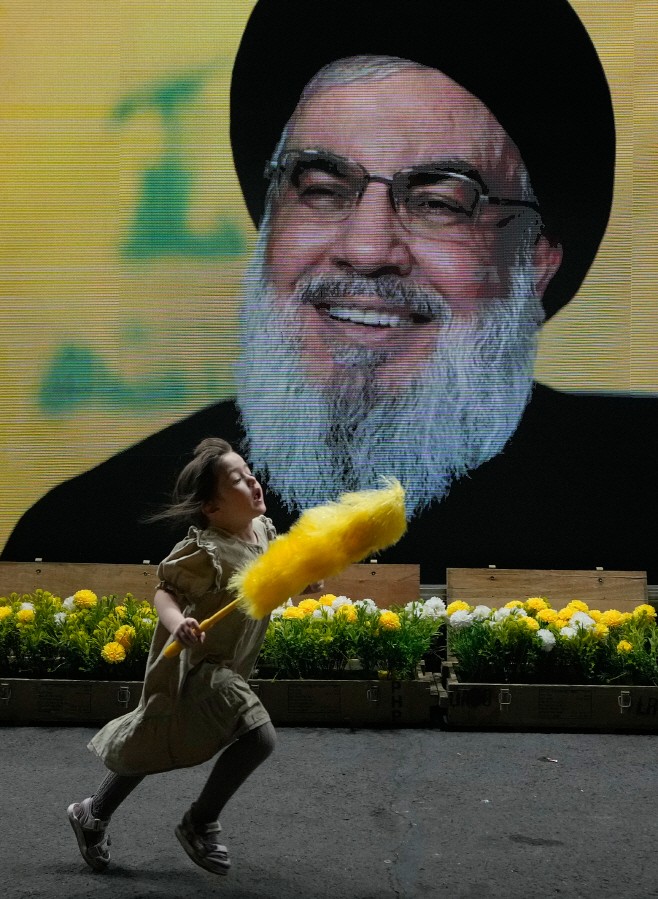 |
| An Iranian girl runs past a large portrait of assassinated Hezbollah leader Hassan Nasrallah during a pro-government rally at Islamic Revolution Square in Tehran, Iran, on May 30 (local time). / Photo via AP, Yonhap News |
Iranian agency reports "release of $12 billion in frozen assets demanded as prerequisite"; Trump counters with "no fund exchanges"
Iran has presented the immediate release of $12 billion in frozen assets as a strict prerequisite for advancing to the next stage of negotiations, Fars News Agency reported. According to the news outlet, Tehran's official stance remains that Iran will not proceed with subsequent phases of the talks until these funds are disbursed.
However, President Trump countered this demand on May 29 via a post on Truth Social, declaring that "no funds will be exchanged until further notice."
The NYT, citing two informed sources, reported that the draft MOU is understood to include a $300 billion reconstruction investment fund for Iran, a mechanism proposed by the U.S. negotiating team including Special Envoy Steve Witkoff and Trump's son-in-law Jared Kushner.
Jon Alterman, Senior Vice President and Director of the Middle East Program at the Center for Strategic and International Studies (CSIS), analyzed the dynamic for Reuters, noting, "Every sign President Trump gives that he wants to wrap this up quickly simply incentivizes the Iranians to hold out longer."
Ha Man-joo
Most Read
-
1
Celltrion’s Omlyclo gains ground in major European..

-
2
Trump demands rates fall below 1% as Fed hikes for..

-
3
Trump makes $1 trillion bet ahead of midterm elect..

-
4
Iran resumes ballistic missile production, assembl..

-
5
Samsung Electronics, Mistral AI to jointly develop..

-
6
Trump warns countries not helping U.S. must pay re..

-
7
Apple launches first foldable, 1 million won prici..

PEOPLE






HEADLINE NEWS
- Trump to roll out ‘unprecedented welcome’ for Xi with B-2 bombers, F-22 fighters
- S. Korea, U.S., and Japan form united front on Taiwan and economic coercion..
- Trump administration moves to impose sweeping sanctions on International Cr..
- Xi to make state visit to U.S. Sept. 23-25, dispelling rumors over his heal..

-
Address : In-Young Bldg., 34, Uisadang-daero 1-gil, Yeongdeungpo-gu, Seoul
Copyright by ASIATODAY CO., LTD. All rights resereved