



Blue Origin’s New Glenn explodes during test; no injuries reported
May 29, 2026, 05:09 pm


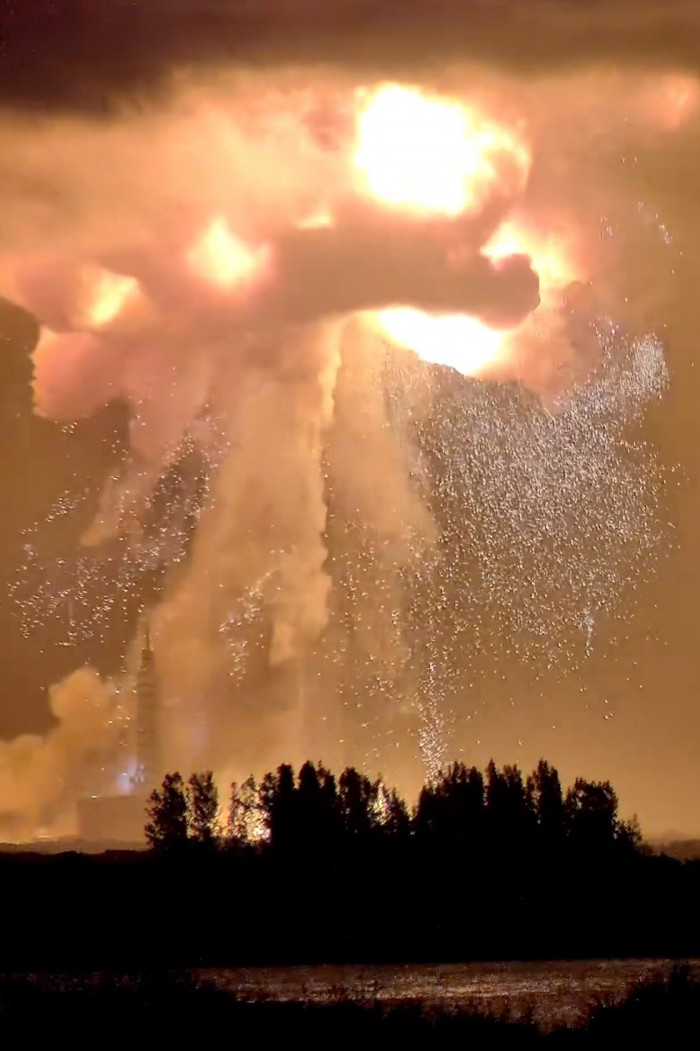 |
| Blue Origin’s New Glenn rocket explodes during a critical engine static fire ignition test at its launch site in Cape Canaveral, Florida, on May 28. / Photo via AP, Yonhap News |
An uncrewed "New Glenn" heavy-lift rocket, developed by Blue Origin—the aerospace venture founded by Amazon billionaire Jeff Bezos—exploded on May 28 (local time) during a routine engine test. Fortunately, no injuries were reported from the scene.
The setback is projected to disrupt Blue Origin's aggressive roadmap to narrow the technological deficit with its primary industry rival, SpaceX, which is currently helmed by Tesla CEO Elon Musk and reportedly positioning for a highly anticipated initial public offering (IPO).
In a formal statement issued to CNN, the Federal Aviation Administration (FAA) confirmed that Blue Origin’s New Glenn launch vehicle experienced an anomaly at approximately 9:00 PM during a scheduled static fire ignition test. The incident occurred at Launch Complex 36 within the Cape Canaveral Space Force Station in Florida.
The regulatory agency added that the specific test fell outside the direct scope of active FAA launch licensing and confirmed that the anomaly posed no operational hazard to regional commercial air traffic.
Addressing the incident via social media on the same day, Bezos reassured the public regarding ground crew welfare. "All personnel are safe and accounted for," Bezos stated. "While it is far too premature to definitively pinpoint the root cause of the anomaly, comprehensive investigative protocols have already been initiated to analyze the data."
"It was an undeniably tough day at the pad, but our teams will complete the necessary recovery operations and return to flight status," Bezos added, striking a resilient tone. "It is worth the effort."
NASA Administrator Jared Isaacman also addressed the situation during a social media broadcast that evening. "NASA is fully aware of the hardware anomaly that occurred tonight involving Blue Origin's New Glenn rocket at Launch Complex 36 in Cape Canaveral," Isaacman noted. "Spaceflight remains an incredibly unforgiving endeavor, and engineering a completely new heavy-lift launch architecture is an exceptionally complex challenge."
The NASA chief emphasized the agency's commitment to its commercial partners, stating, "We will actively collaborate with Blue Origin and industrial stakeholders to support a thorough investigation into this anomaly, evaluate potential timeline impacts on upcoming joint missions, and ensure a safe, efficient return to flight operations."
Concurrently, officials from the U.S. Space Force confirmed that they are actively embedding with Blue Origin and secondary payload partners to isolate the precise triggers behind the engine explosion.
Prior to this incident, Blue Origin had been under a continuous FAA review process following a partial mission failure during its third suborbital flight test last month. The aerospace firm had only recently pivoted back toward resuming the high-stakes test flight campaign for the New Glenn architecture.
Kim Hyun-min
Most Read
-
1
Celltrion’s Omlyclo gains ground in major European..

-
2
Trump demands rates fall below 1% as Fed hikes for..

-
3
Trump makes $1 trillion bet ahead of midterm elect..

-
4
Iran resumes ballistic missile production, assembl..

-
5
Samsung Electronics, Mistral AI to jointly develop..

-
6
Trump warns countries not helping U.S. must pay re..

-
7
Apple launches first foldable, 1 million won prici..

PEOPLE






HEADLINE NEWS
- Trump to roll out ‘unprecedented welcome’ for Xi with B-2 bombers, F-22 fighters
- S. Korea, U.S., and Japan form united front on Taiwan and economic coercion..
- Trump administration moves to impose sweeping sanctions on International Cr..
- Xi to make state visit to U.S. Sept. 23-25, dispelling rumors over his heal..

-
Address : In-Young Bldg., 34, Uisadang-daero 1-gil, Yeongdeungpo-gu, Seoul
Copyright by ASIATODAY CO., LTD. All rights resereved