



Early heatwave sparks ozone crisis across France
May 29, 2026, 03:44 pm


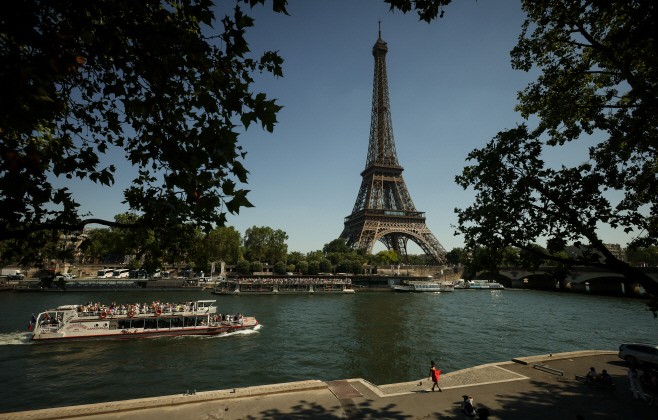 |
| A cruise boat glides down the Seine River past the Eiffel Tower in Paris, France, on May 27. / Photo via AP, Yonhap News |
As an early heatwave grips France in late May, concerns are mounting over escalating ozone concentrations spreading into the northern regions—a secondary air pollution phenomenon historically confined to the southern territories during peak summer.
Local news outlet Ouest-France reported on May 28 (local time) that ozone alerts have been officially triggered across three northern regions: Normandy, Hauts-de-France, and Île-de-France.According to Prév'Air, the national air quality forecasting platform, atmospheric ozone levels in the affected jurisdictions breached the regulatory threshold of 180 micrograms per cubic meter.
This breach represents the initial public information and recommendation tier within the health ministry's three-tier respiratory risk framework. Ozone functions as a secondary pollutant, synthesized through photochemical reactions when nitrogen oxides emitted by automobiles and heavy industry combine with volatile organic compounds from manufacturing processes in the presence of intense sunlight.
The concentration of ground-level ozone thickens under conditions of high ambient temperatures and stalled air currents, precisely mimicking the meteorological matrix currently gripping France, where heatwave warnings were expanded across 14 departments as of May 28. On that day, peak temperatures soared to 34.8 degrees Celsius in Rouen, Normandy, and 34.9 degrees Celsius at the Luxembourg Gardens in Paris, marking sharp spikes of 15.8 and 12.9 degrees Celsius above historical seasonal baselines, respectively.
Environmental experts emphasize that mitigating such systemic air quality crises requires a fundamental redesign of urban landscapes alongside institutional readiness. "Persistent high-pressure systems combined with a near-total absence of wind create an atmospheric trap that encapsulates pollutants," explained Professor Vincent Dubreuil of the Department of Geography and Climatology at Rennes 2 University. "While intense ozone concentrations have traditionally been concentrated in the hotter southern regions during peak summer months, anthropogenic climate change and rising baseline temperatures are now driving this ozone phenomenon into entirely new territories."
Professor Dubreuil added, "To systematically reduce greenhouse gases and primary emission sources, urban planning must pivot away from private vehicle dependency toward expanded public transit networks and green mobility infrastructure. Cultivating urban green spaces alongside blue infrastructure—such as fountains, urban streams, and preserved riverbanks—is vital to counteract local warming effects."
Meanwhile, Atmo France, the national federation of air quality monitoring networks, proposed making public transportation completely free of charge as the most immediate and logistically effective short-term intervention to curb ozone spikes.The policy framework, already implemented in municipal hubs like Nantes and Montpellier, aims to suppress private car usage to achieve a rapid, measurable reduction in ambient ozone precursors.
Lim Yu-jung
Most Read
-
1
Celltrion’s Omlyclo gains ground in major European..

-
2
Trump demands rates fall below 1% as Fed hikes for..

-
3
Trump makes $1 trillion bet ahead of midterm elect..

-
4
Iran resumes ballistic missile production, assembl..

-
5
Samsung Electronics, Mistral AI to jointly develop..

-
6
Trump warns countries not helping U.S. must pay re..

-
7
Apple launches first foldable, 1 million won prici..

PEOPLE





HEADLINE NEWS
- Trump to roll out ‘unprecedented welcome’ for Xi with B-2 bombers, F-22 fighters
- S. Korea, U.S., and Japan form united front on Taiwan and economic coercion..
- Trump administration moves to impose sweeping sanctions on International Cr..
- Xi to make state visit to U.S. Sept. 23-25, dispelling rumors over his heal..

-
Address : In-Young Bldg., 34, Uisadang-daero 1-gil, Yeongdeungpo-gu, Seoul
Copyright by ASIATODAY CO., LTD. All rights resereved