



SK ecoplant establishes AI agent systems for AX
May 29, 2026, 10:49 am


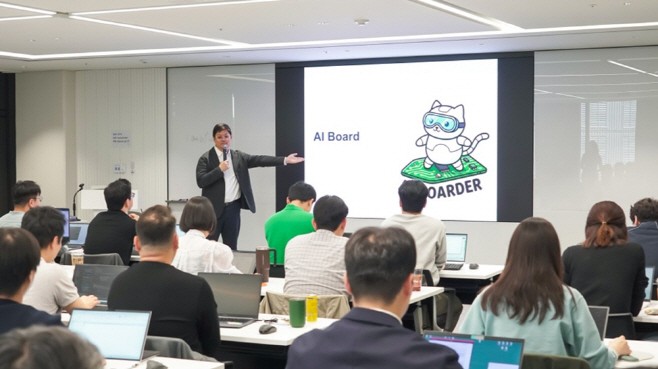 |
| SK ecoplant employees selected from various job functions attend an advanced AI training program. / Photo courtesy of SK ecoplant |
SK ecoplant announced on May 29 that it is accelerating its enterprise-wide artificial intelligence transformation by establishing a system that enables employees to directly design and develop operational AI agents. Moving beyond basic application training, the strategy aims to drive productivity innovation and secure future competitiveness by fostering an architecture where field personnel can directly build and deploy localized AI services.
SK ecoplant recently institutionalized a three-tiered AI integration framework designed to bridge the gap between initial AI adoption and full-scale service deployment. The roadmap consists of three core phases: AI Delivery, the AI Capa. Belt, and the AI FAB.
The corporate initiative is engineered to anchor AI-driven workflows across its engineering, procurement, and construction (EPC) business segments and corporate support divisions, with a central focus on equipping personnel with the self-reliant capacity to resolve specific operational challenges through autonomous AI development.
The foundational tier, AI Delivery, functions as an onboarding program assisting employees in integrating AI into their daily tasks as a practical productivity tool. Internal experts directly visit project sites to provide localized training and technical consulting, while identifying and scaling practical business use cases across different departments.
The company is also operating the "AI Capa. Belt," a structured AI competency certification program. The tiered tiering architecture is designed to systematically elevate AI literacy and cultivate high-caliber internal talent. Personnel who achieve the highest tier of certification are designated as internal AI specialists, tasked with spearheading AI commercialization and leading adoption strategies across their respective business units.
To date, approximately 200 employees have completed the advanced curriculum. Using cutting-edge generative AI utilities alongside structured coaching from external technical consultants, participants gain hands-on experience designing and executing custom AI agents mapped directly onto their real-world operational datasets.
The internal upskilling is already yielding tangible operational milestones. Notably, an employee leveraged "Vibe Coding"—a natural language-driven AI programming methodology—to engineer an autonomous AI agent capable of summarizing a 1,600-page geotechnical investigation report and projecting the data into a 3D visualization model. The company explained that the solution successfully compressed analytical turnaround times while dramatically mitigating the risk of human error during structural planning.
Looking ahead, SK ecoplant plans to introduce the "AI FAB" program, an operational launchpad that transitions the AI agents incubated during the training workshops into live, company-wide production services. Under this framework, the enterprise will provide comprehensive expert mentoring, technical development infrastructure, and specialized software tools to ensure non-technical field staff can continuously build and refine custom workplace AI agents.
As part of its organizational commitment, the company established the "AI Board" at the end of last year to oversee the aggregate corporate AI roadmap. The dedicated unit functions as a strategic command center, orchestrating the scaling of AI tools, coordinating technical competency education, and aligning AI integration with long-term corporate objectives.
"The true significance of this milestone lies in moving beyond one-off educational workshops to establish an end-to-end pipeline where field-level operational bottlenecks are solved via AI, and those solutions are instantly scaled into functional enterprise services," remarked Jung Hee-rak, head of the AI Board team at SK ecoplant. "We intend to continuously sharpen our competitive edge and maximize operational throughput by embedding advanced AI capabilities deeper into our workforce."
Kim Da-bin
Most Read
-
1
Kia Sportage outperforms Mazda CX-5 in German auto..

-
2
Houthis launch successive attacks on Saudi airport..

-
3
Saudi Arabia, Iran hold first diplomatic talks to..

-
4
U.S. deploys carrier, 10,000 more troops to Middle..

-
5
Saudi airport in Riyadh struck again, leaving at l..

-
6
Putin's ally visits China on the 8th ahead of APEC..

-
7
Chinese military support and training center opens..

PEOPLE






HEADLINE NEWS

-
Address : In-Young Bldg., 34, Uisadang-daero 1-gil, Yeongdeungpo-gu, Seoul
Copyright by ASIATODAY CO., LTD. All rights resereved