



China, Taiwan Clash in AI Showdown
May 28, 2026, 05:39 pm


Relations across the Taiwan Strait, long fractured over the "One China" principle, are entering a razor-thin competitive phase as Beijing and Taipei clash over technological supremacy in artificial intelligence (AI). Industry observers report that both sides have effectively pivoted into an all-out "AI war" to secure structural dominance over AI technologies that will provide future livelihoods.
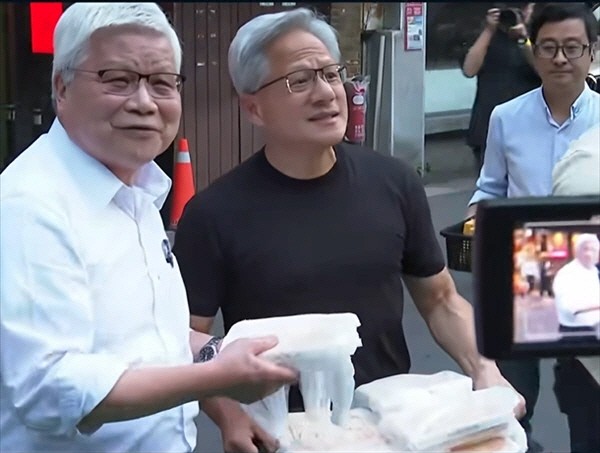 |
| NVIDIA CEO Jensen Huang (left) meets with TSMC Chairman and CEO C.C. Wei at a restaurant in Taipei on the afternoon of May 26. The two leaders agreed to sustain a tight-knit partnership between their respective companies moving forward. / Photo via The Beijing News (Xin Jing Bao) |
Beijing sources well-versed in the Greater China ICT sector indicated on May 28 that China has launched a high-stakes campaign to close the semiconductor gap, which it views as the vital prerequisite for global AI leadership. Despite official rhetoric claiming Beijing can bypass reliance on hardware from US chip designer NVIDIA, the state has reportedly deployed covert networks to smuggle chips through intermediaries in Japan and Southeast Asia.
Furthermore, Chinese firms are stepping up aggressive corporate espionage campaigns targeting top-tier engineering talent in South Korea and Taiwan. Industry insiders reveal that Chinese operations are dangling virtually unchecked financial incentives to poach engineers with backgrounds at global industry leaders like Samsung Electronics and SK Hynix.
"There is an underlying realization within the Chinese semiconductor apparatus that catching up to South Korea or Taiwan via standard, legitimate R&D tracks is highly improbable," an anonymous Beijing-based ICT executive stated. "Consequently, the strategic focus has shifted heavily toward securing intellectual property through corporate espionage and high-altitude talent poaching. This is an active, ongoing operation driven by sheer institutional desperation."
This urgency is further underscored by recent travel restrictions imposed on technical personnel within China, reflecting Beijing’s rigid protective posture over its domestic tech ecosystem. Critics point out the stark double standard in China's approach, which aggressively pursues foreign intellectual property while strictly locking down its own domestic talent pool.
Concurrently, Taiwan is leveraging its massive structural advantage in advanced foundry manufacturing to neutralize Beijing’s advances. Taipei is accelerating joint ventures with American hardware giants to cement its "super-gap" technological lead. This strategy was prominently on display during NVIDIA CEO Jensen Huang's recent high-profile visit to Taipei, where industry titans including TSMC and Foxconn solidified extensive deep-tech partnerships. To anchor this alliance, Huang committed to a massive $150 billion investment pipeline in Taiwan's domestic infrastructure.
Domestically, Taiwanese firms are aggressively reinforcing internal talent retention. TSMC moved to increase employee performance incentives by over 30%, a direct countermeasure designed to insulate its workforce against Chinese poaching attempts and signal Taipei's intent to dominate the cross-strait AI race.
As the geopolitical confrontation shifts from traditional sovereignty disputes toward core technological ecosystems, analysts warn that the cross-strait AI race is rapidly morphing into a zero-sum attrition campaign where only one ecosystem may ultimately survive.
Hong Soon-do
Most Read
-
1
Celltrion’s Omlyclo gains ground in major European..

-
2
Trump demands rates fall below 1% as Fed hikes for..

-
3
Trump makes $1 trillion bet ahead of midterm elect..

-
4
Iran resumes ballistic missile production, assembl..

-
5
Samsung Electronics, Mistral AI to jointly develop..

-
6
Trump warns countries not helping U.S. must pay re..

-
7
Apple launches first foldable, 1 million won prici..

PEOPLE






HEADLINE NEWS
- Trump to roll out ‘unprecedented welcome’ for Xi with B-2 bombers, F-22 fighters
- S. Korea, U.S., and Japan form united front on Taiwan and economic coercion..
- Trump administration moves to impose sweeping sanctions on International Cr..
- Xi to make state visit to U.S. Sept. 23-25, dispelling rumors over his heal..

-
Address : In-Young Bldg., 34, Uisadang-daero 1-gil, Yeongdeungpo-gu, Seoul
Copyright by ASIATODAY CO., LTD. All rights resereved