



Mideast war drains US defense budget, hurts readiness
May 28, 2026, 05:03 pm


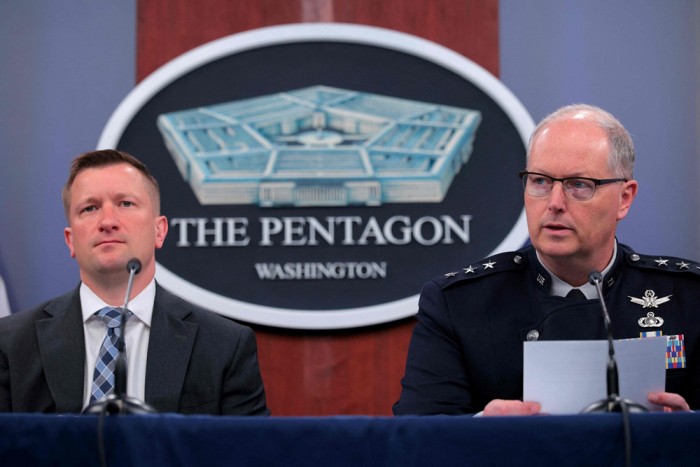 |
| Acting Under Secretary of Defense (Comptroller) Jules Hurst (left) and Director of Force Structure Stephen Whitney hold a press conference to brief the media on the fiscal year 2027 defense budget request at the Pentagon in Arlington, Virginia, on April 21 (local time). / Photo via AFP-Yonhap News |
CNN reported on May 27 (local time) that escalating military expenditures driven by conflicts with Iran have depleted the US defense budget, leading to a wave of canceled military exercises and delays in equipment maintenance.
The Department of Defense has been under severe financial strain since operations targeting Iran commenced in February. With some military units now struggling to carry out routine training and maintenance, top US military leadership is reportedly demanding additional funding from Congress.
Admiral Daryl Caudle, a top Navy commander, told members of the House Armed Services Committee earlier this month that his 2026 budget proposal did not account for Operation Epic Fury—the ongoing mission against Iran. As a result, he noted, the Navy is facing significant disruptions in executing routine operations.
According to internal military documents obtained by CNN, the Texas-based Army III Armored Corps, which oversees approximately 70,000 troops and hundreds of tanks, saw its training budget slashed by roughly $292 million (approximately 439 billion won) late last month.
A memorandum dated April 27 also revealed that a military medical school had canceled dozens of educational courses and halted centralized funding for several programs.
The military typically reallocates necessary funds across specific budget items to cover urgent operations, provided it receives congressional approval. Training costs are generally drawn from the "Operations and Maintenance" budget.
Todd Harrison, a defense budget expert at the American Enterprise Institute (AEI), explained that the Operations and Maintenance budget funds everything from training, deployments, fuel procurement, and travel to equipment repairs and salaries for certain civilian Pentagon employees.
During a House Appropriations Defense Subcommittee hearing on May 12, Acting Under Secretary of Defense (Comptroller) Jules Hurst stated that the recently estimated cost of the war stands at approximately $29 billion. This figure, however, accounts only for ammunition and damaged aircraft, leaving out the costs required to rebuild bases.
Citing sources, CNN reported late last month that the actual cost of the war is closer to $40 billion to $50 billion (approximately 60.16 trillion to 75.2 trillion won).
A defense official familiar with budget matters remarked, "The US military routinely faces budget shortfalls toward the end of the federal fiscal year, which concludes in September, and frequently requests congressional approval to reprogram funds between spending lines."
"In fiscal year 2026, however, mounting costs and sustained military operations have caused these issues to surface months earlier than anticipated," the official pointed out.
Kim Hyun-min
Most Read
-
1
Celltrion’s Omlyclo gains ground in major European..

-
2
Trump demands rates fall below 1% as Fed hikes for..

-
3
Trump makes $1 trillion bet ahead of midterm elect..

-
4
Iran resumes ballistic missile production, assembl..

-
5
Samsung Electronics, Mistral AI to jointly develop..

-
6
Trump warns countries not helping U.S. must pay re..

-
7
Apple launches first foldable, 1 million won prici..

PEOPLE






HEADLINE NEWS
- Trump to roll out ‘unprecedented welcome’ for Xi with B-2 bombers, F-22 fighters
- S. Korea, U.S., and Japan form united front on Taiwan and economic coercion..
- Trump administration moves to impose sweeping sanctions on International Cr..
- Xi to make state visit to U.S. Sept. 23-25, dispelling rumors over his heal..

-
Address : In-Young Bldg., 34, Uisadang-daero 1-gil, Yeongdeungpo-gu, Seoul
Copyright by ASIATODAY CO., LTD. All rights resereved