



Japan puts Philippines front and center as 'like-minded country'
May 28, 2026, 02:11 pm


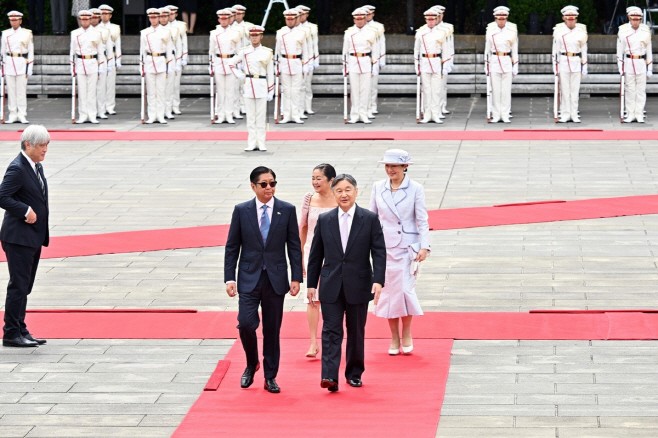 |
| Japanese Emperor Naruhito (center right) welcomes Philippine President Ferdinand Marcos Jr. (center left) at a state welcoming event for the Philippine leader on May 27. / Photo via Yonhap News |
The upcoming summit on May 28 between Japanese Prime Minister Sanae Takaichi and Philippine President Ferdinand Marcos Jr. is projected to serve as a stage that demonstrates the tangible substance of Japan's recently emphasized "like-minded country" diplomacy. Although the Philippines is not a treaty ally of the United States, it is rapidly emerging as a textbook partner with which Japan is simultaneously expanding cooperation across security, defense industries, intelligence, and supply chains.
The Sankei Shimbun reported on May 27 that the two leaders are expected to upgrade bilateral relations to a "Comprehensive Strategic Partnership" and agree to initiate formal negotiations on a General Security of Military Information Agreement (GSOMIA). Philippine President Marcos also stated at a general meeting of the Japan-Philippines Parliamentarians' Friendship Federation in the National Diet on the same day that he intends to "elevate bilateral relations to a Comprehensive Strategic Partnership, which represents the highest level within diplomatic frameworks," according to the Mainichi Shimbun.
This summit is drawing significant attention because the Philippines is positioning itself at the forefront of military and intelligence cooperation within Japan's network to counter China. Japan has already removed the so-called "Type 5" category from the implementation guidelines of its Three Principles on Defense Equipment and Technology Transfer, which previously restricted export purposes. Prime Minister Takaichi has continuously explained that transferring defense equipment "enhances the defense capabilities of like-minded countries." The two nations are also currently in talks regarding the export of the Maritime Self-Defense Force's "Abukuma-class" destroyer escorts, which are slated for decommissioning.
Meanwhile, the Asahi Shimbun pointed out that the definition of "like-minded countries," a term frequently utilized by the Japanese government, remains ambiguous. Foreign Minister Toshimitsu Motegi explained in the Diet last month that like-minded countries are "nations that share objectives regarding diplomatic agendas," but fell short of disclosing which specific countries are encompassed. However, as evidenced by the Philippine case, this concept of a like-minded country is materializing in actual policy as a target nation for defense equipment transfers, military intelligence sharing, and supply chain cooperation.
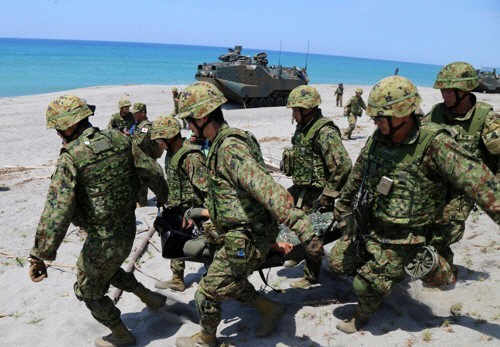 |
| Members of the Japan Self-Defense Forces participate in a joint military exercise in the Philippines. / Photo via Yonhap News |
Three key variables for South Korea to watch
The deepening alignment between Japan and the Philippines serves as a critical focal point for the South Korean government. The first variable is the expansion of intelligence cooperation. Once Japan and the Philippines enter into GSOMIA negotiations, they will establish the institutional foundation required to exchange military secrets. Japan's broader trajectory aims to incorporate the Philippines into its existing security cooperation networks with South Korea, the United States, and Australia to secure multilayered intelligence regarding the South China Sea and the Taiwan Strait. From Seoul's perspective, there is a clear need to monitor the scope and velocity of the intelligence network Japan is constructing in Southeast Asia, independent of trilateral ROK-US-Japan cooperation.
The second variable centers on defense industry competition. Japan's push to export destroyer escorts to the Philippines signals that Tokyo's postwar defense equipment transfer policy has transitioned into a practical, operational phase. South Korea has steadily expanded its footprint in the Southeast Asian defense market, spearheading its presence with naval vessels, aircraft, and armored vehicles. However, if Japan pairs its summit diplomacy with Official Development Assistance (ODA), Official Security Assistance (OSA), and defense equipment transfers, the competitive dynamics within the Southeast Asian defense market could undergo a significant shift.
The third variable involves supply chain cooperation. The Sankei Shimbun reported that the two nations plan to include measures to reinforce supply chains for medical supplies in their joint statement, amid mounting supply anxieties triggered by Iran's de facto blockade of the Strait of Hormuz. This indicates that Japan-Philippines cooperation extends beyond military security to encompass energy crises as well as medical and industrial supply chains. If Japan leverages its network of like-minded countries to entwine economic security cooperation, the regional order that South Korean enterprises and the government must navigate will grow considerably more complex.
During this visit to Japan, Philippine President Marcos is undertaking a comprehensive itinerary that includes a welcoming ceremony and banquet hosted by the Emperor and Empress, an address to the National Diet, and the bilateral summit. This simultaneous deployment of state-visit protocol, defense agendas, and supply chain cooperation underscores that Japan is treating the Philippines as a primary pillar of its Southeast Asian diplomacy. The Takaichi administration's diplomacy toward the Philippines represents more than a mere reinforcement of bilateral ties; it serves as a testing ground for Japan's "like-minded country" strategy, which seeks to simultaneously counter China and pursue economic security by multiplying the number of nations that act in unison with Tokyo, even if they are not formal allies.
Choi Yeong-jae
Most Read
-
1
Celltrion’s Omlyclo gains ground in major European..

-
2
Trump demands rates fall below 1% as Fed hikes for..

-
3
Trump makes $1 trillion bet ahead of midterm elect..

-
4
Iran resumes ballistic missile production, assembl..

-
5
Samsung Electronics, Mistral AI to jointly develop..

-
6
Trump warns countries not helping U.S. must pay re..

-
7
Apple launches first foldable, 1 million won prici..

PEOPLE






HEADLINE NEWS
- Trump to roll out ‘unprecedented welcome’ for Xi with B-2 bombers, F-22 fighters
- S. Korea, U.S., and Japan form united front on Taiwan and economic coercion..
- Trump administration moves to impose sweeping sanctions on International Cr..
- Xi to make state visit to U.S. Sept. 23-25, dispelling rumors over his heal..

-
Address : In-Young Bldg., 34, Uisadang-daero 1-gil, Yeongdeungpo-gu, Seoul
Copyright by ASIATODAY CO., LTD. All rights resereved