



Cambodia sentences 6 Chinese to life imprisonment
May 28, 2026, 09:26 am


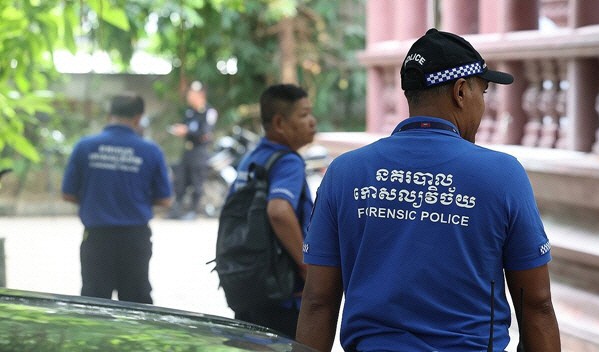 |
| Local police officers are stationed in front of the mortuary at Teuk Thla Pagoda in Phnom Penh, Cambodia, where a joint autopsy is being conducted for a South Korean university student, surnamed Park, who was abducted and murdered by a criminal organization last October (local time). / Photo via Yonhap News |
A Cambodian court has sentenced six Chinese nationals to life imprisonment for the abduction, torture, and murder of a South Korean university student. The Bokor Mountain area in Kampot Province, where the crime took place, has emerged as a notorious stronghold for Chinese cyber fraud syndicates, prompting the South Korean government to designate it as a travel ban zone for its citizens last October.
According to AFP and Reuters on May 28 (local time), the Kampot Provincial Court of Cambodia sentenced six Chinese nationals, aged between 30 and 54, to life in prison on charges of murder accompanied by torture and acts of cruelty, as well as organized aggravated fraud. They were convicted under Articles 205 (Murder), 377 (Torture), and 380 Paragraph 5 (Aggravated Fraud) of the Cambodian Penal Code. Cambodian Information Minister Neth Pheaktra confirmed that all six individuals are currently held in state custody.
The victim was identified as a 22-year-old South Korean university student, surnamed Park, who attended a university in South Chungcheong Province. Park left for Cambodia in mid-July last year after telling his family he was attending an exhibition, after which contact was severed. Roughly a month later, on August 8, his body was discovered inside a pickup truck near Bokor City in Kampot Province. In its ruling, the court explicitly noted that Park died "following extreme torture that left numerous contusions and lacerations across his entire body."
The Bokor Mountain region, where Park was held captive, serves as a primary hub for Cambodia's illicit cyber fraud industry. Chinese criminal syndicates have reportedly purchased local hotels, resorts, and villas to operate them as gated scam compounds, where they confine foreigners and force them to execute romance scams and cryptocurrency investment fraud. While some participants joined voluntarily, foreign media outlets noted that a substantial number were victims of human trafficking, coerced into handling fraud operations against their will.
Following the disclosure of Park's murder, the South Korean government designated the Bokor Mountain area as a travel ban zone in October last year and dispatched a joint task force comprising the Ministry of Foreign Affairs and the National Police Agency to Cambodia. At the time, authorities estimated that roughly 1,000 South Koreans were involved in local fraud syndicates targeting victims back home. This specific method, frequently dubbed "pig butchering," involves building long-term trust with a victim before siphoning off their funds. Around the same period, dozens of South Koreans detained in Cambodia on suspicion of participating in these scam operations were repatriated to South Korea.
Southeast Asia has recently transformed into the epicenter of the global cyber fraud industry. Chinese syndicates have set up a succession of sprawling scam compounds across lawless border enclaves in Cambodia, Laos, the Philippines, and the Myanmar-Thailand frontier. The United States estimated that American citizens suffered approximately 10 billion dollars in losses to Southeast Asian scam networks during 2024 alone. As pressure from Washington and the international community intensifies, the Cambodian government has been stepping up its crackdowns, executing measures such as deporting and extraditing major syndicate operators to China.
Jung Ri-na
Most Read
-
1
Celltrion’s Omlyclo gains ground in major European..

-
2
Trump demands rates fall below 1% as Fed hikes for..

-
3
Trump makes $1 trillion bet ahead of midterm elect..

-
4
Iran resumes ballistic missile production, assembl..

-
5
Samsung Electronics, Mistral AI to jointly develop..

-
6
Trump warns countries not helping U.S. must pay re..

-
7
Apple launches first foldable, 1 million won prici..

PEOPLE






HEADLINE NEWS
- Trump to roll out ‘unprecedented welcome’ for Xi with B-2 bombers, F-22 fighters
- S. Korea, U.S., and Japan form united front on Taiwan and economic coercion..
- Trump administration moves to impose sweeping sanctions on International Cr..
- Xi to make state visit to U.S. Sept. 23-25, dispelling rumors over his heal..

-
Address : In-Young Bldg., 34, Uisadang-daero 1-gil, Yeongdeungpo-gu, Seoul
Copyright by ASIATODAY CO., LTD. All rights resereved