



US-Iran clash over ceasefire MOU as $24 billion frozen assets emerge as key hurdle
May 27, 2026, 08:15 am


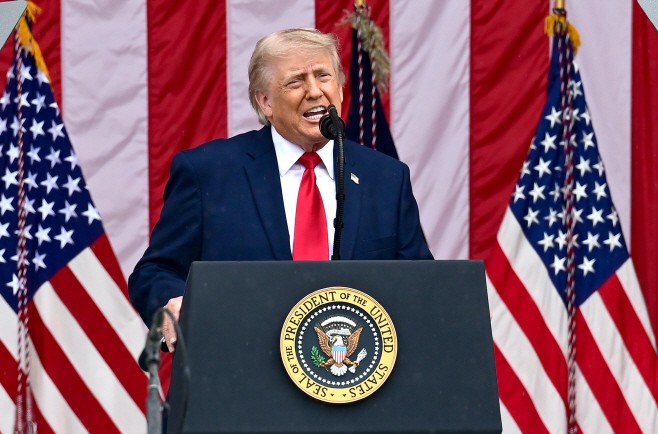 |
| U.S. President Donald Trump delivers remarks at the Memorial Day ceremony after laying a wreath at the Tomb of the Unknown Soldier at Arlington National Cemetery in Virginia on May 25. /UPI-Yonhap |
The United States and Iran are continuing negotiations over a ceasefire memorandum of understanding (MOU) despite renewed clashes near the Strait of Hormuz, with Tehran pressing for the release of $24 billion in frozen overseas assets as a final sticking point.
Iran is demanding that Washington immediately unlock $12 billion once the MOU is signed, while the United States is seeking guarantees on the reopening of the Strait of Hormuz and the handling of Iran’s highly enriched uranium stockpile. Even if an initial deal is reached, key disputes involving Iran’s nuclear and missile programs and the Lebanon front are expected to move into follow-up talks over the next 60 days, raising the risk of renewed conflict.
Iran’s Foreign Ministry on Monday condemned U.S. Central Command airstrikes conducted the previous day, calling them a “clear violation” of the ceasefire arrangement that had been in place since April 8. Tehran warned that “no hostile act will go unanswered.”
Iran’s Islamic Revolutionary Guard Corps (IRGC) claimed its air defense units shot down a U.S. MQ-9 Reaper drone over the Persian Gulf and forced additional drones and F-35 fighter jets to retreat. However, U.S. Defense Department officials denied the drone downing claim, according to The New York Times.
CENTCOM earlier said it struck IRGC vessels and missile launch sites in southern Iran that were allegedly preparing to deploy naval mines in the Strait of Hormuz, describing the operation as an act of self-defense. U.S. officials told the NYT that Washington had detected Iranian drone launches and suspicious missile activity during the previous 24 hours.
The exchange of fire rattled energy markets. Reuters, Bloomberg and the Financial Times reported that Brent crude prices surged nearly 3% to 3.9%, approaching $100 per barrel. The Strait of Hormuz handles roughly one-fifth of global oil and liquefied natural gas trade.
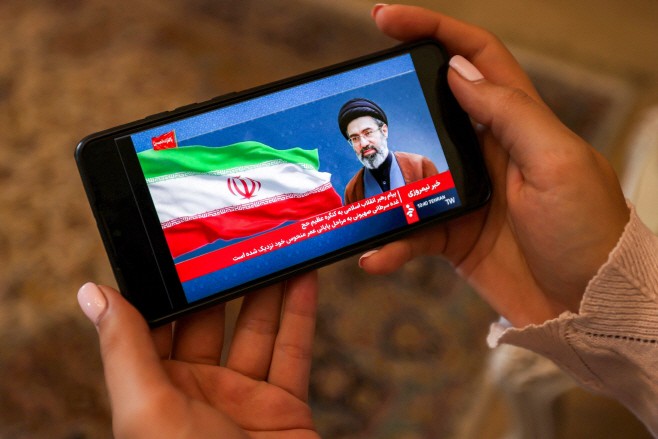 |
| An Iranian woman watches a televised speech carrying a message from Iran’s Supreme Leader Mojtaba Khamenei in Tehran on May 26. /AFP-Yonhap |
Iranian Parliament Speaker Mohammad Bagher Ghalibaf returned home Monday after a two-day visit to Doha, where discussions reportedly focused on procedures for releasing frozen Iranian assets and conditions for restoring maritime passage through Hormuz.
Iran’s semi-official Tasnim News Agency, citing negotiation sources, said Tehran wants $12 billion released immediately upon signing the MOU, with the remaining $12 billion transferred during the subsequent 60-day negotiation phase.
Iranian officials view the asset release as a critical confidence-building measure. Tehran has referenced a previous case in which $6 billion once frozen at South Korea’s Woori Bank and Industrial Bank of Korea was transferred to Qatar before being frozen again.
Reuters reported that the basic framework of the draft MOU includes halting hostilities, lifting the U.S. naval blockade on Iran, and ensuring Iran guarantees safe passage through the Strait of Hormuz. Iranian Foreign Ministry spokesman Esmaeil Baghaei said many of the 14 MOU provisions had been settled but cautioned that a full ceasefire agreement was not yet imminent.
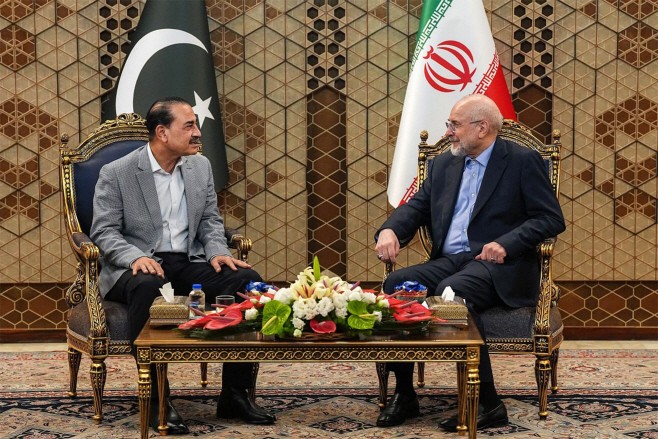 |
| Iranian Parliament Speaker Mohammad Bagher Ghalibaf (right) meets with Pakistan’s Army Chief Field Marshal Syed Asim Munir in Tehran on May 23. /AFP-Yonhap |
The Financial Times reported that the draft also includes phased reopening of Hormuz, removal of naval mines, and a 60-day period during which no shipping fees would be imposed on vessels using the route.
According to The Wall Street Journal, Iran is simultaneously pursuing economic relief and limiting nuclear concessions. Tehran hopes to regain access to part of an estimated $100 billion in frozen assets while reentering global oil markets to ease mounting economic pressure.
At the same time, Iran reportedly does not want to offer enough nuclear concessions for Trump to claim a sweeping diplomatic victory.
On Sunday, Donald Trump wrote on Truth Social that Iran’s highly enriched uranium “must either be immediately turned over to the United States or destroyed in coordination with the Islamic Republic at a local or other acceptable site.” Analysts interpreted the remark as a softening of Washington’s earlier demand that the uranium be physically transferred to the United States.
The WSJ suggested the revised stance could open room for compromise involving dilution of Iran’s uranium stockpile or transfer to Russia. According to Bloomberg, the International Atomic Energy Agency last verified Iran’s stockpile of 60% enriched uranium at 441 kilograms — enough, if further processed, for roughly 12 nuclear weapons.
Iran’s insistence on maintaining influence over the Strait of Hormuz remains another major obstacle. Bloomberg reported that Tehran is considering a long-term system involving transit or navigation service fees and has already discussed related arrangements with Oman.
Iran is also demanding that the Lebanon front be included in broader negotiations, as Israel intensifies operations against the Iran-backed militant group Hezbollah.
U.S. Secretary of State Marco Rubio said during a visit to India that negotiations over the wording of the initial agreement were ongoing and could take several more days. He reiterated that Trump’s position remained “good deal or no deal.”
The New York Times noted that the current negotiations resemble Trump’s phased diplomacy approach, prioritizing reopening Hormuz while postponing more difficult nuclear issues. The paper warned that the pattern seen in stalled second-stage Gaza ceasefire talks could repeat itself in Iran negotiations.
Bloomberg Economics analyst Dina Esfandiary said that even if both sides manage to reach a deal — “itself a big if” — the chances of achieving lasting peace remain slim.
Iranian leaders meanwhile continued issuing warnings. Supreme Leader Mojtaba Khamenei said in a Hajj message that “the clock cannot be turned back” and that regional territories would “no longer serve as shields for U.S. military bases.”
Iranian President Masoud Pezeshkian said in calls with the leaders of Qatar and Egypt that Tehran was prepared to establish a “dignified framework” to end the war and regional tensions, according to state-run IRNA.
Iran’s government also began gradually lifting a nationwide internet shutdown that had lasted 88 days since the outbreak of the war. Digital monitoring group NetBlocks described it as “the longest nationwide internet shutdown in modern history,” according to the NYT.
#US #Iran #Hormuz Strait #Donald Trump #Mohammad Bagher Ghalibaf
Copyright by Asiatoday
Most Read
-
1
Celltrion’s Omlyclo gains ground in major European..

-
2
Trump demands rates fall below 1% as Fed hikes for..

-
3
Trump makes $1 trillion bet ahead of midterm elect..

-
4
Iran resumes ballistic missile production, assembl..

-
5
Samsung Electronics, Mistral AI to jointly develop..

-
6
Trump warns countries not helping U.S. must pay re..

-
7
Apple launches first foldable, 1 million won prici..

PEOPLE






HEADLINE NEWS
- Trump to roll out ‘unprecedented welcome’ for Xi with B-2 bombers, F-22 fighters
- S. Korea, U.S., and Japan form united front on Taiwan and economic coercion..
- Trump administration moves to impose sweeping sanctions on International Cr..
- Xi to make state visit to U.S. Sept. 23-25, dispelling rumors over his heal..

-
Address : In-Young Bldg., 34, Uisadang-daero 1-gil, Yeongdeungpo-gu, Seoul
Copyright by ASIATODAY CO., LTD. All rights resereved