



Quad reaffirms North Korea denuclearization, expands Indo-Pacific security cooperation
May 27, 2026, 08:10 am


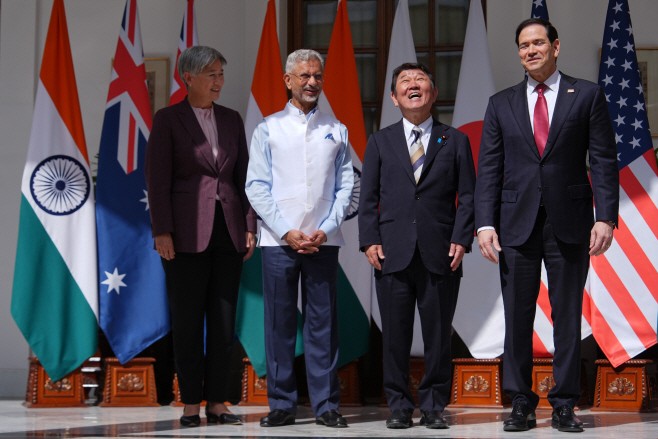 |
| Australian Foreign Minister Penny Wong (from left), Indian External Affairs Minister Subrahmanyam Jaishankar, Japanese Foreign Minister Takeshi Motegi and U.S. Secretary of State Marco Rubio smile during a photo session ahead of the Quad foreign ministers’ meeting at Hyderabad House in New Delhi, India, on May 26. /AP-Yonhap |
The United States, Japan, India and Australia reaffirmed their commitment to the complete denuclearization of North Korea during the 11th Quad foreign ministers’ meeting held in New Delhi on May 26, while also unveiling new initiatives on maritime security, critical minerals and energy cooperation across the Indo-Pacific region.
The four countries officially launched the Indo-Pacific Maritime Surveillance Cooperation (IPMSC) initiative, which will initially focus on the Indian Ocean region. The plan aims to strengthen real-time maritime information sharing and vessel monitoring capabilities through a common operational picture system.
According to the U.S. State Department, the initiative builds on the existing Indo-Pacific Partnership for Maritime Domain Awareness (IPMDA) framework and seeks to integrate regional maritime surveillance capabilities more comprehensively.
In a joint statement, the foreign ministers said recent developments in key waterways highlighted vulnerabilities in major shipping routes and risks to uninterrupted global trade flows. They warned that disruptions to maritime transportation and supply chains could have broad impacts on fuel, food and fertilizer security as well as the safety of seafarers.
The Quad members also agreed that India would host the next Quad-at-Sea Ship Observer Mission to strengthen interoperability and information sharing against illegal maritime activities. In addition, Australia will host a counterterrorism tabletop exercise in June focusing on state-sponsored terrorism and unmanned aerial vehicles.
The ministers strongly condemned terror attacks that occurred in Pahalgam, India, on April 22, 2025, and Bondi Beach, Australia, on Dec. 14, 2025, while calling for sustained international cooperation against terrorist organizations, supporters and financing networks.
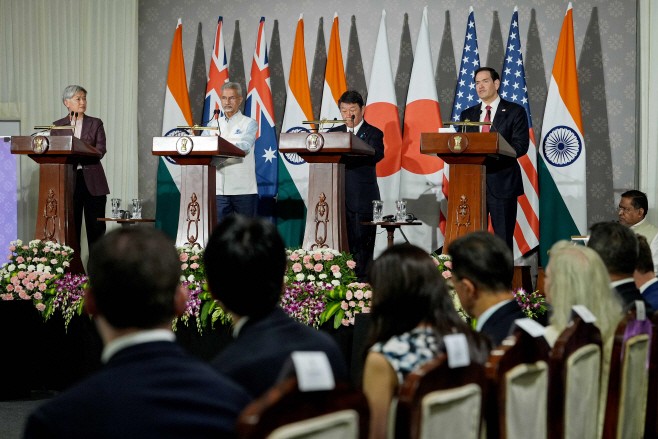 |
| Australian Foreign Minister Penny Wong (from left), Indian External Affairs Minister Subrahmanyam Jaishankar, Japanese Foreign Minister Takeshi Motegi and U.S. Secretary of State Marco Rubio attend a joint press conference following the Quad foreign ministers’ meeting at Hyderabad House in New Delhi, India, on May 26. /AFP-Yonhap |
The four countries also announced the “Quad Critical Minerals Initiative Framework,” which seeks to strengthen supply chains for critical minerals covering mining, processing and recycling. The framework aims to mobilize up to $20 billion in combined government and private-sector investment.
Reuters noted that the initiative could be particularly important for Japan after China halted shipments of certain minerals used in aerospace, defense and semiconductor industries following diplomatic disputes.
The Quad also launched the Indo-Pacific Energy Security Initiative and said more than $25 million in financial and technical assistance is already being provided to support energy technology supply chains in the region.
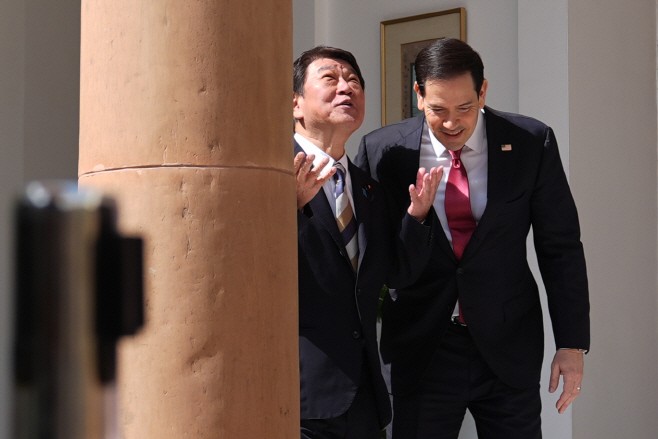 |
| Japanese Foreign Minister Takeshi Motegi and U.S. Secretary of State Marco Rubio talk ahead of the Quad foreign ministers’ meeting at Hyderabad House in New Delhi, India, on May 26. /AP-Yonhap |
U.S. Secretary of State Marco Rubio said Washington plans to host a Quad Fuel Security Forum later this year. The four countries also agreed to work with Fiji on port infrastructure projects, marking the Quad’s first joint regional infrastructure initiative.
In their joint statement, the ministers expressed serious concern over the situations in the East China Sea and South China Sea, criticizing actions that interfere with offshore resource development, repeated violations of freedom of navigation, dangerous maneuvers by military aircraft and coast guard vessels, and the militarization of disputed areas.
The statement also stressed the importance of safe and uninterrupted trade flows through the Strait of Hormuz and the Red Sea. The ministers condemned attacks on commercial vessels and opposed measures such as transit fees that do not comply with the United Nations Convention on the Law of the Sea (UNCLOS).
Australian Foreign Minister Penny Wong warned that the Indo-Pacific region faces “acute economic stress” and said any blockade of key sea lanes would have severe consequences for regional energy security.
The Quad ministers also reaffirmed their commitment to the complete denuclearization of North Korea. They expressed deep concern over Pyongyang’s illegal ballistic missile and weapons of mass destruction programs, malicious cyber activities and overseas IT worker operations used to generate revenue.
Japan’s Foreign Ministry said the four ministers also reaffirmed the need for the immediate resolution of the Japanese abduction issue involving North Korea.
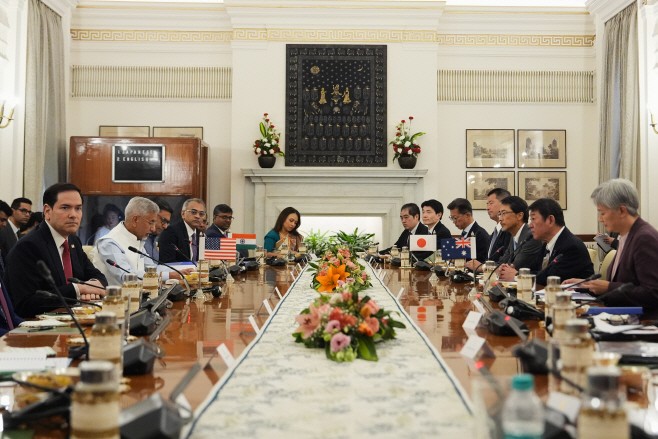 |
| Australian Foreign Minister Penny Wong (right), Japanese Foreign Minister Takeshi Motegi, U.S. Secretary of State Marco Rubio (left) and Indian External Affairs Minister Subrahmanyam Jaishankar attend the Quad foreign ministers’ meeting at Hyderabad House in New Delhi, India, on May 26. /AP-Yonhap |
Rubio described the Quad as “a linchpin and a cornerstone” of U.S. strategy, saying the group was beginning to deliver tangible outcomes.
China criticized the meeting, with Foreign Ministry spokesperson Mao Ning saying cooperation between countries should contribute to regional peace, stability and prosperity rather than target third countries or promote bloc confrontation.
Although a Quad leaders’ summit has yet to take place following delays linked to trade tensions between the United States and India last year, some analysts said the grouping’s importance remains intact as long as ministerial and working-level cooperation continues to produce results.
#Quad #Indo-Pacific #North Korea #denuclearization #Marco Rubio
Copyright by Asiatoday
Most Read
-
1
Celltrion’s Omlyclo gains ground in major European..

-
2
Trump demands rates fall below 1% as Fed hikes for..

-
3
Trump makes $1 trillion bet ahead of midterm elect..

-
4
Iran resumes ballistic missile production, assembl..

-
5
Samsung Electronics, Mistral AI to jointly develop..

-
6
Trump warns countries not helping U.S. must pay re..

-
7
Apple launches first foldable, 1 million won prici..

PEOPLE






HEADLINE NEWS
- Trump to roll out ‘unprecedented welcome’ for Xi with B-2 bombers, F-22 fighters
- S. Korea, U.S., and Japan form united front on Taiwan and economic coercion..
- Trump administration moves to impose sweeping sanctions on International Cr..
- Xi to make state visit to U.S. Sept. 23-25, dispelling rumors over his heal..

-
Address : In-Young Bldg., 34, Uisadang-daero 1-gil, Yeongdeungpo-gu, Seoul
Copyright by ASIATODAY CO., LTD. All rights resereved