



Trump may allow Iran to dispose of enriched uranium internally
May 26, 2026, 05:12 pm


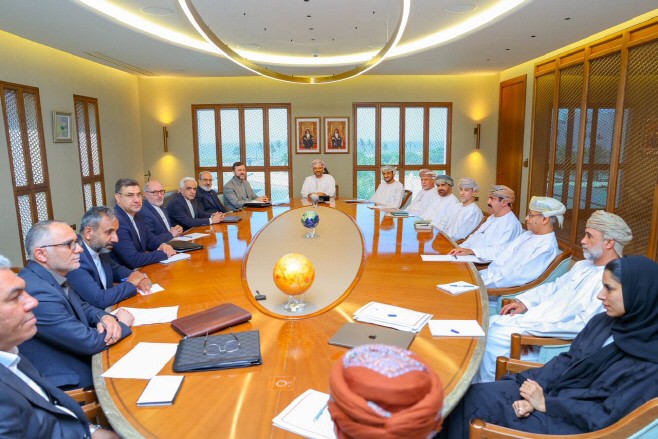 |
| Omani officials led by Omani Foreign Minister Sayyid Badr bin Hamad Albusaidi hold a meeting with the Iranian delegation led by Iranian Deputy Foreign Minister Kazem Gharibabadi in Muscat, Oman, on May 24 (local time). The two sides discussed freedom of navigation in the Strait of Hormuz and recent regional developments. / Photo via Xinhua-Yonhap News |
US President Donald Trump signaled a potential policy shift on May 25 (local time), indicating that Iran might not be strictly required to export its stockpile of enriched uranium to the United States. With termination-of-war negotiations between Washington and Tehran entering a late-stage gridlock, the gesture is being interpreted as a step back from the single largest sticking point—the disposal of enriched uranium—reigniting expectations for a potential diplomatic breakthrough.
"Enriched uranium can be shipped to the United States for disposal, or, more desirably, disposed of locally in Iran under cooperation and coordination with Iran, or handled at another acceptable location," President Trump stated via Truth Social. He added that the US Atomic Energy Commission—or an equivalent body—would be present to oversee the destruction process. Analysts read this as the United States being open to options where the uranium is disposed of inside Iran under the supervision of international monitoring bodies, such as the International Atomic Energy Agency (IAEA), or transferred to a third country, effectively softening Washington's longstanding insistence on a direct transfer to the US.
Up to this point, the United States had staunchly maintained that Iran must hand over approximately 440 kilograms of 60% enriched uranium in its possession. Because this material can be rapidly upgraded to weapons-grade purity, it has long been viewed as the premier gauge of Iran's breakout nuclear capability.
According to senior US officials, Washington and Tehran are currently ironing out a framework to cease hostilities, reopen the Strait of Hormuz, and engage in follow-up nuclear talks over a 60-day window. While the two nations have reportedly forged a broad consensus on the principle of disposing of the enriched uranium, diverging views over the concrete disposal methods and verification protocols remain the final hurdles.
The sudden shift comes at a delicate time when the pace of negotiations had slowed due to friction over explicit nuclear bans and the scope of relief from anti-Iran sanctions. Domestic pushback within the United States remains a potent variable. Hardline Republicans have voiced growing concern that President Trump, in his eagerness to secure a cessation of hostilities and reopen the Strait of Hormuz, might be diluting the core strategic objective of permanently blocking a nuclear Iran.
Apparently mindful of this domestic backlash, President Trump has recently turned his spotlight to plans for expanding the Abraham Accords—a framework aimed at normalizing diplomatic ties between Israel and Arab nations. However, observers note that it remains uncertain whether pivotal Middle Eastern powers, including Saudi Arabia, will actively rally behind the initiative.
Ha Man-joo
Most Read
-
1
Celltrion’s Omlyclo gains ground in major European..

-
2
Trump demands rates fall below 1% as Fed hikes for..

-
3
Trump makes $1 trillion bet ahead of midterm elect..

-
4
Iran resumes ballistic missile production, assembl..

-
5
Samsung Electronics, Mistral AI to jointly develop..

-
6
Trump warns countries not helping U.S. must pay re..

-
7
Apple launches first foldable, 1 million won prici..

PEOPLE






HEADLINE NEWS
- Trump to roll out ‘unprecedented welcome’ for Xi with B-2 bombers, F-22 fighters
- S. Korea, U.S., and Japan form united front on Taiwan and economic coercion..
- Trump administration moves to impose sweeping sanctions on International Cr..
- Xi to make state visit to U.S. Sept. 23-25, dispelling rumors over his heal..

-
Address : In-Young Bldg., 34, Uisadang-daero 1-gil, Yeongdeungpo-gu, Seoul
Copyright by ASIATODAY CO., LTD. All rights resereved