



Pope apologizes for Catholic Church's historical links to slavery
May 26, 2026, 01:32 pm


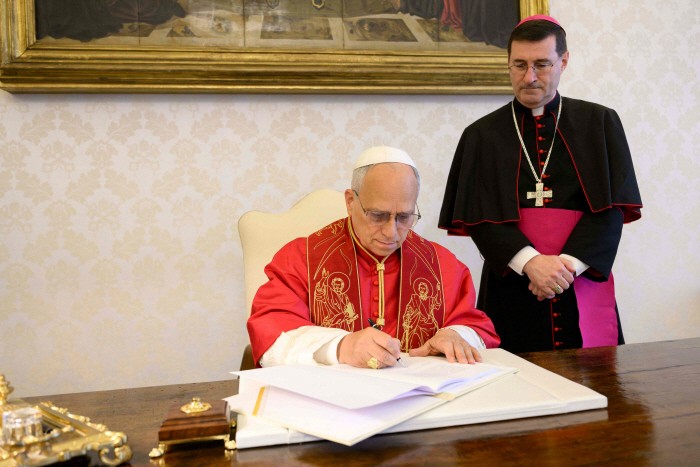 |
| Pope Leo XIV signs the new encyclical 'Magnifica Humanitas' (Magnificent Humanity) at the Vatican on May 25. / Photo via AFP/Yonhap News |
Pope Leo XIV has issued a historic public apology, marking the first time a pontiff has formally acknowledged the Catholic Church’s historical endorsement and justification of slavery, Reuters reported on May 25.
According to Reuters, the Pope confessed to the Church’s past failures in stopping the proliferation of slavery within his newly promulgated papal encyclical, "Magnifica Humanitas" (Magnificent Humanity).
A papal encyclical represents the highest form of pastoral letter addressed by a pope to Catholic bishops and the faithful worldwide, carrying the strongest binding authority among all papal documents, ahead of apostolic letters, exhortations, declarations, and speeches.
"It took centuries for the Church to fully recognize that slavery is irreconcilable with human dignity," the Pope noted, describing the institution as "a wound in the Christian memory."
"In the name of the Church, I sincerely beg forgiveness," he added, expressing profound sorrow over the suffering endured by those subjected to slavery.
The Pope specifically pointed out that ecclesiastical institutions themselves owned slaves during antiquity and the Middle Ages. "The Holy See, at the request of monarchs, justified subjugation and, in certain cases, permitted the enslavement of non-believers," he said.
This marks a direct acknowledgment that Church authorities once legitimized forms of servitude, including the enslavement of non-Christians, to accommodate the demands of sovereign rulers.
While previous pontiffs have apologized for the participation of Christians in the transatlantic slave trade—such as John Paul II, who during a 1985 visit to Africa begged forgiveness from Africans for the suffering inflicted by individuals from Christian nations—and Pope Francis, who in a 2023 official Vatican statement formally repudiated the colonial-era papal bulls that justified slavery and land seizures, those prior actions stopped short of directly addressing the Holy See's institutional liability. Pope Francis's move was viewed as the clearest textual rejection in Vatican history, yet it did not explicitly implicate the papacy itself.
Pope Leo XIV, however, went further by explicitly recognizing and apologizing for the structural nature of the papacy's own role in issuing the very decrees that provided the legal and moral justification for enslavement. Reuters explained that Leo XIV is the first pope to so clearly concede the institutional responsibility of the Holy See and offer a formal apology.
Meanwhile, the newly issued encyclical also includes warnings regarding ethics and regulation in the era of artificial intelligence, as well as modern forms of labor exploitation tied to the digital economy.
Park Jin-sook
Most Read
-
1
Celltrion’s Omlyclo gains ground in major European..

-
2
Trump demands rates fall below 1% as Fed hikes for..

-
3
Trump makes $1 trillion bet ahead of midterm elect..

-
4
Iran resumes ballistic missile production, assembl..

-
5
Samsung Electronics, Mistral AI to jointly develop..

-
6
Trump warns countries not helping U.S. must pay re..

-
7
Apple launches first foldable, 1 million won prici..

PEOPLE






HEADLINE NEWS
- Trump to roll out ‘unprecedented welcome’ for Xi with B-2 bombers, F-22 fighters
- S. Korea, U.S., and Japan form united front on Taiwan and economic coercion..
- Trump administration moves to impose sweeping sanctions on International Cr..
- Xi to make state visit to U.S. Sept. 23-25, dispelling rumors over his heal..

-
Address : In-Young Bldg., 34, Uisadang-daero 1-gil, Yeongdeungpo-gu, Seoul
Copyright by ASIATODAY CO., LTD. All rights resereved