



Samsung SDS sharpens AI infrastructure push
May 12, 2026, 07:48 pm


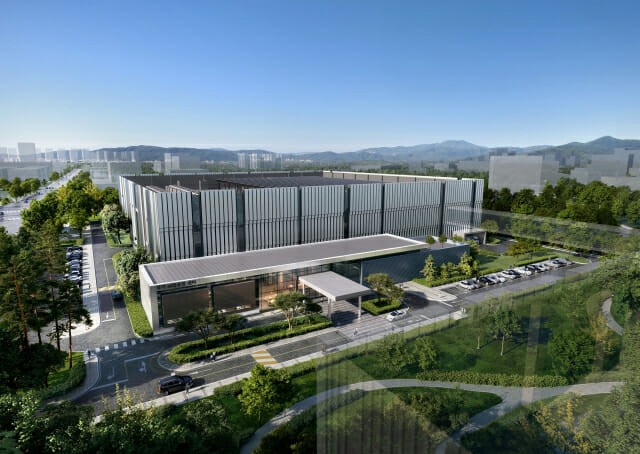 |
| Rendering of the National AI Computing Center project led by Samsung SDS. /Samsung SDS |
Samsung SDS’s blueprint for transforming itself into an “AX (AI Transformation) company” has become more concrete. This follows its final selection as the builder of the National AI Computing Center, a key infrastructure project under the government’s “AI Highway” strategy. The project is expected to strengthen the company’s AI infrastructure capabilities and enable faster, more detailed responses to rapidly growing AX demand. Both inside and outside the company, there are also expectations that this could help reduce its long-standing dependence on internal transactions within the Samsung group.
According to industry sources on the 12th, Samsung SDS was officially selected the previous day as a private-sector participant in the National AI Computing Center project. The consortium, led by Samsung SDS, had submitted the sole bid last year together with Samsung Electronics, Samsung C&T, KT Corporation, Naver Cloud, and Kakao.
The project, worth around 2 trillion won, is part of the government’s AI Highway strategy aimed at making Korea one of the world’s top three AI powers. The goal is to build 15,000 GPUs (Graphics Processing Units) and NPUs (Neural Processing Units), which are key components for AI processing, by 2028. The Ministry of Science and ICT and the Samsung SDS consortium plan to establish a special-purpose corporation (SPC) during the second quarter and begin construction in the third quarter.
According to market research firm Mordor Intelligence, the AI infrastructure market is expected to grow from $101.1 billion this year to $202.4 billion by 2031. Samsung SDS’s participation in this project aligns with that trend. The company is currently focusing heavily on restructuring around AI and cloud businesses. Its logistics business, which accounts for roughly half of its sales, is highly vulnerable to geopolitical risks, while its traditional revenue sources—SI (System Integration) and ITO (IT Outsourcing)—have reached market saturation and no longer contribute to earnings as strongly as before. In the first quarter of this year, excluding the cloud business, revenue either grew only slightly or declined compared to the same period last year.
In addition, the company is also pursuing the construction of an AI data center in Gumi, targeted for completion in 2029. Lee Sang-heon, an analyst at IM Securities, said, “By securing AI data centers with capacities exceeding 200MW in the future, Samsung SDS will establish a core foundation for growth.” He added, “With the AI infrastructure it secures, cloud services as part of an AI ecosystem platform are expected to expand in earnest, accelerating the company’s growth potential.”
Expectations are also rising for an increase in external business transactions. Due to the nature of the SI industry, Samsung SDS still generates over 80% of its revenue from internal group transactions. Since CEO Lee Jun-hee took office in 2024, the company has set a goal of increasing the share of external business by more than 10%. Industry observers believe this project could provide a foundation for diversifying customers not only in Korea but also overseas.
Meanwhile, Samsung SDS plans to invest 5 trillion won in AI infrastructure alone by 2031. During a recent earnings announcement, Lee stated, “We have established a mid- to long-term investment target of 10 trillion won for our AI full-stack strategy,” adding that the company may also consider additional data center investments depending on demand.
#Samsung SDS #AI infrastructure #National AI Computing Center
Copyright by Asiatoday
Most Read
-
1
Kia Sportage outperforms Mazda CX-5 in German auto..

-
2
Houthis launch successive attacks on Saudi airport..

-
3
Saudi Arabia, Iran hold first diplomatic talks to..

-
4
U.S. deploys carrier, 10,000 more troops to Middle..

-
5
Saudi airport in Riyadh struck again, leaving at l..

-
6
Putin's ally visits China on the 8th ahead of APEC..

-
7
Chinese military support and training center opens..

PEOPLE





HEADLINE NEWS

-
Address : In-Young Bldg., 34, Uisadang-daero 1-gil, Yeongdeungpo-gu, Seoul
Copyright by ASIATODAY CO., LTD. All rights resereved