



Foreign ministry denies setback in U.S. security package talks
Feb 25, 2026, 07:46 am


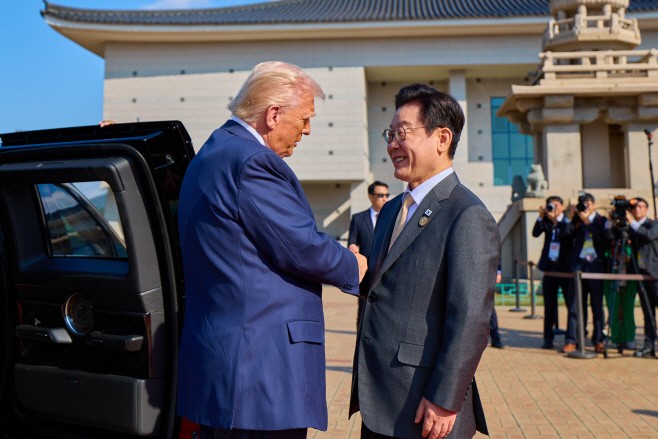 |
| President Lee Jae-myung welcomes U.S. President Donald Trump at the Gyeongju National Museum in North Gyeongsang Province during a Korea-U.S. summit. /Yonhap |
South Korea’s Ministry of Foreign Affairs said Feb. 24 that the delayed visit of a U.S. delegation for “security package” negotiations is a matter of scheduling rather than a setback in talks, dismissing speculation of a breakdown in bilateral coordination.
A senior foreign ministry official told reporters that the issue was related to “scheduling,” not a postponement, adding that Michael Needham, a U.S. State Department adviser known to be close to Secretary of State Marco Rubio, confirmed the matter during a breakfast meeting with Foreign Minister Cho Hyun on Feb. 23.
Earlier this month, Cho told the National Assembly that Washington had confirmed a visit within February for security package negotiations. The ministry later revised its position, saying the delegation could visit in mid-March.
The senior official explained that the U.S. side is preparing to send a single team to address a range of issues, including nuclear-powered submarines and matters related to uranium enrichment and reprocessing. “We were informed that there are difficulties in forming the team, which could lead to delays,” the official said, describing it as a “technical” matter involving coordination among multiple U.S. government departments.
Ongoing international developments — including heightened tensions between the United States and Iran, the Russia-Ukraine war and the Gaza conflict — were also cited as factors affecting the delegation’s schedule.
“From our standpoint, we want to proceed as swiftly as possible. If it is delayed further, we are leaving open the possibility of visiting the United States again,” the official said, adding that security-related aspects of the Korea-U.S. joint fact sheet are proceeding smoothly.
Regarding speculation that a White House official could head the U.S. delegation, the official said leadership would be determined based on division of responsibilities and interagency coordination, noting that South Korea does not necessarily assign such roles to presidential office staff.
The ministry also denied reports that planned 2+2 foreign and defense ministerial talks with Washington had collapsed. According to the official, scheduling discussions took place in connection with Cho’s visit to Canada, but the U.S. side later said Secretary Rubio and the defense secretary were unable to meet jointly due to pressing issues such as Iran.
On Seoul’s proposal to readjust no-fly zones in a bid to bring North Korea back to the negotiating table, the official said consultations with the U.S. are ongoing and that Washington has not yet agreed.
The official added that the recent U.N. approval of sanctions exemptions for 17 humanitarian projects in North Korea followed discussions between Cho and Rubio, though Washington is unlikely to actively pursue further North Korea engagement at this stage. At the same time, the U.S. government appears to be preparing various options in case of a sudden diplomatic initiative by President Donald Trump.
Meanwhile, Cho departed for Canada on Feb. 24 to attend 2+2 foreign and defense ministerial talks, scheduled for Feb. 25 at Ottawa’s request. South Korea maintains such 2+2 frameworks only with the United States, Australia and Canada.
Ahead of his departure, Cho said he would seek to bolster security and defense partnerships and promote cooperation in the defense industry, including efforts to secure Canada’s submarine procurement project. “We will strive to strengthen mutually beneficial security and defense cooperation and advance strategic communication between our two countries,” he said.
#Ministry of Foreign Affairs #security package #United States #Marco Rubio
Copyright by Asiatoday
Most Read
-
1
Trump shares map on social media labeling Strait o..

-
2
Kia Sportage outperforms Mazda CX-5 in German auto..

-
3
Houthis launch successive attacks on Saudi airport..

-
4
U.S. deploys carrier, 10,000 more troops to Middle..

-
5
Trump rejects Iran's offer to open Strait of Hormu..

-
6
N. Korea conducts first swarm attack drill with dr..

-
7
U.S.-China summit falls short on substance as Trum..

PEOPLE





HEADLINE NEWS
- Seoul dismisses Ukraine's claim of 'S. Korean support for Russia' as "inaccurate and inappropriate"
- S. Korea, Japan race to develop nuclear-powered submarines
- Henri Kagan, Kenso Soai win Nobel Prize in Chemistry for uncovering how mol..
- Vance says Alaska LNG cooperation will move forward with Seoul's current or..

-
Address : In-Young Bldg., 34, Uisadang-daero 1-gil, Yeongdeungpo-gu, Seoul
Copyright by ASIATODAY CO., LTD. All rights resereved