



Up to 220 KOSDAQ firms face delisting under new reform
Feb 19, 2026, 09:06 am


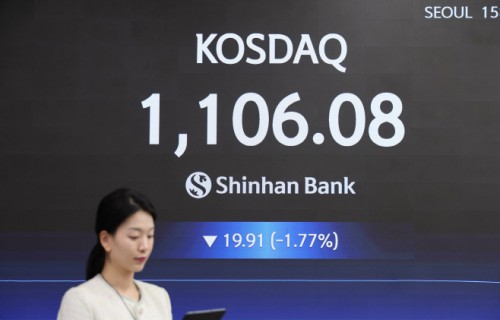 |
| The KOSDAQ index closes at 1,106.08 on the electronic board at Shinhan Bank’s headquarters on Feb. 13. /Shinhan Bank |
South Korea’s financial authorities have launched a sweeping restructuring of the KOSDAQ market, with projections suggesting that up to 220 listed companies could face delisting this year.
According to industry sources on Feb. 18, the Financial Services Commission and the Korea Exchange unveiled reform measures on Feb. 13 aimed at “swift and strict expulsion of insolvent firms.” The plan seeks to transform the KOSDAQ structure from one characterized as “many births, few deaths” to “many births, many deaths,” fundamentally redesigning listing and delisting mechanisms rather than simply tightening requirements.
A basic simulation by the exchange estimates that around 150 companies — with a potential range of 100 to 220 — could be subject to delisting this year. Given that roughly 1,700 firms are currently listed on KOSDAQ, nearly 10 percent of the market could undergo restructuring in the near term.
The reform centers on strengthening four major delisting criteria.
First, the minimum market capitalization requirement will be raised in stages to 30 billion won. While the previous plan envisioned gradual implementation through 2028, the schedule has been accelerated: the threshold will rise to 20 billion won in July this year and to 30 billion won in January 2027.
To prevent companies from temporarily boosting stock prices to avoid delisting, regulators will apply a stricter rule requiring compliance for 45 consecutive trading days within a 90-day evaluation period after being designated as a managed stock.
New delisting standards will also target so-called “penny stocks” trading below 1,000 won. If a stock remains under 1,000 won for 30 consecutive trading days, it will be designated as a managed issue. Should it fail to stay above 1,000 won for 45 consecutive days during the 90-day review window, it will be delisted. Authorities will also block attempts to evade rules through reverse stock splits.
In addition, full capital impairment on a semiannual basis will be subject to substantive review, and the penalty threshold for disclosure violations will be tightened from 15 points to 10 points accumulated over one year. A single serious or intentional disclosure violation may now qualify as grounds for delisting.
The maximum improvement period granted to companies undergoing delisting review will be reduced to one year, further shortened from the previous ceiling of one year and six months.
The Financial Services Commission will establish a task force led by a vice president of the KOSDAQ division and operate an intensive management period through July 2027. Performance related to delisting enforcement will be reflected in internal evaluations to strengthen accountability.
Market participants say the measures may heighten short-term volatility but could improve the KOSDAQ’s fundamentals over the longer term. Institutional investors have often cited high volatility and the accumulation of so-called “zombie firms” as barriers to investment. Strengthened exit standards could enhance market credibility and attract long-term capital, including pension funds.
However, concerns remain that biotech firms and companies listed under special technology-track programs — many of which are loss-making — could face heavier burdens. As authorities simultaneously promote innovation in sectors such as artificial intelligence, space and energy, careful implementation will be crucial to minimizing market disruption.
An industry official said, “Whether this reform becomes merely an expansion of delistings or a genuine turning point that resolves KOSDAQ’s structural discount will depend on how listing and delisting trends unfold in the coming years.”
#KOSDAQ #Financial Services Commission #Korea Exchange #delisting reform
Copyright by Asiatoday
Most Read
-
1
U.S. Treasury Secretary Bessent publicly warns ove..

-
2
Celltrion’s Omlyclo gains ground in major European..

-
3
Hyundai Motor Group breaks ground on integrated st..

-
4
Russia faces warning signs over prolonged war econ..

-
5
Anti-Western solidarity strengthens amid Trump's e..

-
6
U.S. strikes 3 Iranian oil tankers, Iran vows reta..

-
7
S. Korea seeks redemption from World Cup setback w..

PEOPLE






-
Address : In-Young Bldg., 34, Uisadang-daero 1-gil, Yeongdeungpo-gu, Seoul
Copyright by ASIATODAY CO., LTD. All rights resereved