



Ruling party limits prosecutors to review requests only
Feb 06, 2026, 07:33 am


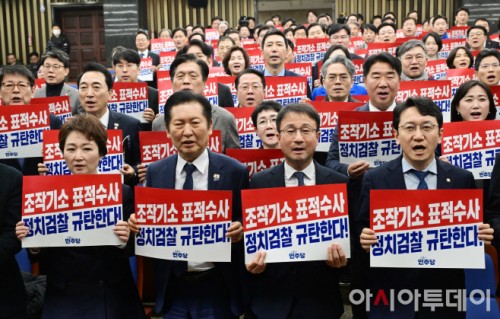 |
| Democratic Party leader Chung Cheong-rae and floor leader Han Byung-do, along with attending lawmakers, hold placards reading “Fabricated indictments, targeted investigations—condemn the political prosecution” at a policy caucus at the National Assembly on Wednesday. / Lee Byung-hwa |
The ruling Democratic Party has finalized its internal position on a sweeping prosecution reform bill that separates investigative and prosecutorial powers, recognizing only a “request for supplementary investigation” by prosecutors while narrowing the investigative scope of the new Serious Crimes Investigation Office (SCIO).
At its 116th policy caucus held Wednesday at the National Assembly, the party shared revised views on the reform package. Kim Han-kyu, the party’s senior deputy policy chief, told reporters after the meeting that the party decided not to grant prosecutors any investigative authority. “We will allow only the right to request supplementary investigations and ensure that this mechanism works in practice,” he said.
Within the party, some had argued for limited supplementary investigative powers to prevent inadequate or delayed investigations. However, considering the original goal of fully separating investigation and indictment, the party ultimately decided against granting any investigative authority. Instead, it plans to strengthen measures allowing the Public Prosecution Office to present opinions to other investigative agencies—and to enforce compliance—so victims are not left without remedy.
The party also agreed on the structure of the newly established SCIO. Qualifications for the SCIO chief will be relaxed to allow police or prosecution investigators with at least 15 years of field experience to assume the post, even if they are not licensed attorneys. The scope of investigations will be reduced from the initial plan by excluding large-scale disasters as well as crimes involving public officials and elections. Cybercrime jurisdiction will be limited to attacks on national infrastructure and advanced technology crimes.
Taking into account the Constitution’s reference to the title “prosecutor general,” the party will propose a legal structure under which the SCIO chief concurrently serves as prosecutor general, while the operational title used will be “Public Prosecution Office chief.”
The Democratic Party plans to submit its position to the government within the week. If the government presents a revised bill, the party aims to complete legislation within this month or by early March at the latest. Kim said the party is working toward a deadline that would allow the Public Prosecution Office and the SCIO to officially launch on Oct. 2.
Chung Cheong-rae said in opening remarks that “the core of prosecution reform is the complete separation of investigation and indictment, and this is a mission of the times,” adding that the National Assembly must take the lead in seeing it through. Floor leader Han Byung-do argued that the prosecution had carried out “targeted investigations” against Lee Jae-myung, saying a recent acquittal underscored why reform is a historical imperative.
Meanwhile, Chung addressed internal debate over a proposed merger with the Rebuilding Korea Party, saying it was “not a declaration but a proposal.” He added that the party would hold a series of listening sessions—from first-term lawmakers to senior figures—before consolidating the party’s collective view.
#Democratic Party #prosecution reform #Public Prosecution Office #Serious Crimes Investigation Office #supplementary investigation request
Copyright by Asiatoday
Most Read
-
1
Trump shares map on social media labeling Strait o..

-
2
Kia Sportage outperforms Mazda CX-5 in German auto..

-
3
Houthis launch successive attacks on Saudi airport..

-
4
U.S. deploys carrier, 10,000 more troops to Middle..

-
5
Trump rejects Iran's offer to open Strait of Hormu..

-
6
N. Korea conducts first swarm attack drill with dr..

-
7
U.S.-China summit falls short on substance as Trum..

PEOPLE






HEADLINE NEWS
- Seoul dismisses Ukraine's claim of 'S. Korean support for Russia' as "inaccurate and inappropriate"
- S. Korea, Japan race to develop nuclear-powered submarines
- Henri Kagan, Kenso Soai win Nobel Prize in Chemistry for uncovering how mol..
- Vance says Alaska LNG cooperation will move forward with Seoul's current or..

-
Address : In-Young Bldg., 34, Uisadang-daero 1-gil, Yeongdeungpo-gu, Seoul
Copyright by ASIATODAY CO., LTD. All rights resereved