



Prosecutor exodus deepens, public investigations at risk
Feb 03, 2026, 08:01 am


 |
| Prosecutors work at a local prosecutors’ office in South Korea. A growing shortage of prosecutors is raising concerns over delays in investigations involving everyday public safety and crime. / Yonhap |
South Korea’s prosecution service is facing a mounting manpower crisis, with a mass departure of prosecutors triggering concerns that investigations affecting people’s daily lives could be severely disrupted.
As the planned abolition of the Supreme Prosecutors’ Office on Oct. 2 clouds the future of the organization, a growing number of prosecutors have resigned, moved to private law firms or been seconded to special prosecutors’ teams. The scale of the departures has been described internally as the largest “exodus” in the service’s history.
The situation has been compounded by the proliferation of special prosecutors, special investigation headquarters and joint task forces, further draining manpower from frontline offices. Prosecutors both inside and outside the organization are increasingly voicing concerns that “there are simply not enough prosecutors left to handle public livelihood cases.”
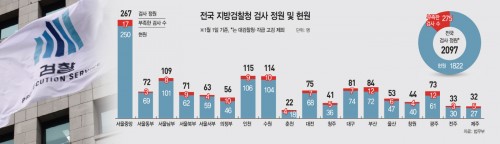
Asia Today analyzed staffing data from 60 local prosecutors’ offices nationwide, comparing authorized quotas and actual staffing levels over the past two years. The analysis found that some offices are handling public safety investigations with less than half of their allotted personnel.
According to data obtained from the Ministry of Justice, as of Jan. 1 this year, local prosecutors’ offices nationwide were authorized to employ 2,097 prosecutors, excluding the Supreme Prosecutors’ Office and high prosecutors’ offices. However, only 1,822 prosecutors were actually on duty, leaving a shortfall of 275 and an average staffing rate of about 86%.
The gap alone exceeds the total authorized number of prosecutors at the Seoul Central District Prosecutors’ Office, effectively equivalent to losing an entire large law enforcement agency.
Over the past two years, 58 of the country’s 60 local prosecutors’ offices have experienced staffing shortages. Seven offices — including Seoul Central, Uijeongbu, Suwon, Anyang, Busan, Busan Western and Gwangju — reported double-digit shortfalls, indicating that manpower gaps are becoming entrenched even in major metropolitan areas.
Seoul Central was short by 17 prosecutors, while Busan and Gwangju each lacked 12. Anyang had only 23 prosecutors out of an authorized 34, and Busan Western, Uijeongbu and Suwon were each short by 10.
Only Yeongwol and Haenam branch offices maintained full staffing for two consecutive years. Namwon recorded the lowest staffing rate, with just two prosecutors filling four authorized positions, a rate of 50%. Gongju and Yeoju also posted staffing levels in the low 60% range.
The shortage is increasingly affecting investigations into everyday crimes and public safety. Beyond the growing complexity of criminal cases, prosecutors say basic manpower shortages are slowing investigations to a crawl.
The problem has been exacerbated by large-scale secondments to special prosecutors’ teams. As of Jan. 1, a total of 59 prosecutors were assigned to special investigations, including 30 to the insurrection probe led by Cho Eun-suk, 17 to the Kim Keon-hee probe headed by Min Joong-ki, seven to the fallen marine case under Lee Myung-hyun, and five to permanent special prosecutors. The number is comparable to the entire staff of the Uijeongbu Prosecutors’ Office.
With an additional 15 prosecutors expected to be dispatched to a second comprehensive special probe, and further resignations following recent personnel reshuffles among senior and mid-level officials, the manpower decline is expected to worsen.
Legal experts warn that prosecutors may soon be pushed beyond their limits in handling public livelihood cases and court proceedings. While returning secondees are being temporarily reassigned to criminal divisions to plug immediate gaps, critics say this is merely a stopgap measure.
A former district chief prosecutor, speaking on condition of anonymity, said, “I once asked prosecutors not to let cases expire due to the statute of limitations. The fact that we are worrying about deadlines rather than the substance of investigations shows how dire the situation has become.”
A senior official at the Supreme Prosecutors’ Office said efforts are under way to prioritize cases directly affecting public welfare. “We are deploying returning prosecutors first to criminal divisions to ensure swift handling of cases tied to people’s daily lives,” the official said, adding that manpower strategies are being continuously reviewed.
#prosecutor shortage #prosecution exodus #abolition of prosecution office #special prosecutors
Copyright by Asiatoday
Most Read
-
1
Trump shares map on social media labeling Strait o..

-
2
Kia Sportage outperforms Mazda CX-5 in German auto..

-
3
Houthis launch successive attacks on Saudi airport..

-
4
U.S. deploys carrier, 10,000 more troops to Middle..

-
5
Trump rejects Iran's offer to open Strait of Hormu..

-
6
N. Korea conducts first swarm attack drill with dr..

-
7
U.S.-China summit falls short on substance as Trum..

PEOPLE






HEADLINE NEWS
- Seoul dismisses Ukraine's claim of 'S. Korean support for Russia' as "inaccurate and inappropriate"
- S. Korea, Japan race to develop nuclear-powered submarines
- Henri Kagan, Kenso Soai win Nobel Prize in Chemistry for uncovering how mol..
- Vance says Alaska LNG cooperation will move forward with Seoul's current or..

-
Address : In-Young Bldg., 34, Uisadang-daero 1-gil, Yeongdeungpo-gu, Seoul
Copyright by ASIATODAY CO., LTD. All rights resereved