



Han expulsion fallout tests Jang’s expansion drive
Feb 02, 2026, 07:59 am


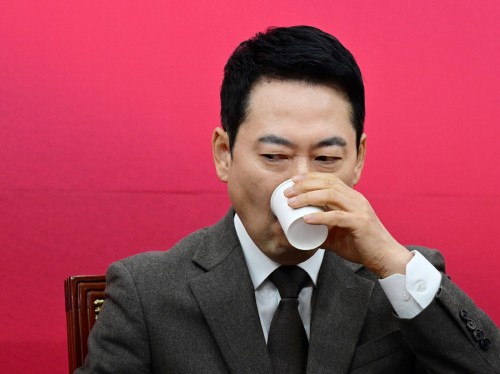 |
| Jang Dong-hyuk, leader of the People Power Party, drinks water during a Supreme Council meeting at the National Assembly on Jan. 29. / Lee Byung-hwa |
The aftershocks from the expulsion of former party leader Han Dong-hoon continue to ripple through South Korea’s main conservative party, leaving Jang Dong-hyuk, leader of the People Power Party, grappling with a dilemma over how to broaden the party’s electoral base.
While Jang has pushed forward with efforts to expand the party’s appeal — including outreach to the Honam region and the appointment of moderate figures — signs of resistance have emerged from younger reform-minded lawmakers and the minor Reform Party, raising doubts about the effectiveness of his strategy.
According to political sources on Saturday, Jang has sought to shift the party’s center of gravity toward the “future” in the wake of Han’s expulsion. In his parliamentary address scheduled for Feb. 4, he is expected to outline a reform agenda and a forward-looking vision for the party. He is also reportedly reviewing plans to visit Honam and Jeju, areas traditionally seen as conservative strongholds.
The party is set to unveil a shortlist of potential new party names on Feb. 5. Submissions to the public naming contest reportedly included keywords such as “people,” “freedom,” “republic,” “future” and “new.”
Ahead of the June 3 local elections, Jang is also considering appointing a centrist lawmaker as head of the party’s talent recruitment committee, in a bid to signal openness and expansion beyond the party’s traditional base. Observers say the move reflects an attempt to move past internal strife and pivot toward an expansion strategy focused on upcoming elections.
However, the stance of the Reform Party remains a key variable. While the People Power Party has explored policy coordination with the Reform Party — particularly around special prosecutor bills targeting allegations involving the Unification Church and campaign finance — prospects for electoral cooperation appear slim.
Lee Jun-seok, leader of the Reform Party, dismissed the possibility of an electoral alliance, saying after a party leadership meeting on Jan. 29 that “there is no basis for an election coalition,” adding that he knows the People Power Party “too well to be surprised by its thinking.” The Reform Party has left the door open to policy cooperation but drawn a clear line against joint election strategies.
Lee’s recent schedule underscores this stance. Rather than meeting with the People Power Party leadership on Feb. 3, he is set to give a lecture at the invitation of “Alternative and Future,” a group of young and reformist lawmakers within the People Power Party. The group has openly challenged Jang’s leadership over Han’s expulsion, calling for an emergency party caucus and raising questions about the legitimacy of the decision.
Potential legal action by Han and continued backlash from his supporters are also weighing on Jang’s expansion efforts. Han’s supporters held a large rally in Yeouido, Seoul, on Friday, demanding Jang’s resignation.
Debate is also ongoing within the pro-Han faction over the justification for the expulsion and possible legal responses, fueling expectations that internal turbulence will persist.
Eom Gyeong-young, head of the Zeitgeist Institute, said Han’s expulsion could help consolidate the conservative base but warned it may simultaneously drive away moderate voters, ultimately having a negative impact on the People Power Party.
#Jang Dong-hyuk #People Power Party #Han Dong-hoon expulsion #conservative politics
Copyright by Asiatoday
Most Read
-
1
Trump shares map on social media labeling Strait o..

-
2
Kia Sportage outperforms Mazda CX-5 in German auto..

-
3
Houthis launch successive attacks on Saudi airport..

-
4
U.S. deploys carrier, 10,000 more troops to Middle..

-
5
Trump rejects Iran's offer to open Strait of Hormu..

-
6
N. Korea conducts first swarm attack drill with dr..

-
7
U.S.-China summit falls short on substance as Trum..

PEOPLE





HEADLINE NEWS
- Seoul dismisses Ukraine's claim of 'S. Korean support for Russia' as "inaccurate and inappropriate"
- S. Korea, Japan race to develop nuclear-powered submarines
- Henri Kagan, Kenso Soai win Nobel Prize in Chemistry for uncovering how mol..
- Vance says Alaska LNG cooperation will move forward with Seoul's current or..

-
Address : In-Young Bldg., 34, Uisadang-daero 1-gil, Yeongdeungpo-gu, Seoul
Copyright by ASIATODAY CO., LTD. All rights resereved