



Hyundai speeds up restructuring with US investment push
Feb 02, 2026, 07:58 am


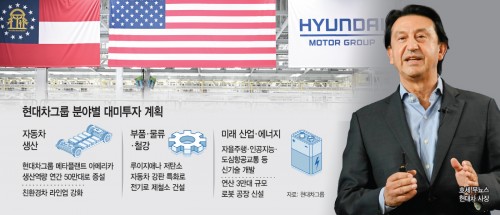 |
Jose Munoz, CEO of Hyundai Motor Group, has reaffirmed the company’s commitment to investing in the United States, even amid renewed tariff threats under a potential second term of Donald Trump.
Trump has warned of raising tariffs on South Korean-made vehicles to 25 percent — the level prior to a trade agreement — citing delays in US-bound investment legislation. Despite growing uncertainty in the trade environment, Munoz stressed that Hyundai would move forward with its existing plans at an accelerated pace.
According to industry sources and foreign media reports on Saturday, Munoz said the company is “focused on increasing the speed” of investment, adding that “the faster we move, the sooner we can benefit.” Regarding renewed tariff uncertainty, he noted that he believes Trump “understands Hyundai’s willingness to invest in the United States.”
Hyundai Motor Group has been expanding its share of local production in response to US tariff policies. The group aims to reach annual US production of 1 million vehicles by the end of this year, with 80 percent of its North American sales to be produced locally. Currently, about 40 percent of its US sales are manufactured domestically.
The group also plans to establish a full value chain in the US spanning steel, auto parts and finished vehicles. By 2028, Hyundai plans to invest approximately $26 billion, or more than 35 trillion won, in the US, focusing on future industries such as steelmaking, automobiles and robotics. As part of this strategy, the group will build an electric arc furnace steel plant in Louisiana with an annual capacity of 2.7 million tons.
Hyundai also plans to significantly expand its US vehicle production capacity, offering a wide range of models including electric vehicles, hybrids and internal combustion engine cars. Parts and logistics affiliates will expand facilities to raise localization rates, while strengthening supply chains between automakers and parts suppliers by sourcing key EV components, such as battery packs, locally.
Since April last year, when a 25 percent tariff was applied, Hyundai Motor and Kia have refrained from raising prices in the US, opting instead to defend market share. As a result, their combined US market share rose from 10.8 percent to 11.3 percent last year, marking a record high.
Despite this performance, concerns are growing over increased dependence on the US market, as Hyundai struggles in Europe and China. In terms of wholesale global sales, the US accounted for 25.9 percent of Hyundai Motor Group’s total in 2025, up from 25.5 percent in 2024, followed by South Korea at 17.3 percent, Europe at 15.6 percent, India at 11.7 percent and China at 2.9 percent.
While experts stress the importance of the US market, many predict that expanding local production will lead to a decline in vehicle exports from South Korea, raising concerns about the domestic auto parts industry.
Korea Automobile Research Institute researcher Lee Hang-koo said reports that the US is preparing to reimpose tariffs through official notice have heightened uncertainty, warning that exports will continue to fall and that domestic parts suppliers, in particular, face an increasing risk of contraction.
#Jose Munoz #Hyundai Motor Group #US investment #tariffs
Copyright by Asiatoday
Most Read
-
1
Kia Sportage outperforms Mazda CX-5 in German auto..

-
2
Houthis launch successive attacks on Saudi airport..

-
3
Saudi Arabia, Iran hold first diplomatic talks to..

-
4
U.S. deploys carrier, 10,000 more troops to Middle..

-
5
Saudi airport in Riyadh struck again, leaving at l..

-
6
Putin's ally visits China on the 8th ahead of APEC..

-
7
Chinese military support and training center opens..

PEOPLE






HEADLINE NEWS

-
Address : In-Young Bldg., 34, Uisadang-daero 1-gil, Yeongdeungpo-gu, Seoul
Copyright by ASIATODAY CO., LTD. All rights resereved