



Finance ministry adds 11 public institutions
Jan 30, 2026, 11:05 am


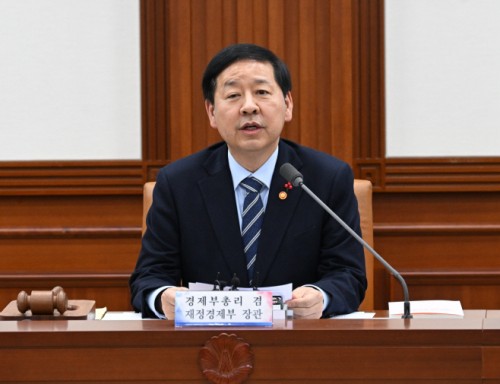 |
| Deputy Prime Minister and Minister of Economy and Finance Koo Yun-cheol delivers opening remarks at the first Public Institutions Management Committee meeting for 2026 at the Government Complex Seoul on Jan. 29. / Ministry of Economy and Finance |
South Korea’s Ministry of Economy and Finance on Wednesday designated 11 additional entities as public institutions, bringing the total to 342, while deferring a decision on the Financial Supervisory Service until next year.
The ministry said it convened the Public Institutions Management Committee on Jan. 29, chaired by Deputy Prime Minister and Finance Minister Koo Yun-cheol, and approved the 2026 public institutions designation plan. The newly designated entities met statutory requirements, including receiving government support exceeding 50 percent of total revenue.
The newly added institutions include the Korea Customs Information Service, the Gadeokdo New Airport Construction Authority, the Child Support Agency, the National Incheon Maritime Museum, Korea Sports Leisure, the Korea Statistics Promotion Institute, the Spatial Information Industry Promotion Institute, the Korea Water Technology Certification Institute, the National Agricultural Museum, the Central Social Service Institute and the National Disaster Relief Association.
As for the Financial Supervisory Service, the committee decided to defer designation, citing the need to prioritize substantive improvements in governance and operations over formal status changes.
Instead, the government ordered enhanced oversight equivalent to or stronger than that applied to other public institutions. Measures include clearer requirements to consult the competent ministry on staffing adjustments and organizational restructuring, expanded public disclosures via the ALIO platform — including detailed breakdowns of executive expenses and additional ESG items — and the faithful implementation of the previously announced roadmap to strengthen financial consumer protection.
The committee said it will review the results of these conditions and reconsider the FSS’s designation status next year.
Koo said that while designation could improve public accountability and transparency at the FSS, it could also create inefficiencies by overlapping with the current supervision framework led by the competent ministry, potentially undermining autonomy and expertise.
The ministry also announced it will disclose a list of institutions that meet designation criteria but were not designated, along with the main reasons — the first such disclosure since the enactment of the relevant law in 2007.
Separately, the designation categories of two institutions were revised due to staffing changes requiring legal reclassification. The Korea Broadcast Advertising Corporation and the Korea Rehabilitation Agency were reclassified as an “other public institution” and a “quasi-government institution,” respectively.
#Ministry of Economy and Finance #public institutions #designation #Financial Supervisory Service
Copyright by Asiatoday
Most Read
-
1
Trump shares map on social media labeling Strait o..

-
2
Kia Sportage outperforms Mazda CX-5 in German auto..

-
3
Houthis launch successive attacks on Saudi airport..

-
4
U.S. deploys carrier, 10,000 more troops to Middle..

-
5
Trump rejects Iran's offer to open Strait of Hormu..

-
6
N. Korea conducts first swarm attack drill with dr..

-
7
U.S.-China summit falls short on substance as Trum..

PEOPLE






HEADLINE NEWS
- Seoul dismisses Ukraine's claim of 'S. Korean support for Russia' as "inaccurate and inappropriate"
- S. Korea, Japan race to develop nuclear-powered submarines
- Henri Kagan, Kenso Soai win Nobel Prize in Chemistry for uncovering how mol..
- Vance says Alaska LNG cooperation will move forward with Seoul's current or..

-
Address : In-Young Bldg., 34, Uisadang-daero 1-gil, Yeongdeungpo-gu, Seoul
Copyright by ASIATODAY CO., LTD. All rights resereved