



Trump warns of restoring 25% tariffs on Korea
Jan 27, 2026, 11:13 am


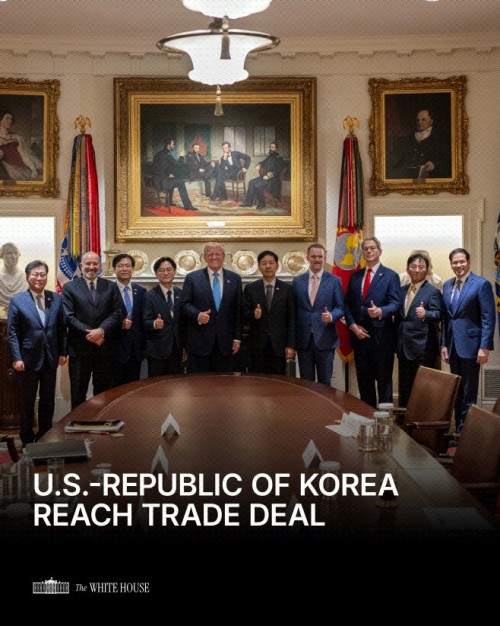 |
| U.S. President Donald Trump (fifth from left) poses for a commemorative photo with South Korea’s trade negotiation team, including Deputy Prime Minister Koo Yun-cheol, Trade Minister Kim Jung-kwan and Trade Minister for Negotiations Yeo Han-koo, during U.S.–Korea trade talks at the White House on July 30, 2025. The photo was posted by the White House on X the following day. Also pictured are Secretary of State Marco Rubio, Treasury Secretary Scott Bessent, USTR Jamieson Greer and Commerce Secretary Howard Lutnick. / White House X capture |
U.S. President Donald Trump on Jan. 26 warned that tariffs on South Korean products would be restored from 15 percent to 25 percent, accusing the Korean National Assembly of failing to complete legislative procedures required to implement a bilateral trade agreement.
The move is widely seen as a pressure tactic tied to delays in legal measures supporting South Korea’s pledged $350 billion investment in the United States. In response, the South Korean government decided to dispatch Trade, Industry and Energy Minister Kim Jung-kwan to Washington to assess Trump’s intentions and seek countermeasures.
In a post on his social media platform Truth Social, Trump directly criticized South Korea’s legislature.
He wrote, “The Korean Legislature is not honoring the agreement between Korea and the United States,” adding, “President Lee Jae-myung and I made a Great Deal for both countries on July 30, 2025, and I reconfirmed those terms when I was in Korea on October 29, 2025.”
Trump then asked, “Why has the Korean Legislature not approved it?” before declaring, “Because the Korean Legislature has not enacted our Historic Trade Agreement, I hereby raise tariffs on Korean automobiles, lumber, pharmaceuticals, and all other Reciprocal Tariffs from 15% to 25%.”
While Trump did not specify an effective date, his use of the word “hereby” suggested the measure could take effect immediately.
Trump’s reference to “legislative approval” is widely interpreted as pointing to delays in passing a special law designed to support South Korean companies’ investments in the United States.
Following a bilateral summit in Gyeongju on Oct. 29 last year, South Korea and the United States released a joint fact sheet stating that Washington would lower tariffs on Korean automobiles in exchange for Seoul’s commitment to invest $350 billion in the U.S. economy. The United States also agreed to retroactively apply tariff reductions once the special investment bill was submitted to the Korean legislature.
Although the ruling Democratic Party introduced the bill on Nov. 26 and the United States officially lowered tariffs to 15 percent on Dec. 4, the legislation has yet to pass, prompting Trump to characterize the delay as a breach of the agreement.
“We acted quickly to lower tariffs in line with the agreed deal,” Trump wrote. “We naturally expect our trading partners to do the same.”
Concerns in Washington that South Korea may struggle to meet its annual $20 billion investment target—amid a weakening won—are also believed to have influenced Trump’s move. U.S. Treasury Secretary Scott Bessent recently issued verbal warnings over the sharp depreciation of the Korean currency.
By contrast, Japan has moved swiftly to advance its investment projects, with Economy, Trade and Industry Minister Ryosei Akazawa holding virtual talks with Commerce Secretary Howard Lutnick, highlighting the growing gap between Seoul and Tokyo in Washington’s eyes.
The South Korean government has responded with urgency. The presidential office convened an emergency meeting chaired by policy chief Kim Yong-bum, while Minister Kim Jung-kwan decided to cut short his Canada trip and head to the United States. He is expected to meet Lutnick to explain the legislative situation in Seoul and push for a withdrawal of the tariff hike.
Some analysts also view Trump’s move as a warning shot over South Korea’s proposed online platform regulations, which have raised concerns among U.S. tech firms. Vice President J. D. Vance reportedly raised the issue of a Coupang data breach during a White House meeting with Prime Minister Kim Min-seok earlier this week, signaling broader trade and regulatory tensions.
#Trump tariffs #Korea US trade deal #reciprocal tariffs
Copyright by Asiatoday
Most Read
-
1
Trump shares map on social media labeling Strait o..

-
2
Kia Sportage outperforms Mazda CX-5 in German auto..

-
3
Houthis launch successive attacks on Saudi airport..

-
4
U.S. deploys carrier, 10,000 more troops to Middle..

-
5
Trump rejects Iran's offer to open Strait of Hormu..

-
6
N. Korea conducts first swarm attack drill with dr..

-
7
U.S.-China summit falls short on substance as Trum..

PEOPLE





HEADLINE NEWS
- Seoul dismisses Ukraine's claim of 'S. Korean support for Russia' as "inaccurate and inappropriate"
- S. Korea, Japan race to develop nuclear-powered submarines
- Henri Kagan, Kenso Soai win Nobel Prize in Chemistry for uncovering how mol..
- Vance says Alaska LNG cooperation will move forward with Seoul's current or..

-
Address : In-Young Bldg., 34, Uisadang-daero 1-gil, Yeongdeungpo-gu, Seoul
Copyright by ASIATODAY CO., LTD. All rights resereved