



Nuclear authority divide raises crisis management concerns
Jan 27, 2026, 10:59 am


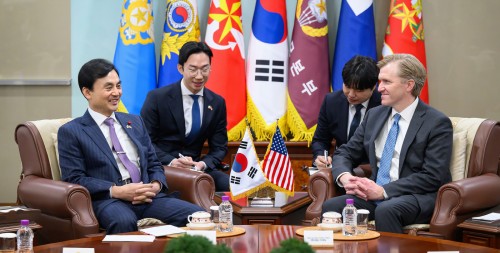 |
| Defense Minister Ahn Gyu-back (left) meets with Elbridge Colby, U.S. Under Secretary of Defense for Policy, at the Ministry of National Defense in Seoul on Jan. 26. / Courtesy of the Ministry of National Defense |
Elbridge Colby, U.S. Under Secretary of Defense for Policy and a key architect of Washington’s National Defense Strategy (NDS), visited South Korea this week and held a series of meetings with senior foreign and security officials. The meetings are widely seen as an effort to explain the NDS framework and press U.S. strategic demands on Seoul, including a redefinition of alliance roles and expanded strategic flexibility for U.S. Forces Korea (USFK). Analysts say this could accelerate the transfer of wartime operational control (OPCON) to South Korea faster than Seoul anticipates.
On the morning of Jan. 26, Colby held a breakfast meeting with Foreign Minister Cho Hyun, attended by Xavier Brunson, who also serves as commander of the United Nations Command and the Combined Forces Command. The presence of the USFK commander underscored that discussions were closely tied to the future operational scope of the U.S.–South Korea alliance. Brunson later accompanied Colby to a meeting with Defense Minister Ahn Gyu-back.
South Korea’s Foreign Ministry said only that the two sides exchanged views on follow-up measures after the recent U.S.–Korea summit, Korean Peninsula issues, and alliance matters. The Defense Ministry said the talks covered regional security, nuclear-powered submarines, OPCON transfer, and strengthening allied defense capabilities.
At the core of the discussions, however, was likely a reassessment of the role of USFK. Under the NDS, the United States plans to build a strong “denial defense” along the First Island Chain to counter China’s expansion. USFK is positioned within this strategic line, suggesting that U.S. forces stationed in Korea could be redeployed in a Taiwan contingency or other regional crises.
From Colby’s perspective, conventional deterrence against North Korea should increasingly be led by South Korea. If U.S. forces are redeployed elsewhere, Seoul would be expected to secure the rear against potential North Korean threats.
Colby’s visit is viewed as a test of how Washington’s evolving strategy will translate into alliance management. South Korea and the United States are currently in the second phase of OPCON transfer procedures, with verification of Full Operational Capability (FOC) of the future Combined Forces Command planned for this year. While official explanations emphasize a gradual transition based on South Korea’s military readiness and political judgment, analysts note that from the NDS viewpoint, OPCON transfer could serve as a tool to accelerate burden-sharing and enhance U.S. operational flexibility.
If driven primarily by U.S. calculations rather than South Korea’s, a faster-than-expected OPCON transfer could impose significant costs on Seoul. Despite South Korea’s growth in defense spending and conventional forces, it remains heavily dependent on the United States for strategic assets such as intelligence, surveillance and reconnaissance (ISR), missile defense, and space and cyber capabilities.
Even after OPCON transfer, the alliance would remain intact, but friction could arise over command authority and the use of strategic assets in a crisis. The effectiveness of the U.S. nuclear umbrella is considered the most sensitive concern. Although the Nuclear Consultative Group (NCG) has been established, ultimate authority over nuclear use rests with Washington. A structure in which South Korea holds wartime command while the United States controls nuclear decision-making could create strategic confusion in emergencies.
Park Beom-jin, a professor at Kyung Hee University’s Graduate School of Business Administration, said Colby is likely emphasizing expanded allied roles, noting that the presence of the USFK commander signaled Washington’s direct control over U.S. forces in Korea. “OPCON transfer could proceed faster than Seoul expects, depending on U.S. needs,” he said. “In return, South Korea should press for tangible gains, such as strong executive and congressional support for its nuclear-powered submarine program.”
#U.S.–South Korea alliance #wartime operational control #nuclear decision authority #Elbridge Colby #NDS
Copyright by Asiatoday
Most Read
-
1
Trump shares map on social media labeling Strait o..

-
2
Kia Sportage outperforms Mazda CX-5 in German auto..

-
3
Houthis launch successive attacks on Saudi airport..

-
4
U.S. deploys carrier, 10,000 more troops to Middle..

-
5
Trump rejects Iran's offer to open Strait of Hormu..

-
6
N. Korea conducts first swarm attack drill with dr..

-
7
U.S.-China summit falls short on substance as Trum..

PEOPLE






HEADLINE NEWS
- Seoul dismisses Ukraine's claim of 'S. Korean support for Russia' as "inaccurate and inappropriate"
- S. Korea, Japan race to develop nuclear-powered submarines
- Henri Kagan, Kenso Soai win Nobel Prize in Chemistry for uncovering how mol..
- Vance says Alaska LNG cooperation will move forward with Seoul's current or..

-
Address : In-Young Bldg., 34, Uisadang-daero 1-gil, Yeongdeungpo-gu, Seoul
Copyright by ASIATODAY CO., LTD. All rights resereved