



DP and Rebuilding Korea Party clash over merger terms
Jan 27, 2026, 10:57 am


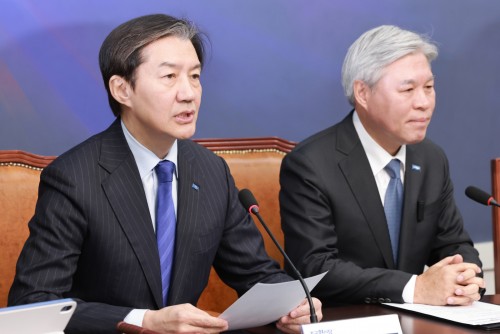 |
| Cho Kuk, leader of the Rebuilding Korea Party, speaks at a Supreme Council meeting at the National Assembly on Jan. 26. At right is floor leader Seo Wang-jin. / Yonhap |
Merger talks proposed by Jeong Cheong-rae, leader of the Democratic Party, and the Rebuilding Korea Party got off to a rocky start, with both sides showing signs of resistance from the outset.
While Democratic Party officials have signaled a fast-track approach and what critics describe as an absorption-style merger, the Rebuilding Korea Party pushed back strongly, saying its independent identity and values must not be compromised. Resistance has also surfaced within the Democratic Party, where some lawmakers question why their party should make concessions.
On Jan. 26, the ruling camp refrained from provocative public remarks out of respect for the mourning period following the death of former party leader Lee Hae-chan. Behind the scenes, however, tensions over the method, timing, and distribution of influence in a potential merger have intensified.
The first public counterattack came from the Rebuilding Korea Party. Floor leader Seo Wang-jin criticized comments made a day earlier by Democratic Party Secretary-General Cho Seung-rae, who said the smaller party’s “DNA would blend well within the larger organism of the Democratic Party.”
Seo called the remark “a de facto absorption merger proposal” and expressed “strong regret,” stressing that any integration must be based on a “union of values,” not simply numerical expansion.
The Rebuilding Korea Party later convened a party executive meeting and granted full negotiating authority to its leader Cho Kuk.
Party spokesperson Park Byeong-eon said the party agreed it must not be swayed by the dominant ruling party, adding that it would not feel bound by the Democratic Party’s suggested early-March deadline for a merger.
“The possibility of merger talks collapsing cannot be ruled out,” Park said, noting that preparations for local elections would proceed as scheduled. The remark signaled the party’s willingness to pursue an independent run if negotiations fail.
Discontent within the Democratic Party has also grown. Lawmakers have raised procedural concerns over Jeong’s “surprise proposal,” which some say bypassed party leadership, while others argue the party should not compromise its pride or identity to accommodate the smaller party.
Rep. Kang Deuk-gu wrote on Facebook that the Democratic Party has more than 70 years of history and tradition, adding that its identity is nothing to be ashamed of. He rejected suggestions that the party should even consider changing its name for the sake of integration.
“While I am not opposed to unity, it must be a principled merger,” Kang said. “Our identity should never be undermined in the process.”
Policy differences are also emerging. Cho Kuk welcomed the government’s decision to end temporary relief on capital gains tax hikes for multiple-home owners as scheduled, but argued that the constitutional concept of public land ownership must go beyond symbolic declarations. He called for stronger legislation, dubbed the “three public land ownership bills,” highlighting a sharper ideological stance.
As the Democratic Party pursues a more flexible, centrist policy line and the Rebuilding Korea Party opts for a harder approach, analysts expect further friction in the negotiations ahead.
#Democratic Party #Rebuilding Korea Party #merger talks #Cho Kuk #Jeong Cheong-rae
Copyright by Asiatoday
Most Read
-
1
Trump shares map on social media labeling Strait o..

-
2
Kia Sportage outperforms Mazda CX-5 in German auto..

-
3
Houthis launch successive attacks on Saudi airport..

-
4
U.S. deploys carrier, 10,000 more troops to Middle..

-
5
Trump rejects Iran's offer to open Strait of Hormu..

-
6
N. Korea conducts first swarm attack drill with dr..

-
7
U.S.-China summit falls short on substance as Trum..

PEOPLE






HEADLINE NEWS
- Seoul dismisses Ukraine's claim of 'S. Korean support for Russia' as "inaccurate and inappropriate"
- S. Korea, Japan race to develop nuclear-powered submarines
- Henri Kagan, Kenso Soai win Nobel Prize in Chemistry for uncovering how mol..
- Vance says Alaska LNG cooperation will move forward with Seoul's current or..

-
Address : In-Young Bldg., 34, Uisadang-daero 1-gil, Yeongdeungpo-gu, Seoul
Copyright by ASIATODAY CO., LTD. All rights resereved