



Military to dismantle counterintelligence command
Jan 09, 2026, 08:15 am


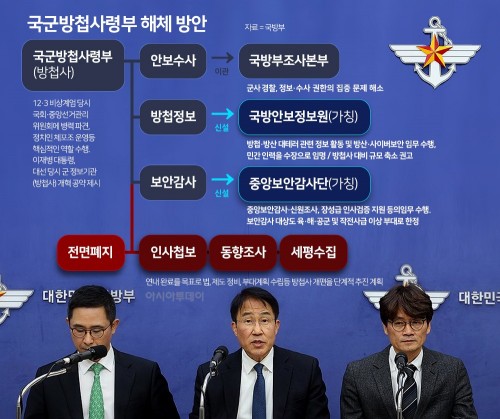 |
| Hong Hyun-ik, chair of the Military Counterintelligence and Security Redesign Subcommittee, briefs reporters at the Ministry of National Defense in Yongsan, Seoul, on Jan. 8 after recommending the phased dismantling of the Defense Counterintelligence Command to the defense minister. / Yonhap |
South Korea will move forward with dismantling the Defense Counterintelligence Command, redistributing and abolishing its functions as part of a broader reform of the military’s counterintelligence and security system.
The plan was unveiled on Thursday by the Military Counterintelligence and Security Redesign Subcommittee under a civilian–government–military joint special advisory committee tasked with post-crisis reforms and future defense planning. The subcommittee said the dismantling aims to decentralize functions and enhance specialization while strengthening democratic oversight.
Hong Hyun-ik, chair of the subcommittee, said at a briefing held at the Ministry of National Defense in Seoul that he had formally recommended a “developmental dismantling” of the command to the defense minister. The ministry plans to push ahead step by step with legal and institutional revisions and unit restructuring within this year.
Under the recommendations, the command’s current roles—including security investigations, counterintelligence information, security audits, and personnel monitoring—will be either transferred or abolished. Its remaining counterintelligence information function will be replaced by a newly established specialized body tentatively named the National Defense Security Intelligence Agency.
The new agency will be responsible for intelligence activities related to counterintelligence, the defense industry, and counterterrorism, as well as defense industrial and cybersecurity missions. Its head is expected to be a civilian, such as a government employee, and the organization’s size will be reduced to an appropriate level reflecting the transfer and abolition of other functions.
To ensure transparency and accountability, the agency will establish basic operational guidelines to be reported to the National Assembly and will be required to submit regular work reports. A compliance oversight committee made up of civilian experts will also be set up to monitor adherence to laws and regulations.
The security investigation function will be transferred to the Defense Ministry Investigation Headquarters to address concerns over the concentration of intelligence and investigative powers. The subcommittee noted that in many advanced countries, counterintelligence agencies do not hold investigative authority.
Security audit functions will be reassigned to a newly created specialized body tentatively named the Central Security Audit Group. This group will handle central security audits, background checks, and support for vetting senior military appointments, while routine security audits at corps level and below will be transferred to individual service branches. The new audit body will operate under the supervision and control of the Defense Ministry’s inspector general.
In addition, the ministry plans to establish a director-level post, tentatively called the Information Security Policy Director, to oversee and coordinate the work of the new intelligence agency, the central audit group, and the Defense Intelligence Headquarters, while setting overall military information and security policy.
Newly established and restructured organizations will form a security investigation consultative body to share information and coordinate operations. Audit officers at these institutions will be appointed from civilian government staff or external personnel to ensure independence and neutrality.
Functions long criticized as problematic—such as personnel intelligence gathering, reputation monitoring, and trend surveillance—will be completely abolished.
Hong said the reform must both strengthen counterintelligence and security, which are core to national security, and uphold democratic control and constitutional values. “This recommendation is intended to fundamentally reshape the institutional framework so that each organization can focus on its core mission while remaining in harmony with democratic oversight,” he said.
#Defense Counterintelligence Command #counterintelligence reform #Ministry of National Defense #National Defense Security Intelligence Agency
Copyright by Asiatoday
Most Read
-
1
Trump shares map on social media labeling Strait o..

-
2
Kia Sportage outperforms Mazda CX-5 in German auto..

-
3
Houthis launch successive attacks on Saudi airport..

-
4
U.S. deploys carrier, 10,000 more troops to Middle..

-
5
Trump rejects Iran's offer to open Strait of Hormu..

-
6
N. Korea conducts first swarm attack drill with dr..

-
7
U.S.-China summit falls short on substance as Trum..

PEOPLE






HEADLINE NEWS
- Seoul dismisses Ukraine's claim of 'S. Korean support for Russia' as "inaccurate and inappropriate"
- S. Korea, Japan race to develop nuclear-powered submarines
- Henri Kagan, Kenso Soai win Nobel Prize in Chemistry for uncovering how mol..
- Vance says Alaska LNG cooperation will move forward with Seoul's current or..

-
Address : In-Young Bldg., 34, Uisadang-daero 1-gil, Yeongdeungpo-gu, Seoul
Copyright by ASIATODAY CO., LTD. All rights resereved