



Opposition pushes special probe over ruling camp scandals
Jan 05, 2026, 07:25 am


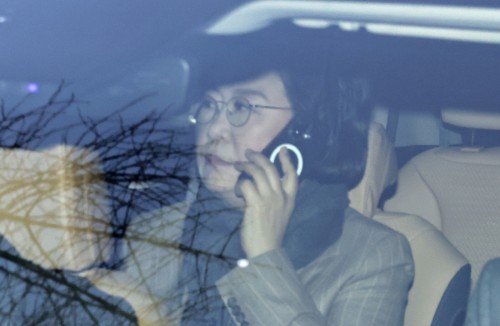 |
| Lee Hye-hoon, nominee for minister of the Ministry of Economy and Finance, arrives at her confirmation hearing preparation office in central Seoul on Jan. 2. / Yonhap News |
South Korea’s main opposition People Power Party has stepped up its offensive against the ruling Democratic Party of Korea, calling for special prosecutors over a string of controversies as local elections loom five months away.
The opposition is seeking to capitalize on what it describes as “ruling camp liabilities,” including allegations of nomination bribery involving Democratic Party figures, workplace abuse claims against Lee Hye-hoon, and suspicions of ties between political figures and the Unification Church.
The People Power Party aims to frame the controversies as part of a broader pattern rather than isolated incidents, intensifying a public opinion campaign that could shape the entire election landscape, political observers say.
According to political sources on Jan. 4, the party has identified three key issues as pillars of its offensive: alleged nomination bribes involving former Democratic Party floor leader Kim Byung-gi and lawmaker Kang Sun-woo; abuse and verbal harassment allegations surrounding Lee, the nominee for minister of economy and finance; and claims of close ties between ruling party figures and the Unification Church. The opposition insists all three cases warrant investigations by independent special prosecutors.
The People Power Party has characterized the alleged nomination bribes as outright “vote-buying,” arguing that unfair practices in candidate selection must be highlighted ahead of the June 3 local elections.
Choi Bo-yoon, the party’s chief spokesperson, said in a statement that the scandal “has increasingly revealed itself as a massive, power-driven corruption case involving an organized core and higher-level figures, rather than mere individual misconduct.” He added that the allegations go beyond what could be dismissed by “cutting off a few tails.”
Choi argued that the case amounts to an attempt to conceal corruption that undermines democratic principles, saying special prosecutors should be introduced precisely for such situations.
The opposition has also sharpened its attacks ahead of Lee Hye-hoon’s parliamentary confirmation hearings. Despite Lee being a former People Power Party lawmaker, the party has vowed a rigorous review, reflecting internal backlash over her acceptance of a cabinet post under the Lee Jae-myung administration without extensive consultation with party leadership.
The People Power Party is reportedly pushing for a two-day confirmation hearing and has focused criticism on allegations that Lee verbally abused and mistreated aides. Choi described audio recordings and testimonies alleging repeated shouting, humiliation, and personal errands as “shocking,” arguing that the issue cannot be resolved with explanations or apologies alone and calling on Lee to step down.
The opposition is also pressing the Democratic Party to accept a special prosecutor bill jointly proposed with the New Reform Party to investigate alleged political ties to the Unification Church.
Negotiations over the bill remain stalled. While the Democratic Party has insisted on expanding the probe to include allegations involving the Shincheonji Church, the People Power Party has rejected the move as an attempt to dilute the investigation.
Floor leader Song Eon-seok criticized the ruling camp during a New Year’s gathering in the Daegu–North Gyeongsang region, saying that bringing in Shincheonji amounted to “watering down” the probe and signaled an implicit admission of wrongdoing.
To increase pressure, the People Power Party is considering a joint hunger strike by party leader Jang Dong-hyuk and New Reform Party leader Lee Jun-seok. The Democratic Party, meanwhile, has said it will seek to pass its own version of the special prosecutor bill at a plenary session before the end of the current extraordinary parliamentary session on Jan. 8.
#People Power Party #Democratic Party of Korea #Lee Hye-hoon #special prosecutor #nomination bribery
Copyright by Asiatoday
Most Read
-
1
Trump shares map on social media labeling Strait o..

-
2
Kia Sportage outperforms Mazda CX-5 in German auto..

-
3
Houthis launch successive attacks on Saudi airport..

-
4
U.S. deploys carrier, 10,000 more troops to Middle..

-
5
Trump rejects Iran's offer to open Strait of Hormu..

-
6
N. Korea conducts first swarm attack drill with dr..

-
7
U.S.-China summit falls short on substance as Trum..

PEOPLE





HEADLINE NEWS
- Seoul dismisses Ukraine's claim of 'S. Korean support for Russia' as "inaccurate and inappropriate"
- S. Korea, Japan race to develop nuclear-powered submarines
- Henri Kagan, Kenso Soai win Nobel Prize in Chemistry for uncovering how mol..
- Vance says Alaska LNG cooperation will move forward with Seoul's current or..

-
Address : In-Young Bldg., 34, Uisadang-daero 1-gil, Yeongdeungpo-gu, Seoul
Copyright by ASIATODAY CO., LTD. All rights resereved