



Medical school applicants fall to 7,000 level
Jan 04, 2026, 07:56 pm


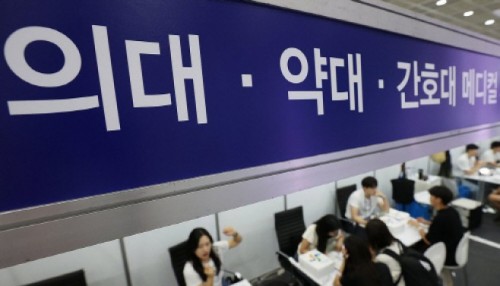 |
| Students and parents consult admissions counselors at the “2026 College Admissions Information Fair” held at COEX in Gangnam, Seoul. / Yonhap News |
The number of applicants to medical schools through Korea’s regular college admissions track has fallen to the 7,000 range, marking the lowest level in the past five years.
According to an analysis released on Jan. 4 by Jongro Hagwon, a total of 7,125 students applied to regular admissions at 39 medical schools nationwide for the 2026 academic year. This represents a 32.3 percent decrease from last year’s 10,518 applicants.
It is the smallest applicant pool since medical schools began shifting to undergraduate-based programs in the 2022 academic year. Over the past five years, regular-admission applicants numbered 9,233 in 2022, 8,044 in 2023, 8,098 in 2024, and 10,518 in 2025, consistently remaining in the 8,000–9,000 range until this year’s sharp drop.
The decline coincided with a reduction in available slots. The number of students admitted through regular admissions for the 2026 academic year fell to 1,078, down 32.6 percent, or 521 places, from last year’s 1,599. Despite the reduced intake, the nationwide average competition rate edged up slightly to 6.61 to 1, compared with 6.58 to 1 a year earlier.
Competition trends varied by region. Medical schools in Seoul recorded an average competition rate of 3.8 to 1, down from 4.19 to 1 last year. In contrast, schools in the greater Seoul metropolitan area posted a sharply higher rate of 7.04 to 1, while non-metropolitan schools saw the highest average competition at 8.17 to 1.
By institution, Kosin University showed the highest competition rate at 24.65 to 1, while Ewha Womans University recorded the lowest at 2.94 to 1. Among major medical schools, competition rose at most universities except Seoul National University. Yonsei University’s medical school posted a rate of 4.38 to 1, up from last year, while Catholic University of Korea, Sungkyunkwan University, and the University of Ulsan also saw increases. Seoul National University’s medical school dipped slightly to 3.2 to 1.
Jongro Hagwon attributed the sharp decline in applicants to both the reduced number of available places and the increased difficulty of the College Scholastic Ability Test, noting that more students opted for conservative application strategies. The institute added that the number of repeat test-takers applying to medical schools appeared to have fallen significantly.
However, it cautioned against interpreting the trend as a loss of interest in medical education, saying that rising competition at top-tier schools suggests demand remains strong. “It will be necessary to monitor additional admissions results and next year’s medical school admissions trends,” the institute said.
#medical school admissions #college entrance exam #regular admissions #applicant decline #Jongro Hagwon
Copyright by Asiatoday
Most Read
-
1
Celltrion’s Omlyclo gains ground in major European..

-
2
Trump demands rates fall below 1% as Fed hikes for..

-
3
Hyundai Motor Group breaks ground on integrated st..

-
4
U.S. strikes 3 Iranian oil tankers, Iran vows reta..

-
5
Trump makes $1 trillion bet ahead of midterm elect..

-
6
Iran resumes ballistic missile production, assembl..

-
7
Samsung Electronics, Mistral AI to jointly develop..

PEOPLE







-
Address : In-Young Bldg., 34, Uisadang-daero 1-gil, Yeongdeungpo-gu, Seoul
Copyright by ASIATODAY CO., LTD. All rights resereved