



Democracy tops economy in public priorities
Dec 24, 2025, 09:14 am


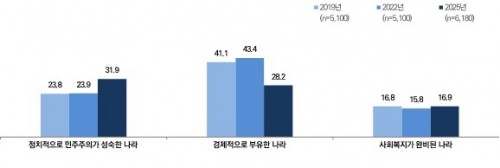 |
| The future image of South Korea most desired by the public. / Ministry of Culture, Sports and Tourism |
For the first time in nearly three decades, South Koreans have placed democratic maturity above economic prosperity as their most desired vision for the country’s future, signaling a profound shift in public values.
According to the “2025 Korean Awareness and Values Survey” released on Dec. 23 by the Ministry of Culture, Sports and Tourism, 31.9% of respondents selected “a country with mature democracy” as the ideal future for South Korea. The long-dominant choice, “an economically wealthy nation,” fell to second place at 28.2%, followed by “a country with a comprehensive welfare system” at 16.9%.
Since the survey began in 1996, economic affluence had consistently ranked first. The ministry said the reversal reflects heightened public sensitivity to democratic fragility, shaped in part by last December’s political turmoil, including former President Yoon Suk Yeol’s declaration of emergency martial law and the deployment of troops to the National Assembly.
Public assessments of South Korea’s democratic level were relatively positive, with 46.9% rating it as “high,” compared with 21.8% who said it was “low.”
Despite a growing perception of personal economic stability—60.5% of respondents identified themselves as middle class or above, up 18.1 percentage points from 2022—overall happiness and life satisfaction declined sharply. The share of people describing themselves as happy fell from 65.0% to 51.9%, while life satisfaction dropped from 63.1% to 52.9%.
Social divisions remain a major concern. The most serious conflicts were cited as progressives versus conservatives (82.7%), employers versus workers (76.3%), the wealthy versus ordinary citizens (74.0%), the Seoul metropolitan area versus regional areas (69.0%), older versus younger generations (67.8%), and men versus women (61.1%).
Income inequality emerged as the most urgent task for the government, chosen by 23.2% of respondents, overtaking job creation (22.9%) and housing issues (13.2%). In the previous survey, employment had ranked first.
Attitudes toward labor policy showed strong support for extending the mandatory retirement age. A total of 74.0% favored extension, with 50.9% calling for a higher retirement age and 23.1% advocating the abolition of mandatory retirement altogether. Only 15.7% supported maintaining the current system.
The survey also examined views on generative artificial intelligence. More than half of respondents (55.2%) said they use generative AI, averaging 3.3 uses per day. While 64.3% feared AI would replace labor and worsen job inequality, 51.8% also expected benefits such as shorter working hours and job sharing.
Multiculturalism was viewed relatively favorably, with 66.0% saying it helps secure labor supply and 61.3% citing broader social inclusion. Among foreign residents living in South Korea for more than two years, 55.9% said they were happy with life in the country, though 43.7% reported experiencing discrimination, most commonly based on nationality.
The survey, conducted by CaseStat Research through in-home interviews, polled 6,180 Koreans aged 13 to 79 and 1,020 foreign residents between Aug. 15 and Oct. 2. First launched in 1996 and conducted every three years since 2013, this year marked its ninth edition.
#democracy #economic growth #public opinion survey #income inequality #retirement age extension
Copyright by Asiatoday
Most Read
-
1
Celltrion’s Omlyclo gains ground in major European..

-
2
Trump demands rates fall below 1% as Fed hikes for..

-
3
Hyundai Motor Group breaks ground on integrated st..

-
4
U.S. strikes 3 Iranian oil tankers, Iran vows reta..

-
5
Trump makes $1 trillion bet ahead of midterm elect..

-
6
Iran resumes ballistic missile production, assembl..

-
7
Samsung Electronics, Mistral AI to jointly develop..

PEOPLE







-
Address : In-Young Bldg., 34, Uisadang-daero 1-gil, Yeongdeungpo-gu, Seoul
Copyright by ASIATODAY CO., LTD. All rights resereved