



Fake information bill nears passage
Dec 24, 2025, 08:36 am


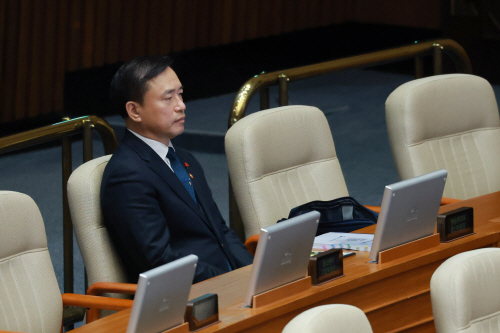 |
| Kim Jong-cheol, chair of the Korea Communications and Media Commission, listens to an unlimited debate on a proposed amendment to the Information and Communications Network Act delivered by People Power Party lawmaker Choi Soo-jin during a plenary session of the National Assembly on Dec. 23. / Yonhap News |
A controversial amendment to the Information and Communications Network Act—dubbed the “fake and manipulated information eradication law”—is on the brink of passage, raising concerns that it could enable “legal” media control that goes beyond constitutional limits.
The bill was placed on the National Assembly agenda on Dec. 23 and is expected to pass on Dec. 24, despite mounting criticism that it could infringe on constitutionally protected freedom of the press and expression. The legislation introduces punitive damages for the distribution of false or manipulated information, even as the criteria for defining such content remain unclear. Opposition parties and civic groups warn the bill amounts to unconstitutional legislation that could open the door to government and ruling-party control over the media.
The ruling Democratic Party of Korea moved to table the amendment at a plenary session on Tuesday. The opposition People Power Party launched a filibuster in protest, but with the Democratic Party holding a majority and adopting the bill as a party line, passage is effectively assured.
At the core of the amendment is a significant strengthening of liability for journalists and platforms accused of spreading false or manipulated information. Media outlets, YouTubers and platforms found to have intentionally disseminated illegal or fabricated content for unfair gain could be ordered to pay punitive damages of up to five times the actual harm. The Democratic Party argues that the bill addresses constitutional concerns by specifying intent requirements and introducing safeguards against abusive lawsuits aimed at silencing the press.
Critics, however, say constitutional controversy is far from settled. One key issue is the vague standard of “information that harms the public interest.” In 2010, the Constitutional Court of Korea struck down a provision of the Framework Act on Telecommunications that punished the spread of false information “with the intent to harm the public interest,” ruling that such an abstract and ambiguous concept could not justify restrictions on freedom of expression. Legal experts argue the same flaw persists in the current amendment, making it directly incompatible with constitutional principles.
Concerns have also grown over expanded regulatory powers for the Korea Communications and Media Commission. Under the amendment, platforms repeatedly found to distribute false or manipulated information could face administrative fines of up to 1 billion won, separate from court-ordered damages—amounting to what critics describe as “double punishment.” During a parliamentary hearing on Dec. 16, Commission Chair Kim Jong-cheol said the president could exercise “comprehensive oversight” of the commission’s work, fueling fears it could function as a de facto censorship body targeting media critical of the administration.
The bill has also revived concerns about so-called strategic lawsuits against public participation. Powerful figures—such as politicians, senior officials, or major corporate shareholders—could use punitive damage claims to overwhelm media outlets and deter legitimate criticism. Although the Democratic Party has proposed a procedural safeguard allowing courts to dismiss abusive lawsuits at an early stage, critics question its effectiveness, warning it could itself violate the right to trial.
Jang Young-soo, emeritus professor at Korea University Law School, cautioned that “indiscriminate litigation could confront media outlets with lawsuits they cannot possibly handle,” adding that “as politics polarizes further, courts will also face overwhelming pressure, potentially paralyzing the judicial system itself.”
#fake information #manipulated information #Information and Communications Network Act #freedom of expression #press freedom
Copyright by Asiatoday
Most Read
-
1
Celltrion’s Omlyclo gains ground in major European..

-
2
Trump demands rates fall below 1% as Fed hikes for..

-
3
Hyundai Motor Group breaks ground on integrated st..

-
4
U.S. strikes 3 Iranian oil tankers, Iran vows reta..

-
5
Trump makes $1 trillion bet ahead of midterm elect..

-
6
Iran resumes ballistic missile production, assembl..

-
7
Samsung Electronics, Mistral AI to jointly develop..

PEOPLE







-
Address : In-Young Bldg., 34, Uisadang-daero 1-gil, Yeongdeungpo-gu, Seoul
Copyright by ASIATODAY CO., LTD. All rights resereved