



Privilege without responsibility challenges Korean fairness
Dec 23, 2025, 09:24 am


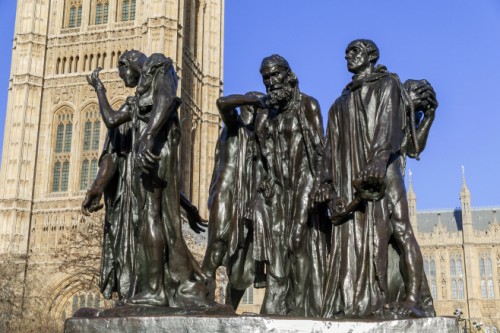 |
| The Burghers of Calais, a sculpture symbolizing the spirit of noblesse oblige. / Getty Images |
The principle of “noblesse oblige,” which holds that greater privilege entails greater responsibility, remains elusive in South Korea, where political and social elites are increasingly criticized for enjoying special treatment while evading accountability.
President Lee Jae-myung on Dec. 19 proposed introducing a system of differential fines, under which penalties for minor offenses would vary according to a violator’s income or assets. Speaking during a briefing by the Ministry of Justice, he said the current system was “not fair,” noting that traffic fines of 50,000 to 100,000 won may deter ordinary citizens but have little impact on the wealthy. His remarks revived debate over institutionalizing noblesse oblige in law and practice.
The concept is famously symbolized by The Burghers of Calais. During the Hundred Years’ War, six leading citizens of the French city of Calais volunteered to sacrifice themselves to save fellow residents after an English siege. Their act of responsibility and sacrifice has since been upheld as a defining example of moral leadership.
Critics argue that Korea’s elite, despite being the greatest beneficiaries of the social system, often treat privilege as an entitlement while neglecting their social “debt.” Recent cases have fueled perceptions of unfairness. The Anti-Corruption and Civil Rights Commission referred allegations to police involving lawmakers accused of receiving improper gifts at family events. Separately, a former vice transport minister resigned amid allegations of speculative property investments, despite having publicly advocated real estate reform.
A look at global standards shows a stark contrast. In Finland, a proportional fine system already applies, with penalties scaled to income to deter repeat violations by high earners. In one widely cited case, a senior executive at Nokia paid a fine exceeding 180 million won for speeding, underscoring how wealth does not shield offenders from meaningful punishment.
France operates the High Authority for Transparency in Public Life (HATVP), an independent body established in 2013 to scrutinize the assets and conflicts of interest of senior officials and elected leaders. Under the system, officials must prove the legality of their wealth when suspicions arise, reversing the burden of explanation and enabling strong sanctions.
Germany provides another example. Former President Christian Wulff resigned after prosecutors charged him over allegations that he received hotel benefits worth about 750,000 won while in office. Even the country’s highest-ranking officials were not immune from investigation.
Singapore also enforces a zero-tolerance approach. Ng Boon Gay, former head of the Central Narcotics Bureau, was prosecuted and sentenced to six months in prison for misconduct involving improper relationships and hospitality, following an investigation by the Corrupt Practices Investigation Bureau.
By contrast, South Korea’s Constitution grants sitting presidents immunity from criminal prosecution except in cases of insurrection or foreign aggression, a provision critics say weakens accountability at the highest level.
Experts argue that as unfair practices become structural, Korea must move beyond rhetoric to strengthen legal and social mechanisms that ensure the powerful are held to higher standards. Without such reforms, they warn, noblesse oblige risks remaining an ideal admired abroad but absent at home.
#noblesse oblige #differential fines #fairness debate #political elites #corruption allegations
Copyright by Asiatoday
Most Read
-
1
Celltrion’s Omlyclo gains ground in major European..

-
2
Trump demands rates fall below 1% as Fed hikes for..

-
3
Hyundai Motor Group breaks ground on integrated st..

-
4
U.S. strikes 3 Iranian oil tankers, Iran vows reta..

-
5
Trump makes $1 trillion bet ahead of midterm elect..

-
6
Iran resumes ballistic missile production, assembl..

-
7
Samsung Electronics, Mistral AI to jointly develop..

PEOPLE







-
Address : In-Young Bldg., 34, Uisadang-daero 1-gil, Yeongdeungpo-gu, Seoul
Copyright by ASIATODAY CO., LTD. All rights resereved