



Lee backs Unification Ministry’s role on inter-Korean ties
Dec 22, 2025, 08:49 am


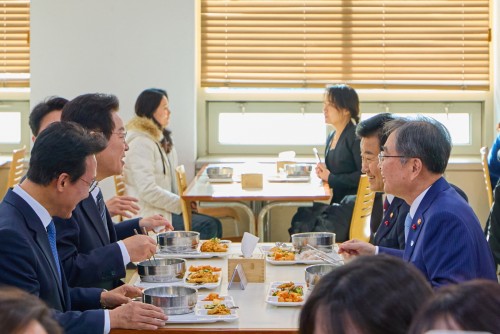 |
| President Lee Jae-myung has lunch with Foreign Minister Cho Hyun and Unification Minister Chung Dong-young at the cafeteria of the Government Complex Seoul annex on Dec. 19 after receiving policy briefings from the Ministry of Unification and the Ministry of Foreign Affairs. / Presidential Office |
President Lee Jae-myung has instructed the government to convene a security-related ministers’ meeting involving the ministries of Foreign Affairs, Unification, and National Defense, while also reactivating a vice-ministerial communication channel between the foreign and unification ministries. The move signals that simmering turf tensions between the two ministries over North Korea policy are entering a phase of containment.
According to the Presidential Office on Dec. 21, the security-related ministers’ meeting ordered by the president is not intended as a standing body. An official said such meetings have been held on an as-needed basis under past administrations and that the directive is not unprecedented. With signs of continued discord between the foreign and unification ministries, the instruction is widely interpreted as a call to expand contact points and tighten policy coordination across security issues.
In the same vein, a working-level consultative body has been formed between Chung Youn-doo, head of the Foreign Ministry’s Office of Strategic Information, and Unification Vice Minister Kim Nam-joong. A similar forum operated informally when Unification Minister Chung Dong-young first took office in 2005, marking its revival after more than 20 years.
Analysts expect North Korea policy to settle into a system in which issues are coordinated through regular vice-ministerial talks and the security-related ministers’ meeting before final adjustment at the National Security Council (NSC). A key question is which ministry will take the lead during coordination. In political circles, President Lee’s remarks at the Dec. 19 briefings—“We should do our utmost to ease inter-Korean hostility and allow trust to take root, and this is a role the Ministry of Unification should play”—are seen as tilting weight toward the Unification Ministry.
Despite this “traffic control,” differences remain evident, leaving open the possibility of further friction. The clearest fault line is sanctions on North Korea, where the Foreign Ministry’s cautious stance could collide with the Unification Ministry’s push for easing measures.
At the briefing, Unification Minister Chung argued that sanctions have lost effectiveness and that discussions on easing them are necessary. He also outlined plans to create conditions for U.S.–North Korea and inter-Korean dialogue through a “Korean Peninsula peace envoy” engaging major powers—an initiative critics say could overlap with the role of Chung Youn-doo, who concurrently serves as South Korea’s chief envoy to the six-party talks.
Foreign Minister Cho Hyun, speaking to reporters after the briefing, urged caution on sanctions relief, saying it must be discussed with the Unification Ministry and deliberated by relevant ministries at the National Security Office to form a unified government position. He added that the Unification Ministry’s report does not amount to a change in the Lee administration’s overall foreign policy course.
Cho also addressed Unification Ministry proposals such as a Seoul–Beijing high-speed rail link, international peace tourism at Wonsan–Kalma, and a peace trade system—initiatives that would presuppose sanctions relief or exemptions—saying he would “make diplomatic efforts to turn ideals into reality.” The remarks were interpreted as acknowledging the Unification Ministry’s initiative while hinting at limited feasibility.
Earlier, President Lee had stressed at the joint briefing that “it helps for each ministry to have its own position,” adding that such diversity “widens the range of choices when selecting foreign policy options.”
#Lee Jae-myung #inter-Korean relations #Ministry of Unification #Ministry of Foreign Affairs #North Korea policy
Copyright by Asiatoday
Most Read
-
1
Trump shares map on social media labeling Strait o..

-
2
Kia Sportage outperforms Mazda CX-5 in German auto..

-
3
Houthis launch successive attacks on Saudi airport..

-
4
U.S. deploys carrier, 10,000 more troops to Middle..

-
5
Trump rejects Iran's offer to open Strait of Hormu..

-
6
N. Korea conducts first swarm attack drill with dr..

-
7
U.S.-China summit falls short on substance as Trum..

PEOPLE




HEADLINE NEWS
- Seoul dismisses Ukraine's claim of 'S. Korean support for Russia' as "inaccurate and inappropriate"
- S. Korea, Japan race to develop nuclear-powered submarines
- Henri Kagan, Kenso Soai win Nobel Prize in Chemistry for uncovering how mol..
- Vance says Alaska LNG cooperation will move forward with Seoul's current or..

-
Address : In-Young Bldg., 34, Uisadang-daero 1-gil, Yeongdeungpo-gu, Seoul
Copyright by ASIATODAY CO., LTD. All rights resereved