



Government to speed up housing supply, push restructuring
Dec 22, 2025, 08:41 am


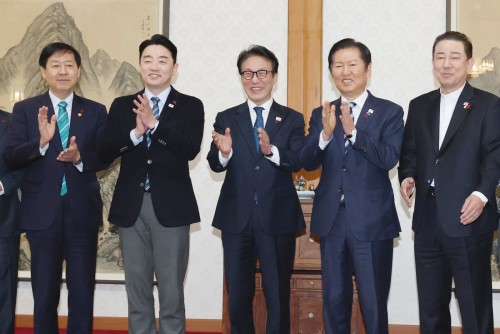 |
| From left, Kang Hoon-sik, Kim Min-seok, and Jung Cheong-rae pose for a photo during a high-level government–ruling party policy meeting at the prime minister’s official residence in Jongno District, Seoul, on Dec. 21. / Park Sung-il |
The government said Sunday it will move swiftly to flesh out housing supply plans while pressing ahead with unavoidable structural reforms in the petrochemical and steel industries, following a high-level meeting with the ruling party.
Speaking at a briefing at the National Assembly, Park Soo-hyun, senior spokesperson for the Democratic Party of Korea, said the government pledged to “do its utmost to manage housing demand, including household lending,” at the meeting held at the prime minister’s official residence in Samcheong-dong, Seoul.
According to Park, the government and ruling party assessed that short-term overheating in home prices in Seoul and the greater metropolitan area has eased somewhat since the announcement of the Oct. 15 housing measures. However, they agreed to closely monitor the market, citing continued upward pressure driven by weak supply and excess liquidity.
“Given that the situation remains serious, we decided not to let down our guard and to monitor market conditions closely,” Park said.
Party leader Jung Cheong-rae said the ruling bloc would work together to identify timely measures to stabilize housing and provide tangible support for housing security for ordinary citizens. Prime Minister Kim Min-seok also stressed the need to closely track market developments and seek feasible, region-specific stabilization measures.
The meeting also addressed the need for restructuring in the petrochemical and steel sectors amid China’s rising competitiveness, along with ways to mitigate potential economic shocks from such reforms.
“Structural reform in the petrochemical and steel industries has become unavoidable,” Kim said. “The government will support corporate innovation while focusing on protecting workers and easing the impact on regional economies.”
Jung echoed the sentiment, saying swift and bold restructuring is necessary to ensure the long-term sustainability of the industries, while emphasizing that safeguards must be put in place to prevent job losses and regional economic downturns.
The government also urged parliamentary cooperation for the swift passage of livelihood-related bills. Kim said delays caused by filibusters have fueled public frustration, citing legislation such as a special bill on semiconductors. “I earnestly ask the National Assembly to come together to pass bills vital to people’s livelihoods,” he said.
Presidential Chief of Staff Kang Hoon-sik said key bills directly affecting livelihoods remain stalled in parliament. “These are measures to ease the pain faced by businesses, workers and local economies during industrial transition and to protect public safety,” he said, adding that the government stands ready to implement prepared policies without delay and urged active cooperation from the ruling party to pass the bills before year’s end.
Participants also reviewed the first-ever live broadcast of government policy briefings. Jung said the president’s briefings have drawn strong public attention, noting that they have allowed the public to better grasp the direction of state affairs and hear detailed discussions firsthand.
#housing supply #real estate policy #petrochemical industry #steel industry #structural reform
Copyright by Asiatoday
Most Read
-
1
Trump shares map on social media labeling Strait o..

-
2
Kia Sportage outperforms Mazda CX-5 in German auto..

-
3
Houthis launch successive attacks on Saudi airport..

-
4
U.S. deploys carrier, 10,000 more troops to Middle..

-
5
Trump rejects Iran's offer to open Strait of Hormu..

-
6
N. Korea conducts first swarm attack drill with dr..

-
7
U.S.-China summit falls short on substance as Trum..

PEOPLE






HEADLINE NEWS
- Seoul dismisses Ukraine's claim of 'S. Korean support for Russia' as "inaccurate and inappropriate"
- S. Korea, Japan race to develop nuclear-powered submarines
- Henri Kagan, Kenso Soai win Nobel Prize in Chemistry for uncovering how mol..
- Vance says Alaska LNG cooperation will move forward with Seoul's current or..

-
Address : In-Young Bldg., 34, Uisadang-daero 1-gil, Yeongdeungpo-gu, Seoul
Copyright by ASIATODAY CO., LTD. All rights resereved