



Lee urges support to elect merged Daejeon–Chungnam leader
Dec 19, 2025, 09:14 am


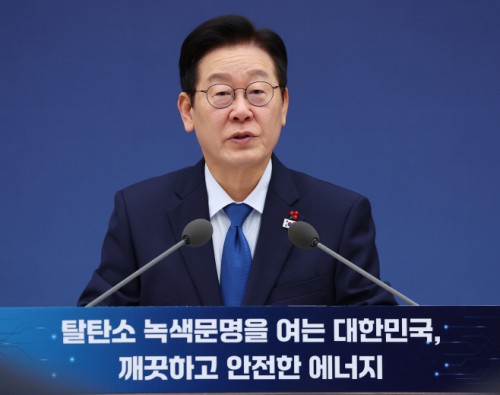 |
| President Lee Jae-myung speaks during a policy briefing by the Climate Ministry (Korea Meteorological Administration) and the Nuclear Safety and Security Commission at the Government Sejong Convention Center on December 17. / Source: Yonhap News |
President Lee Jae-myung on December 18 emphasized the need for strong administrative support from the central government so that voters in Daejeon and South Chungcheong Province can elect a leader of a newly integrated local government in the upcoming local elections.
Lee’s remarks clarified his intent for the June 3 local elections next year to include the selection of a “merged metropolitan government head,” a signal expected to accelerate parliamentary deliberations on related legislation. The Democratic Party has agreed to complete administrative procedures for the integration by March next year.
According to presidential spokesperson Kang Yu-jung, Lee made the comments during a luncheon meeting with Democratic Party lawmakers from Daejeon and South Chungcheong Province at the presidential office in Yongsan. “Resolving the overconcentration in the Seoul metropolitan area is one of our most pressing tasks,” Lee said, adding that the integration of Daejeon and South Chungcheong could serve as a breakthrough for balanced regional development.
Calling the issue a historic one tied to the nation’s future, Lee said local government integration should be considered as an alternative to metropolitan overcrowding. While acknowledging the political complexities involved, he urged policymakers to make decisions that rise above competing interests. He also called for an open and forward-looking approach to contentious issues such as the location and naming of integrated administrative institutions.
Lee had previously raised the idea of local government integration on December 8 during a briefing by the Presidential Committee for Regional Development, framing it as part of a “five hubs, three special zones” strategy for balanced growth. To prevent disputes over the placement or naming of provincial offices, he proposed options such as building offices in two locations or situating them along regional boundaries.
During the meeting, Lee asked lawmakers to ensure that the benefits of integration are shared broadly by residents, and to examine special provisions within the widest acceptable scope for fiscal decentralization and expanded local autonomy. “As this is the first integration between metropolitan-level governments, I ask for your active cooperation so it can become a model case,” he said.
Democratic Party officials welcomed the call. Park Jeong-hyun, head of the party’s Daejeon chapter, said the economic effects of integration should be carefully examined, while Lee Jung-moon, head of the South Chungcheong chapter, said active discussion would be necessary.
Lawmakers from the two regions also agreed to seek the creation of a party-level preparatory body or special committee to explore the possibility of expanding the integration to include North Chungcheong Province. They discussed plans to introduce legislation on the Daejeon–South Chungcheong merger and to gather public input from local residents.
#Lee Jae-myung #Daejeon–Chungnam integration #local government merger #local elections #balanced regional development
Copyright by Asiatoday
Most Read
-
1
Trump shares map on social media labeling Strait o..

-
2
Kia Sportage outperforms Mazda CX-5 in German auto..

-
3
Houthis launch successive attacks on Saudi airport..

-
4
U.S. deploys carrier, 10,000 more troops to Middle..

-
5
Trump rejects Iran's offer to open Strait of Hormu..

-
6
N. Korea conducts first swarm attack drill with dr..

-
7
U.S.-China summit falls short on substance as Trum..

PEOPLE





HEADLINE NEWS
- Seoul dismisses Ukraine's claim of 'S. Korean support for Russia' as "inaccurate and inappropriate"
- S. Korea, Japan race to develop nuclear-powered submarines
- Henri Kagan, Kenso Soai win Nobel Prize in Chemistry for uncovering how mol..
- Vance says Alaska LNG cooperation will move forward with Seoul's current or..

-
Address : In-Young Bldg., 34, Uisadang-daero 1-gil, Yeongdeungpo-gu, Seoul
Copyright by ASIATODAY CO., LTD. All rights resereved