



Gov’t considers Dec. 3 as People’s Sovereignty Day
Dec 18, 2025, 09:01 am


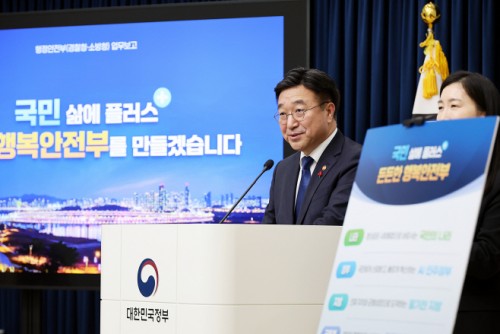 |
| A government briefing is held at the Government Complex Sejong. / Source: Ministry of the Interior and Safety |
The government is reviewing a plan to designate December 3 as “People’s Sovereignty Day” to commemorate citizens’ role in blocking the imposition of emergency martial law. It is also moving to curb hate-filled political banners and strengthen regional support policies aimed at overcoming the concentration of power in the capital region.
Yoon Ho-jung, minister of the Interior and Safety, outlined the government’s 2026 policy direction during a ministry briefing chaired by President Lee Jae-myung at the Government Sejong Convention Center on December 17.
“Over the past six months since the launch of the new administration, we have laid the foundation for a people-sovereignty government and focused all efforts on restoring livelihoods,” Yoon said. “We have also built the groundwork to respond to major challenges of our time, including the AI transition, regional extinction and climate change.” He stressed that 2026, the administration’s second year, would be a “critical year to deliver concrete outcomes the public can truly feel.”
The Ministry of the Interior and Safety (MOIS) presented three broad policy directions, five key tasks and two additional priority initiatives under the slogan “Adding value to people’s lives, a dependable Ministry of Happiness and Safety.” As a central pillar of state administration, the ministry said it would place citizens’ lives and safety at the core of governance, embed participation, solidarity and innovation across public administration, and strengthen protection for vulnerable groups while restoring communities.
The five key tasks include just social integration, building an AI-powered democratic government, genuine local autonomy and balanced growth, fostering warm communities, and protecting safety and life for all. Additional priorities cover economic measures that balance livelihoods and innovation, as well as enhanced winter safety management.
As part of efforts to honor citizens who defended constitutional order on December 3, the ministry is pushing to establish a provisional “People’s Sovereignty Day.” The government is considering designating it as a national commemorative day through a presidential decree, following a public naming contest and opinion surveys. Awards recognizing contributions to democratic development — suspended under the previous administration — will resume in June next year, with eligibility expanded to include civic groups devoted to democratization and contributors to the so-called “Light Revolution.” Issuing certificates to recognized contributors is also under review.
“People’s Sovereignty Day can be designated through a revision of a presidential decree under the ministry’s authority,” Yoon said, adding that the government would proceed after 충분한 public consultation.
Cracking down on hate expression banners was also named a top priority. The ministry plans to support revisions to the Outdoor Advertising Act and the Political Parties Act in the first quarter of next year and prepare management guidelines that would abolish special exemptions for party banners. Based on bills currently pending in the National Assembly, the government aims to strengthen measures against banners containing hateful or derogatory expressions.
President Lee criticized such banners during the briefing, saying they represent “an abuse of authority that exploits administrative loopholes to disgrace society and stir unnecessary conflict,” adding that they “must not be left unchecked.” Yoon responded that guidelines have already been distributed to local governments for interim enforcement, while acknowledging limitations until the law is amended. He said review committees would be used to minimize disputes over subjective standards, with additional guidance to follow once legal revisions are completed.
To dismantle the capital-centric system, the ministry will also pursue a major overhaul of local autonomy. It plans to fully support the launch of “integrated special cities” based on the consolidation of local governments, granting them status comparable to Seoul, including official special-city titles and the creation of politically appointed deputy mayors. A “differentiated support index” — reflecting distance from Seoul and levels of regional social and economic development — will be finalized within the year and applied across fiscal, tax and other policy areas to strengthen preferential support for non-capital regions.
#People’s Sovereignty Day #Ministry of the Interior and Safety
Copyright by Asiatoday
Most Read
-
1
Celltrion’s Omlyclo gains ground in major European..

-
2
Trump demands rates fall below 1% as Fed hikes for..

-
3
Hyundai Motor Group breaks ground on integrated st..

-
4
U.S. strikes 3 Iranian oil tankers, Iran vows reta..

-
5
Trump makes $1 trillion bet ahead of midterm elect..

-
6
Iran resumes ballistic missile production, assembl..

-
7
Samsung Electronics, Mistral AI to jointly develop..

PEOPLE






-
Address : In-Young Bldg., 34, Uisadang-daero 1-gil, Yeongdeungpo-gu, Seoul
Copyright by ASIATODAY CO., LTD. All rights resereved