



PPP, New Reform Party align on Unification Church probe
Dec 15, 2025, 09:33 am


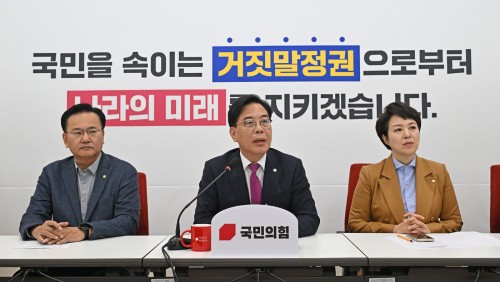 |
| Song Eon-seok, floor leader of the People Power Party (PPP), speaks during a press briefing at the National Assembly in Yeouido, Seoul, on Dec. 14, regarding a proposal to appoint a special prosecutor over alleged Unification Church bribery cases. From left are Yoo Sang-bum, senior deputy floor leader, Song, and Kim Eun-hye, chief policy deputy floor leader. / Source: Song Ui-joo |
The People Power Party (PPP) and the New Reform Party are showing rare coordination over the introduction of a special prosecutor to investigate alleged political lobbying and illicit donations linked to the Unification Church, raising questions about whether broader cooperation could emerge ahead of next June’s local elections.
According to political sources on Dec. 14, the two parties’ floor leaderships are expected to hold formal talks on a special prosecutor bill aimed at uncovering the truth behind allegations involving Unification Church political funding and lobbying. Once a draft bill being prepared by New Reform Party floor leader Chun Ha-ram takes shape, the two sides plan to exchange views on the scope and structure of the legislation. It marks the first time since the New Reform Party’s launch that the leaderships of the two parties have aligned publicly on the same issue.
Both parties share concerns that the Unification Church allegations could extend beyond isolated cases and ripple across the political establishment. With ongoing controversy surrounding the independence and fairness of existing investigations, the PPP argues that a parliamentary-level institutional response has become unavoidable.
Within the PPP, some lawmakers have begun referring to the case as a potential “Unification Church gate,” warning that further revelations about ties between the church and political figures could significantly affect the broader political landscape. The New Reform Party has likewise maintained that police investigations alone are insufficient to uncover the full truth, repeatedly calling for the appointment of an independent special prosecutor.
The PPP has also raised concerns about the impartiality of the current probe. At a press briefing, PPP floor leader Song Eon-seok said that Special Prosecutor Min Joong-ki had delayed investigating allegations involving current and former Democratic Party lawmakers and government officials, despite being aware of them. He argued that not only the Unification Church allegations but also the fairness of the special prosecutor’s investigation itself should be examined.
Song added that PPP-affiliated figures should not be exempt from scrutiny, a remark widely seen as an attempt to preempt accusations of pushing a “shielding probe” designed to protect its own members.
The emerging cooperation has drawn attention given the two parties’ historically uneasy relationship. Differences over former President Yoon Suk Yeol and other key political issues have often kept them at arm’s length. Recently, however, overlapping criticism of the current administration appears to have created common ground, with the Unification Church probe serving as a key point of convergence.
Some political observers interpret the move as a strategic calculation with local elections in mind, particularly in closely contested metropolitan areas where vote splitting among conservative blocs could prove costly. Despite this, both parties’ leaderships have publicly dismissed speculation about an electoral alliance, insisting that no such discussions have taken place. The unresolved question of how to position themselves in relation to former President Yoon remains a central variable shaping future cooperation.
#People Power Party #New Reform Party #Unification Church #special prosecutor #local elections
Copyright by Asiatoday
Most Read
-
1
Trump shares map on social media labeling Strait o..

-
2
Kia Sportage outperforms Mazda CX-5 in German auto..

-
3
Houthis launch successive attacks on Saudi airport..

-
4
U.S. deploys carrier, 10,000 more troops to Middle..

-
5
Trump rejects Iran's offer to open Strait of Hormu..

-
6
N. Korea conducts first swarm attack drill with dr..

-
7
U.S.-China summit falls short on substance as Trum..

PEOPLE




HEADLINE NEWS
- Seoul dismisses Ukraine's claim of 'S. Korean support for Russia' as "inaccurate and inappropriate"
- S. Korea, Japan race to develop nuclear-powered submarines
- Henri Kagan, Kenso Soai win Nobel Prize in Chemistry for uncovering how mol..
- Vance says Alaska LNG cooperation will move forward with Seoul's current or..

-
Address : In-Young Bldg., 34, Uisadang-daero 1-gil, Yeongdeungpo-gu, Seoul
Copyright by ASIATODAY CO., LTD. All rights resereved