



Lee orders tough probe into Unification Church
Dec 11, 2025, 09:06 am


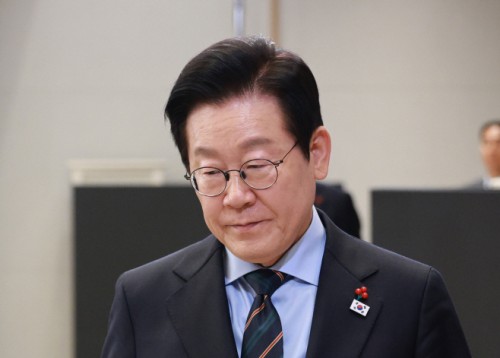 |
| President Lee Jae-myung arrives for a briefing on Korea’s semiconductor vision and development strategy in the AI era at the presidential office in Yongsan, Seoul, on December 10. / Source: Yonhap News |
President Lee Jae-myung on December 10 instructed investigators to carry out a strict and impartial probe into alleged illegal ties between religious groups and political figures, stressing that “no one is exempt, regardless of party or rank.” His remarks were widely interpreted as a pointed warning toward the Unification Church, which is under investigation over alleged collusion with the previous Yoon Suk-yeol administration.
Lee’s directive comes as scrutiny of the Unification Church widens beyond the opposition to figures close to the president within the ruling bloc, raising concerns about perceived bias by the special prosecutor and prompting the administration to tighten control before allegations further spread.
According to officials, the president sees the controversy as a threat to the fundamental order of state governance and believes it must be corrected irrespective of political affiliation.
“A matter of national order—there are no sanctuaries”
A senior presidential official said Lee has long voiced concerns about religious organizations penetrating politics, noting that his warnings were not limited to the Unification Church.
The official referenced Japan’s political turmoil surrounding the assassination of former Prime Minister Shinzo Abe and the country’s far-right drift. “The president has consistently said we must be cautious so that such erosion of public authority does not happen here,” the official added.
As the controversy spread across the political spectrum, Lee’s message was intended as a clear warning against any form of political entanglement with religious groups.
Another official stressed, “This is not about religion or partisan politics. It’s about the basic order and discipline of state governance. There are no protected zones when it comes to conduct that disrupts social order.”
Lee signals dissolution review, presses on property issues
Lee escalated his pressure by raising the possibility of dissolving groups that violate legal and constitutional norms. On December 2 and again on December 9, he said that any incorporated foundation or religious corporation that commits “reprehensible acts in violation of the Constitution or the law must be dissolved.”
He pressed Korea’s legislative chief, Cho Won-chul, to review dissolution options. “Have you examined whether we can dismantle religious groups that meddle in politics and use illicit funds?” he asked. He further demanded clarity on which government office has the authority to revoke establishment permits for religious entities.
Notably, Lee directly asked how the group’s assets would be handled upon dissolution, signaling a strong commitment to pursuing the matter.
During a cabinet meeting earlier this month, Lee also referenced Japan’s decision to order the dissolution of the Unification Church following findings of systematic political involvement, urging Korean officials to conduct a thorough review of relevant legal frameworks.
Top officials named in probe deny wrongdoing
The special counsel investigating alleged collusion between the Yoon administration and the Unification Church reportedly secured testimony that former church world headquarters leader Yoon Young-ho provided financial benefits to Oceans and Fisheries Minister Jeon Jae-soo. Investigators are also probing whether the church sought access to Jeong Jin-sang, one of Lee’s closest former aides and the Democratic Party’s former political coordination chief.
Both Jeon and Jeong flatly denied the allegations, calling them “completely untrue.”
#Lee Jae-myung #Unification Church #dissolution review #political influence #special probe
Copyright by Asiatoday
Most Read
-
1
Trump shares map on social media labeling Strait o..

-
2
Kia Sportage outperforms Mazda CX-5 in German auto..

-
3
Houthis launch successive attacks on Saudi airport..

-
4
U.S. deploys carrier, 10,000 more troops to Middle..

-
5
Trump rejects Iran's offer to open Strait of Hormu..

-
6
N. Korea conducts first swarm attack drill with dr..

-
7
U.S.-China summit falls short on substance as Trum..

PEOPLE




HEADLINE NEWS
- Seoul dismisses Ukraine's claim of 'S. Korean support for Russia' as "inaccurate and inappropriate"
- S. Korea, Japan race to develop nuclear-powered submarines
- Henri Kagan, Kenso Soai win Nobel Prize in Chemistry for uncovering how mol..
- Vance says Alaska LNG cooperation will move forward with Seoul's current or..

-
Address : In-Young Bldg., 34, Uisadang-daero 1-gil, Yeongdeungpo-gu, Seoul
Copyright by ASIATODAY CO., LTD. All rights resereved