



PPP opens protest tents against eight ‘evil bills’
Dec 11, 2025, 09:04 am


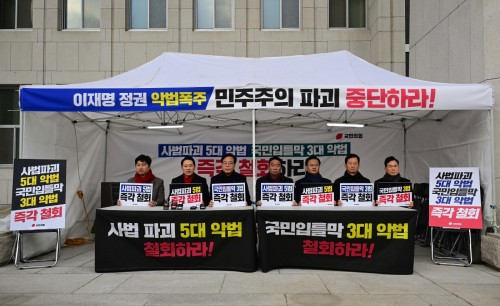 |
| Jang Dong-hyuk, leader of the conservative People Power Party (PPP), and floor leader Song Eon-seok join party leaders in a relay sit-in at a protest tent in front of the main building of the National Assembly in Seoul on December 10, calling for the repeal of eight so-called “evil bills.” / Source: Lee Byung-hwa |
The conservative People Power Party (PPP) has begun an open-ended sit-in under protest tents, vowing to continue its action until the ruling Democratic Party withdraws its judicial reform package. With the governing party holding a majority and pushing ahead with the legislation, the PPP is throwing its weight behind a public-opinion campaign to claw back the political initiative it has lost inside the National Assembly.
Led by party chief Jang Dong-hyuk, the PPP leadership on December 10 pitched tents in front of the main National Assembly building and started a relay sit-in. The tents are emblazoned with slogans such as “Withdraw the five evil bills destroying the judiciary,” “Stop the Lee Jae-myung administration’s evil-law rampage that is wrecking democracy,” and “Immediately scrap the three gag laws muzzling the public.” Over the coming week, all 107 PPP lawmakers are scheduled to take turns guarding the tents in groups of four to five for two-hour shifts.
“If these eight evil bills pass, Korean democracy will collapse and the country as a whole will go down with it,” Jang told reporters at the protest site. “When the judiciary is destroyed and democracy crumbles, the only remaining force that can defend democracy is the people,” he stressed.
The PPP’s so-called “eight evil bills” consist of five “judiciary-destroying” measures — including a bill to create a special court division dedicated to insurrection cases, legislation to introduce a new crime of “distorting the law,” a bill to increase the number of Supreme Court justices, a proposal to introduce a new petition system for challenging court rulings, and an expansion of the Corruption Investigation Office for High-Ranking Officials’ jurisdiction — together with three “gag laws” targeting free speech: a bill to regulate political party banners, a punitive damages scheme for false or manipulated information, and a bill to restrict filibusters.
Floor leader Song Eon-seok pledged an all-out fight. “All 107 PPP lawmakers will wage a full-scale struggle to block the eight evil bills,” he said, vowing to “fight together with the people both inside the National Assembly and out on the streets.” His remarks hinted at the possibility of full-fledged outdoor rallies following the filibuster and the tent sit-in. Since Jang took over the party leadership, the PPP has already held a ten-day tour of regional rallies nationwide, using the controversy over the dropped appeal in the Daejang-dong development scandal as a rallying point.
Song has also escalated his attacks on National Assembly Speaker Woo Won-shik, who cut off the microphone of PPP lawmaker Na Kyung-won during her filibuster speech in the December 9 plenary session.
Accusing Woo of bias, Song said the speaker should “step down from the chair and return to his original home in the Democratic Party as an ordinary lawmaker,” adding that the PPP is considering referring him to the National Assembly’s ethics committee and pursuing legal action. He reaffirmed that the party will maintain its strategy of staging filibusters on every bill that comes up at the December 11 plenary session.
#People Power Party #protest tent #eight evil bills #filibuster #National Assembly
Copyright by Asiatoday
Most Read
-
1
Trump shares map on social media labeling Strait o..

-
2
Kia Sportage outperforms Mazda CX-5 in German auto..

-
3
Houthis launch successive attacks on Saudi airport..

-
4
U.S. deploys carrier, 10,000 more troops to Middle..

-
5
Trump rejects Iran's offer to open Strait of Hormu..

-
6
N. Korea conducts first swarm attack drill with dr..

-
7
U.S.-China summit falls short on substance as Trum..

PEOPLE





HEADLINE NEWS
- Seoul dismisses Ukraine's claim of 'S. Korean support for Russia' as "inaccurate and inappropriate"
- S. Korea, Japan race to develop nuclear-powered submarines
- Henri Kagan, Kenso Soai win Nobel Prize in Chemistry for uncovering how mol..
- Vance says Alaska LNG cooperation will move forward with Seoul's current or..

-
Address : In-Young Bldg., 34, Uisadang-daero 1-gil, Yeongdeungpo-gu, Seoul
Copyright by ASIATODAY CO., LTD. All rights resereved