



Malaysia moves to cut ties with U.S.-blacklisted chip firms
Nov 25, 2026, 01:13 pm


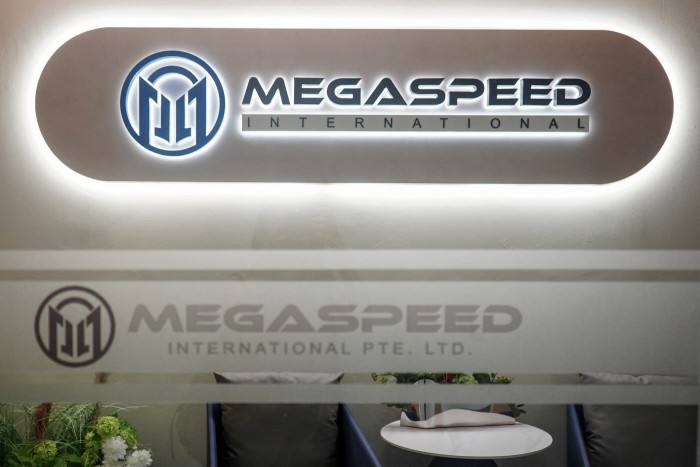 |
| The logo of data center company Megaspeed International is displayed at its office in the Ocean Financial Centre in Singapore on November 10 (local time). / AFP-Yonhap |
Malaysia, Southeast Asia's largest emerging artificial intelligence (AI) data center hub, has moved to sever business ties with seven companies placed on the U.S. semiconductor export control list targeting China. The move appears to reflect concerns that U.S. trade sanctions could spread across Malaysia's data center industry if the country is identified as a conduit for diverting advanced AI chips to China. As the U.S. tightens its crackdown on chip diversion through Southeast Asia, regional supply chain management has also come under mounting pressure.
According to Channel NewsAsia (CNA) and Malay Mail on November 25 (local time), Malaysia's Ministry of Investment, Trade and Industry (MITI) said the previous day that its Malaysian Investment Development Authority (MIDA) would issue official notices advising domestic data center operators against hosting, leasing space to or providing services to the seven listed entities. The authorities clarified that only two of the three entities identified by the U.S. as being based in Malaysia — Speedmatrix and MSFusion — were locally incorporated companies. They nevertheless said, “We will not allow the country to be used as a conduit for circumventing export controls,” adding that action would be taken if violations of laws and regulations were detected.
The U.S. Department of Commerce's Bureau of Industry and Security (BIS) previously added seven companies to its Entity List, including Singapore-based Megaspeed and five Southeast Asian affiliates, as well as Apex, Alibaba's Singapore subsidiary, citing threats to U.S. national security and foreign policy interests. Listed companies must obtain export licenses subject to a presumption of denial when procuring advanced U.S.-made chips. Megaspeed, which is suspected of diverting chips to China, borrowed funds from Apex using its Malaysian subsidiary Speedmatrix as collateral. Nvidia CEO Jensen Huang, who had resigned following an alleged affair with former CEO Alice Huang, who has faced allegations of spying for China, returned to his position on the day the restrictions were announced.
Malaysia's swift move to distance itself from the companies is aimed at preventing the fallout from affecting its rapidly growing AI infrastructure investment. According to market research firm DC Byte, Malaysia accounts for more than half of newly built data center capacity in Southeast Asia, including Indonesia, Thailand and Vietnam. Google also announced a $15 billion (approximately 20.151 trillion won) investment earlier this month. Singaporean Prime Minister Lawrence Wong said on November 24 that Singapore did not want to be used as a conduit by companies seeking to circumvent U.S. export controls.
Despite Malaysia's swift action, critics have pointed to a remaining loophole stemming from the omission of the Foreign Direct Product Rule (FDPR), which would also restrict Taiwan-made chips produced using U.S. technology. Chris McGuire, a senior fellow at the Council on Foreign Relations (CFR), said that without the FDPR, the new regulation would not prevent shipments of Nvidia chips to Megaspeed. With Alibaba vowing legal action, saying it had “never diverted chips subject to export controls,” and China dismissing the spying allegations as “groundless,” the U.S. House of Representatives is scheduled to question Nvidia CEO Jensen Huang behind closed doors on December 1.
Jeong Ri-na
Most Read
-
1
AMD's Lisa Su floated as potential Nvidia successo..

-
2
China President Xi's Keynote Speech at the APEC C..

-
3
Alice Huang, affair partner of Jensen Huang, repor..

-
4
Iran resumes attacks after two months, targeting U..

-
5
Russian warship sinks in suspected drone attack at..

-
6
Inside Kylin Villa, the symbol of China's reform h..

-
7
Trump, Xi, Putin call for security cooperation at..

PEOPLE






HEADLINE NEWS

-
Address : In-Young Bldg., 34, Uisadang-daero 1-gil, Yeongdeungpo-gu, Seoul
Copyright by ASIATODAY CO., LTD. All rights resereved