



Hanwha Aerospace secures export rights for KM3 bridging system
Nov 25, 2026, 10:43 am


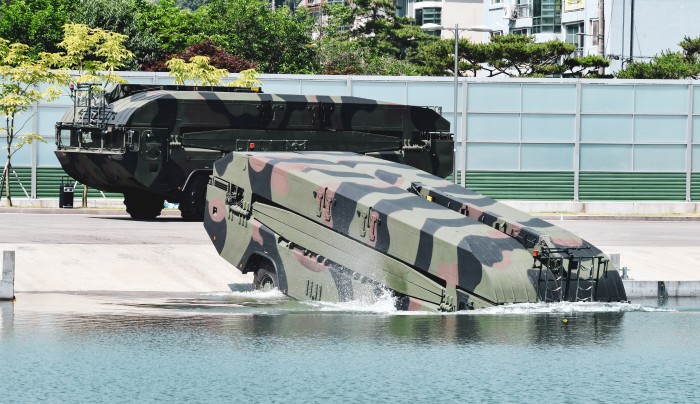 |
| The Suryong (KM3) amphibious bridging vehicle. / Hanwha Aerospace |
Hanwha Aerospace has secured export rights for its Suryong (KM3) amphibious bridging vehicle. The Suryong enables the Army's key equipment, including tanks and self-propelled howitzers, to cross rivers and streams. With overseas exports now possible beyond domestic production and deployment in the South Korean military, Hanwha Aerospace is expected to further expand its portfolio of defense export products.
Hanwha Aerospace announced on November 25 that it had amended its manufacturing license agreement (MLA) with Germany's GDELS-BS, the original manufacturer of the KM3 amphibious bridging vehicle, and secured export rights for the equipment.
Among the countries that have acquired Germany's M3 amphibious bridging vehicle, South Korea is the only one to manufacture the equipment domestically, with Hanwha Aerospace handling production. It is also the first among those countries to secure export rights. Under the amended agreement, Hanwha Aerospace can now export the KM3 to select countries in Europe, the Middle East and Asia.
Hanwha Aerospace has been supplying the KM3 to the South Korean military since June 2024. It recently completed key verification procedures, including field operational tests and fielding evaluations, and plans to deliver the first batch of mass-produced vehicles by next year. Deployment of the second production batch is also set to begin in 2028.
Hanwha Aerospace plans to target overseas markets by leveraging the equipment's operational track record with the South Korean military and its localization rate of nearly 90 percent. In particular, the company expects package exports involving its existing major weapons systems, such as the K9 self-propelled howitzer and armored vehicles, to be possible.
“Securing these rights has laid the groundwork for us to take the lead in pursuing overseas exports of the KM3,” said Park Mae-hoon, head of the LS4 Business Division at Hanwha Aerospace. “We will do our utmost to maximize benefits to the national interest and promote mutual cooperation with our supplier ecosystem by expanding our export product lineup and ensuring stable follow-on production in Korea.”
Kim So-young
Most Read
-
1
AMD's Lisa Su floated as potential Nvidia successo..

-
2
China President Xi's Keynote Speech at the APEC C..

-
3
Alice Huang, affair partner of Jensen Huang, repor..

-
4
Iran resumes attacks after two months, targeting U..

-
5
Russian warship sinks in suspected drone attack at..

-
6
Inside Kylin Villa, the symbol of China's reform h..

-
7
Trump, Xi, Putin call for security cooperation at..

PEOPLE






HEADLINE NEWS

-
Address : In-Young Bldg., 34, Uisadang-daero 1-gil, Yeongdeungpo-gu, Seoul
Copyright by ASIATODAY CO., LTD. All rights resereved