



S. Korea to retain CSAT test papers for five years to probe AI-assisted cheating
Nov 25, 2026, 10:35 am


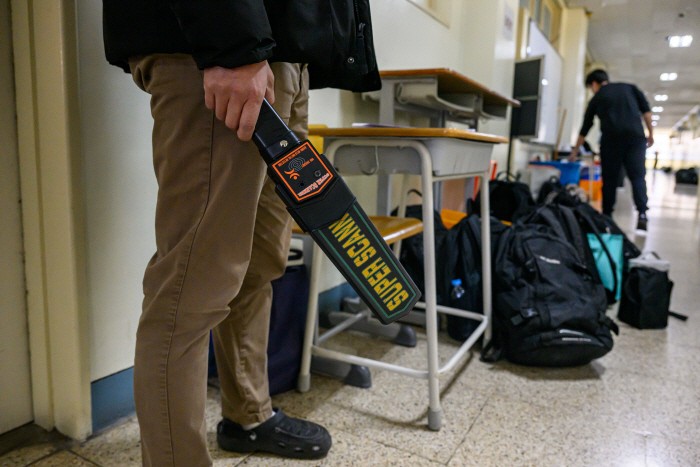 |
| An exam proctor holds a metal detector at Yongsan High School in Yongsan-gu, Seoul, on November 19, when the College Scholastic Ability Test (CSAT) for the 2027 academic year was administered. / Joint Press Corps |
The Ministry of Education will extend the retention period for CSAT test papers from the current one year to five years to strengthen post-exam investigations into cheating involving artificial intelligence (AI). The move follows concerns over limitations in investigating past cheating cases after approximately 18 percent of last year's test centers were found to have already discarded their test papers.
The Ministry of Education said on November 25 that a survey on the retention of test papers from the CSAT for the 2026 academic year found that 1,077 (82.2 percent) of the 1,310 test centers nationwide were retaining their test papers. The remaining 233 centers (17.8 percent) had discarded them.
Test paper retention rates varied significantly by region. In Gangwon Province, all 44 test centers had discarded their test papers. Retention rates in Incheon and Jeju stood at just 41.3 percent and 50.0 percent, respectively. In Seoul, 52 of the 228 test centers had discarded their test papers, resulting in a retention rate of 77.2 percent. In contrast, all test centers in Sejong and South Gyeongsang Province were retaining their test papers.
The ministry is conducting further inquiries into the 233 schools that discarded their test papers to determine the exact quantities discarded, disposal dates and procedures. The retained test papers will be used to investigate suspected cheating cases, including those reported to the reporting center.
At a Cabinet meeting the previous day, the ministry presented measures to address cheating on the CSAT and university-specific examinations and launched a dedicated task force (TF) to conduct post-exam investigations into CSAT cheating.
However, with the ministry having decided to accept reports of and investigate past CSAT cheating cases, its ability to prove cheating and the outcomes of investigations could vary depending on whether test papers have been retained in each region.
The ministry plans to revise relevant regulations, including extending the test paper retention period from one year to five years, to ensure that thorough post-exam investigations into cheating can be conducted.
Park Ji-sook
Most Read
-
1
AMD's Lisa Su floated as potential Nvidia successo..

-
2
China President Xi's Keynote Speech at the APEC C..

-
3
Alice Huang, affair partner of Jensen Huang, repor..

-
4
Iran resumes attacks after two months, targeting U..

-
5
Russian warship sinks in suspected drone attack at..

-
6
Inside Kylin Villa, the symbol of China's reform h..

-
7
Trump, Xi, Putin call for security cooperation at..

PEOPLE






HEADLINE NEWS

-
Address : In-Young Bldg., 34, Uisadang-daero 1-gil, Yeongdeungpo-gu, Seoul
Copyright by ASIATODAY CO., LTD. All rights resereved