



S. Korea to expand training for chip plant construction workers
Nov 25, 2026, 10:22 am


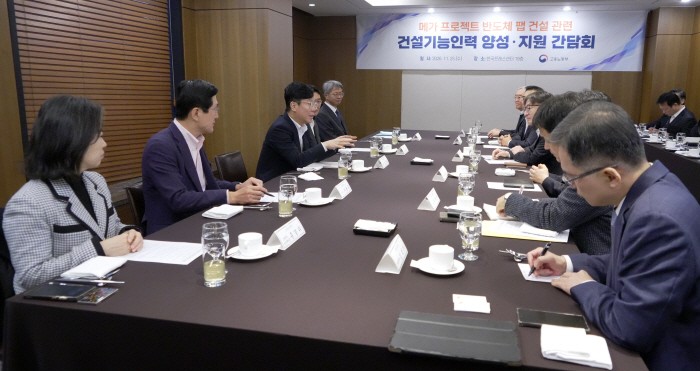 |
| Employment and Labor Minister Kim Young-hoon discusses ways to train skilled workers needed for semiconductor plant construction with construction industry representatives, including those from Samsung C&T and SK ecoplant, at the Korea Press Center in Jung-gu, Seoul, on November 25. / Ministry of Employment and Labor |
The Ministry of Employment and Labor has decided to significantly expand vocational training support in the construction sector to secure skilled workers to build semiconductor plants. With the construction of large-scale production facilities planned in the southwestern region and elsewhere, demand for workers specializing in equipment installation, electrical work and piping is expected to rise, while an aging construction workforce is making it more difficult to secure workers.
Employment and Labor Minister Kim Young-hoon held a meeting with Samsung C&T, SK ecoplant and others at the Korea Press Center in Jung-gu, Seoul, on November 25 to discuss ways to meet labor demand for semiconductor plant construction. The two companies shared their estimates of the workforce needed for construction, their own plans to secure workers and the difficulties they face on construction sites.
“Companies know best which trades need workers, when they are needed and how many are required,” Kim said. “We will ensure close communication between companies and the government to support the timely supply of workers.”
At a meeting hosted by the Ministry of Land, Infrastructure and Transport the previous day, construction companies and their subcontractors projected that demand for more than 260,000 workers would arise by 2030 once large-scale semiconductor plant construction gets underway in earnest. In particular, they requested government support for education and training, citing difficulties in securing skilled workers for piping, welding and ductwork.
According to the Ministry of Land, Infrastructure and Transport, workers aged 50 and older accounted for 62.9 percent of Korean skilled construction workers as of the end of October, while those in their 20s and 30s accounted for 18.0 percent. The number of industrial plant pipefitters stood at 1,152, while that of industrial plant welders stood at 620.
Semiconductor plants require specialized piping to supply gases and ultrapure water for manufacturing processes, as well as cleanrooms to control the entry of dust. According to industry sources, such facilities require a higher level of expertise than conventional building construction, meaning that training precision piping specialists alone requires at least one to two years of on-site experience and training.
“Construction workers are key to accelerating megaprojects,” Kim said. “Without skilled workers to connect pipes, install electrical systems and build cleanrooms, fabs cannot be completed on time.”
The labor ministry plans to expand vocational training support and consult with companies to ensure that trained workers are deployed to construction sites when needed. The land ministry also plans to establish a joint public-private consultative body and flesh out plans for the public and private sectors to jointly develop education and training programs tailored to semiconductor plant construction.
“When construction schedules are tight and large numbers of workers work simultaneously at a single site, the risk of accidents increases accordingly,” Kim said. “I urge you to work together to ensure safety from the design stage, bearing in mind that a safe construction site is the fastest construction site.”
Kim Nam-hyung
Most Read
-
1
AMD's Lisa Su floated as potential Nvidia successo..

-
2
China President Xi's Keynote Speech at the APEC C..

-
3
Alice Huang, affair partner of Jensen Huang, repor..

-
4
Iran resumes attacks after two months, targeting U..

-
5
Russian warship sinks in suspected drone attack at..

-
6
Inside Kylin Villa, the symbol of China's reform h..

-
7
Trump, Xi, Putin call for security cooperation at..

PEOPLE





HEADLINE NEWS

-
Address : In-Young Bldg., 34, Uisadang-daero 1-gil, Yeongdeungpo-gu, Seoul
Copyright by ASIATODAY CO., LTD. All rights resereved