



Two in three S. Koreans have no religion
Nov 25, 2026, 10:16 am


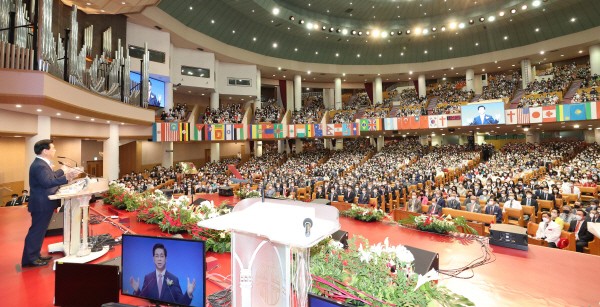 |
| A worship service at Yoido Full Gospel Church, South Korea's largest church. According to the results of the 2025 Population and Housing Census sample survey released by the Ministry of Data and Statistics on the 24th, two in three South Koreans have no religious affiliation. / Courtesy of Yoido Full Gospel Church |
South Korea's religious population has declined by more than 4 million over the past decade, with only 17.16 million people, or 34.8 percent of the population, identifying with a religion. This means that two in three South Koreans have no religious affiliation.
According to the results of the 2025 Population and Housing Census sample survey released by the Ministry of Data and Statistics on the 24th, the number of Korean nationals with a religious affiliation stood at 17,156,360 as of November 1 last year.
The survey, the first to collect religious statistics in a decade since 2015, showed a decline of approximately 4,397,000 people, or 20.4 percent, from 10 years earlier. Over the same period, the number of people with no religious affiliation increased by approximately 4,695,000, or 17.1 percent, to 32,193,347, accounting for 65.2 percent of all Korean nationals.
The proportion of people with a religious affiliation rose from 42.6 percent in 1985, when the survey was first conducted, to 50.7 percent in 1995 and 53.1 percent in 2005. However, it fell to 43.9 percent in the 2015 survey and further declined to 34.8 percent last year.
By religion, Protestantism had the largest number of followers at 8,439,316 (17.1 percent), followed by Buddhism at 5,184,182 (10.5 percent) and Catholicism at 3,304,002 (6.7 percent). Together, followers of the three religions accounted for 34.3 percent of all Korean nationals. Won Buddhism followed with 84,373 followers, Daesoon Jinrihoe with 34,446, Confucianism with 24,655 and Cheondogyo with 19,132.
Protestantism remains largest religion but faces wake-up call; Buddhist population sees sharp decline
Protestantism retained its position as the country's largest religion, but its decline in followers was pronounced. Compared with approximately 9.67 million followers (19.7 percent) a decade ago, the number fell by 1.23 million, marking a decline of about 13 percent from the 2015 survey.
Following the release of the survey results, the United Christian Churches of Korea and Yoido Full Gospel Church issued separate statements, pledging to reflect on the findings and take the lead in reforming Korean churches.
“The loss of 1.23 million followers compared with 10 years ago is a warning of a crisis that leaves no room for complacency,” the United Christian Churches of Korea said. “We feel a deep sense of responsibility for failing to focus on restoring the essence of the church, failing to invest sufficiently in elementary, middle and high school students and young adults, and disappointing the public through division and secularization within the church.”
The organization outlined three priorities for overcoming the crisis and achieving renewal: restoring the essence of the Gospel and the holiness of the church while promoting unity and solidarity; strengthening communication with people in their teens, 20s and 30s and increasing investment in nurturing the next generation; and fulfilling social responsibilities, including addressing the low birth rate and caring for the vulnerable.
Lee Young-hoon, senior pastor of Yoido Full Gospel Church, also said, “Rather than boasting about the size of their congregations, Korean churches must make greater efforts to restore the essence of the Gospel and earn the trust and love of the public.”
“In particular, churches must listen to the struggles of the next generation and share responsibility for their dreams and future,” he said, stressing that churches should also play an active role in addressing the low birth rate.
Buddhism experienced the steepest decline. The number of Buddhists fell by approximately 2.43 million (32 percent) from 7.619 million in 2015. The Buddhist population, which exceeded 10 million in 2005, has been halved over the past 20 years. This is because the influx of younger Buddhists has not kept pace with the decline in the number of older followers.
A senior monk at a chongnim, a comprehensive monastic training complex equipped with a monastic college, a meditation center and a Vinaya institute, affiliated with the Jogye Order of Korean Buddhism, said, “We had anticipated this to some extent when the number of people entering monastic life began declining after 2010.”
“Given the nature of Buddhism, parents are less inclined to encourage their children to embrace their religion than Protestant parents are, and I think the weakening of the transmission of religious practice to the next generation has been a major factor,” the monk said.
“Visitor numbers have increased since temple admission fees were abolished, but visitors are not entering the worship halls,” the monk added. “It is concerning that the number of practicing Buddhists is declining and temples are increasingly becoming tourist attractions. It is time for the entire order to consider ways to address this issue.”
The Catholic population fell by 590,000 from 3.89 million a decade ago to approximately 3.3 million. Although the decline was smaller in absolute terms than those of Buddhism and Protestantism, the 15 percent decrease over the past decade was the second steepest in percentage terms, after Buddhism.
The sharp decline in the Catholic population appears to reflect the impact of population aging, as Catholics tend to be older than Protestants. For this reason, the Catholic Church in Korea is expected to use World Youth Day (WYD) Seoul 2027 as an impetus to bring young lapsed Catholics back to church.
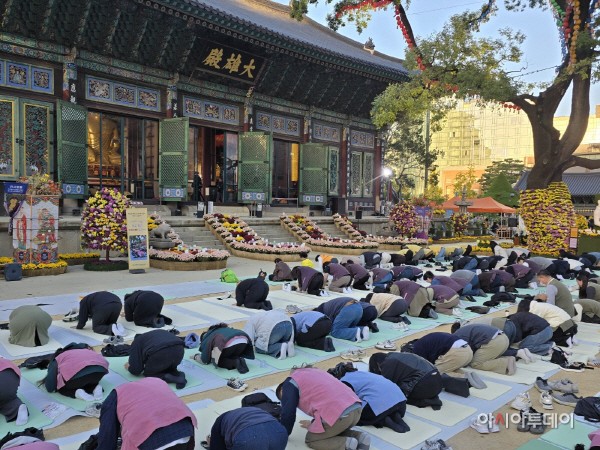 |
| An event for children with intractable diseases held at Jogyesa Temple in Seoul. Amid an overall decline in the religious population, Buddhism, with its aging congregation, experienced the most pronounced decline. / Photo by Hwang Ui-joong |
Hwang Ui-joong
Most Read
-
1
AMD's Lisa Su floated as potential Nvidia successo..

-
2
China President Xi's Keynote Speech at the APEC C..

-
3
Alice Huang, affair partner of Jensen Huang, repor..

-
4
Iran resumes attacks after two months, targeting U..

-
5
Russian warship sinks in suspected drone attack at..

-
6
Inside Kylin Villa, the symbol of China's reform h..

-
7
Trump, Xi, Putin call for security cooperation at..

PEOPLE





HEADLINE NEWS

-
Address : In-Young Bldg., 34, Uisadang-daero 1-gil, Yeongdeungpo-gu, Seoul
Copyright by ASIATODAY CO., LTD. All rights resereved