



S. Korean business sentiment deteriorates amid global oversupply and rising costs
Nov 25, 2026, 09:58 am


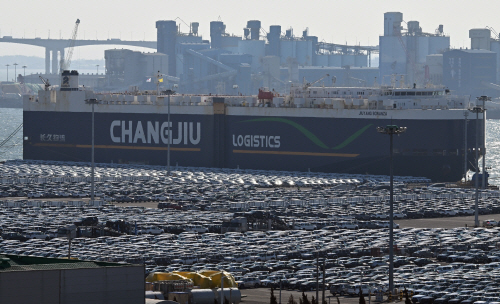 |
| Vehicles awaiting export are parked at Pyeongtaek Port in Pyeongtaek, Gyeonggi Province. / Song Ui-joo |
Business sentiment deteriorated just one month after improving sharply last month. Global oversupply and rising raw material prices increased inventory burdens in the manufacturing sector, while higher labor and fuel costs worsened business conditions in the non-manufacturing sector.
According to the November Business Survey and Economic Sentiment Index (ESI) released by the Bank of Korea (BOK) on November 25, the Composite Business Sentiment Index (CBSI) for all industries stood at 103.5 this month, down 0.7 points from 104.2 the previous month. The index reversed course just one month after rising 5.1 points in October.
The manufacturing CBSI stood at 104.8, down 0.8 points from the previous month. Rising product inventories were the biggest contributor to the decline. The BOK attributed this to a combination of sluggish sales of food and chemical products, the restoration of adequate inventory levels following the normalization of automobile production, and inventory stockpiling in the pharmaceutical industry. Product inventories are a countercyclical indicator, meaning that rising inventories negatively affect the business sentiment index.
By industry, the business conditions index for food products plunged 11 points from the previous month, reflecting rising grain prices due to abnormal weather conditions and sluggish domestic sales among manufacturers of food processing ingredients and animal feed. The index for chemicals and chemical products also fell 4 points due to global oversupply and declining orders from downstream industries such as construction. The "negative lagging effect," in which profitability deteriorates as inventories acquired at previously high raw material prices are sold at relatively lower prices, also contributed to the decline.
Business sentiment diverged between exporters and domestic market-oriented companies. The CBSI for exporters fell 2.7 points from 106.1 the previous month to 103.4, while that for domestic market-oriented companies rose 1.5 points from 103.8 to 105.3. "Business sentiment among domestic market-oriented companies improved as production increased among manufacturers benefiting from favorable semiconductor industry conditions and the normalization of automobile production," said Park Yong-min, head of the BOK's Economic Tendency Survey Team. "In contrast, exporters were affected by declining production and rising product inventories in the chemicals and chemical products industry, as well as weaker production resulting from falling demand related to mobile phones and home appliances."
The non-manufacturing CBSI also fell 0.7 points from the previous month to 102.5. In the arts, sports and recreation sector, the business conditions index and sales index fell 14 points and 27 points, respectively, as lower temperatures reduced outdoor leisure activities at facilities such as golf courses and amusement parks. The business conditions index for the transportation and storage sector also declined 7 points due to rising operating costs, including fuel expenses, and falling ocean freight rates.
Weak domestic demand remained the biggest business challenge cited by companies. In the manufacturing sector, sluggish domestic demand was the most frequently cited difficulty, accounting for 21.2% of responses. It was also the biggest challenge in the non-manufacturing sector, at 19.1%.
The business sentiment outlook for next month improved slightly. The CBSI outlook for all industries in December stood at 102.0, up 0.2 points from the November outlook of 101.8 in the previous month's survey. The manufacturing outlook fell 0.2 points to 102.8, while the non-manufacturing outlook rose 0.4 points to 101.4. The ESI, which combines the economic sentiment of businesses and consumers, fell 0.9 points from 100.8 the previous month to 99.9, slipping below its long-term average of 100.
Han Sang-wook
Most Read
-
1
AMD's Lisa Su floated as potential Nvidia successo..

-
2
China President Xi's Keynote Speech at the APEC C..

-
3
Alice Huang, affair partner of Jensen Huang, repor..

-
4
Iran resumes attacks after two months, targeting U..

-
5
Russian warship sinks in suspected drone attack at..

-
6
Inside Kylin Villa, the symbol of China's reform h..

-
7
Trump, Xi, Putin call for security cooperation at..

PEOPLE





HEADLINE NEWS

-
Address : In-Young Bldg., 34, Uisadang-daero 1-gil, Yeongdeungpo-gu, Seoul
Copyright by ASIATODAY CO., LTD. All rights resereved