



S. Korea's anti-cheating measures face scrutiny over practical and legal challenges
Nov 25, 2026, 09:46 am


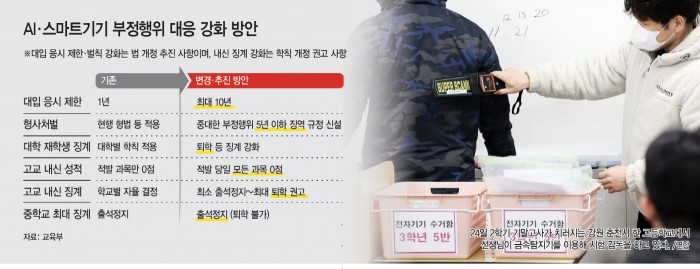 |
The government has decided to significantly strengthen the management and supervision of middle and high school examinations, along with disciplinary measures, to prevent cheating involving artificial intelligence (AI). However, concerns are growing over the effectiveness of the policy's implementation, as many schools have already begun their final exams and neither the effectiveness of advanced device detection nor its legal basis has been sufficiently established. Critics also warn that measures intended to ensure fairness could instead undermine equity in student assessments.
According to the Seoul Metropolitan Office of Education on November 24, of the 239 schools that submitted final exam schedules for high school seniors, 200 (83.7%) are scheduled to begin their exams this week (November 23-27). Another 14 schools have already begun their exams. This leaves insufficient time to secure metal detectors, obtain prior consent from students and parents, and revise school regulations. Recognizing the difficulty of immediately implementing universal screening for high school seniors, the Ministry of Education has advised schools to use metal detectors in situations such as when there are indications of cheating or when students reenter examination rooms.
In particular, with the reliability of student assessments becoming increasingly important ahead of the overhaul of the university admissions system for the 2028 academic year, which incorporates a five-tier school grading system, differences in schools' supervision capabilities depending on their staffing and equipment levels could create another equity issue.
It also remains unclear whether tougher penalties will have a meaningful deterrent effect. As metal detectors cannot identify AI, recording or communication capabilities themselves, relying on physical inspections has limitations as cheating methods become increasingly sophisticated. Legal and procedural issues also remain. Unless clear standards are established for handling students who refuse inspections and distinguishing between penalties for merely possessing smart devices and actually using them, responsibility for resulting disputes is likely to fall largely on individual schools and teachers.
Calls for caution are also emerging within education authorities. At a press briefing that day, Seoul Metropolitan Superintendent of Education Chung Keun-sik said additional metal detectors would be purchased to ensure that each classroom had one, but noted that "it is educationally inappropriate to treat students as potential cheaters."
Teachers' organizations have also voiced opposition. The Korean Federation of Teachers' Unions criticized the lack of clarity regarding the effectiveness of metal detectors in detecting advanced devices, procedures for handling students who refuse inspections and where responsibility lies. The Korean Teachers and Education Workers Union also called for a fundamental overhaul of the assessment system, arguing that teachers were being burdened with surveillance and control duties on top of the increased assessment workload brought about by the high school credit system.
The Ministry of Education plans to establish a legal basis for metal detector inspections through legislative amendments and develop technological measures to prevent cheating in cooperation with the Ministry of Science and ICT. However, questions are also being raised about the sequence of policy implementation, given that supervision guidelines are being introduced before the necessary technological and legal foundations are in place.
"The government has introduced tough measures in view of the gravity of the situation," said Park Nam-gi, professor emeritus at Gwangju National University of Education. However, he predicted that proportionality in sentencing compared with other crimes would become a major issue in the legislative amendment process. Park stressed that "substantial investment at the national level is needed to ensure that a three-stage management system for AI-assisted cheating — prevention, detection before and after examinations, and punishment — functions as an integrated whole." Furthermore, noting that examinations constitute a form of social agreement designed to ensure the fair distribution of social goods, he said, "In the long term, we need a fundamental discussion about the criteria and methods by which social goods should be distributed in the AI era."
Park Ji-sook
Most Read
-
1
AMD's Lisa Su floated as potential Nvidia successo..

-
2
China President Xi's Keynote Speech at the APEC C..

-
3
Alice Huang, affair partner of Jensen Huang, repor..

-
4
Iran resumes attacks after two months, targeting U..

-
5
Russian warship sinks in suspected drone attack at..

-
6
Inside Kylin Villa, the symbol of China's reform h..

-
7
Trump, Xi, Putin call for security cooperation at..

PEOPLE






HEADLINE NEWS

-
Address : In-Young Bldg., 34, Uisadang-daero 1-gil, Yeongdeungpo-gu, Seoul
Copyright by ASIATODAY CO., LTD. All rights resereved