



UK urges households to stockpile emergency supplies
Oct 26, 2026, 11:09 am


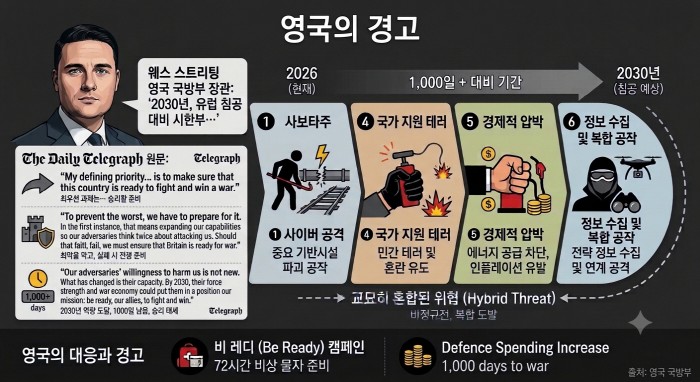 |
| Britain's warning: 1,000 days to prepare for a potential European invasion by 2030. Based on British Defence Secretary Wes Streeting's warning and his article in The Daily Telegraph, this AI-generated infographic presents a timeline highlighting the increasingly sophisticated security threats that Britain believes are posed by Russia and other anti-Western powers. / AI-generated image by Koo Pil-hyun |
The threat of war is growing across Europe, with warnings that the continent has only a limited time to prepare. The British government has launched a civilian preparedness campaign urging households to stockpile enough emergency supplies to last 72 hours. The country's defence secretary has also raised the alarm, warning that "just over 1,000 days" remain to prepare for war. The warning reflects an assessment that Russia and other anti-Western powers are modernizing their militaries faster than expected, potentially enabling a full-scale war against European countries or unprecedentedly sophisticated hybrid operations around 2030.
British Defence Secretary Wes Streeting warned in an article published in The Daily Telegraph on Oct. 24 (local time) that "our adversaries are modernizing at an incredible pace, and we must stay ahead of them." Streeting identified the period around 2030 as a critical turning point for military security. He warned that hostile powers could develop the troop strength and wartime economic capacity needed to undertake aggressive military action in just over three years.
"Our adversaries' willingness to harm us is not new. What has changed is their capacity," he said. "To prevent the worst, we have to prepare for it. In the first instance, that means expanding our capabilities so our adversaries think twice about attacking us." He further warned that if deterrence fails, Britain and its allies have "a little over 1,000 days" to ensure they are ready to fight and win.
Streeting's warning was not limited to the possibility of conventional warfare between regular armed forces. In addition to the threat of a full-scale Russian military invasion, he specifically raised the possibility of state-sponsored hybrid attacks and sabotage aimed at crippling critical infrastructure and spreading fear among the population. His remarks suggest that the threat of comprehensive hybrid warfare, combining conventional military operations with irregular attacks, is drawing closer to Europe.
'Be Ready' emergency kits recommended
The defence secretary's stark warning, together with the British government's previously announced civilian emergency preparedness measures, highlights a sweeping shift in Britain's security posture from peacetime arrangements toward a system capable of rapidly transitioning to wartime conditions. On Oct. 22, the government officially launched its "Be Ready" campaign, urging households to prepare enough emergency supplies to survive for 72 hours without outside assistance, including bottled water, canned food, flashlights and portable radios.
The governing Labour Party has also begun a major overhaul of the military, sharply criticizing what it describes as years of poor defence management under previous governments. Streeting said that under past Conservative administrations, the British armed forces had been reduced to their lowest personnel levels since the Napoleonic Wars, while recruitment failures and declining morale were left unaddressed. He emphasized that the current government had undertaken the largest increase in defence spending since the end of the Cold War. The move signals the government's intention to make rebuilding the defence industrial base and strengthening regular military forces top national priorities.
Expert analysis: "Europe's 1,000-day countdown sends a serious warning for South Korea's comprehensive national defence"
The British defence secretary's "1,000-day warning" and the "72-hour emergency supplies campaign" also carry serious implications for security on the Korean Peninsula, on the other side of the world. North Korea is advancing its missile and nuclear capabilities through closer ties with Russia while seeking to compensate for weaknesses in its conventional forces through drones, unmanned systems and a strategy of fortifying the Demilitarized Zone (DMZ). Against this backdrop, Britain's proactive preparations for a potential all-out conflict offer important lessons for South Korea.
In a telephone interview with AsiaToday on Oct. 25, Joo Eun-sik, head of the Korea Research Institute for Strategy, said, "The crisis Europe anticipates in 2030 is not simply a border dispute, but a series of sophisticated, multifaceted provocations by hostile powers that have shifted to wartime economies. ... South Korea must also move beyond simply maintaining conventional forces centered on main battle tanks and artillery and begin rapidly deploying drone- and AI-based manned-unmanned teaming systems (Agile Defense), while overhauling its civilian preparedness for comprehensive national defence."
Unless South Korea strengthens its deterrence capabilities to discourage potential adversaries from attacking while immediately establishing an integrated emergency preparedness system involving civilians, the government and the military, Europe's 1,000-day warning could serve as an urgent reminder that the window for strengthening security on the Korean Peninsula is narrowing.
Koo Pil-hyun
Most Read
-
1
Celltrion nears additional contract with major U.S..

-
2
Putin proposes trilateral U.S.-China-Russia summit..

-
3
U.S. weighs dropping MOAB, world's most powerful n..

-
4
"Aren't those foreigners on welfare?": M..

-
5
Attention centers on APEC for possible Trump-Xi-Pu..

-
6
U.S., Israel plan to resume strikes on Iran after..

-
7
Saudi Arabia, Iran hold first diplomatic talks to..

PEOPLE







-
Address : In-Young Bldg., 34, Uisadang-daero 1-gil, Yeongdeungpo-gu, Seoul
Copyright by ASIATODAY CO., LTD. All rights resereved