



Government to inject 71.3 billion won into recovery from July heavy rains
Aug 20, 2026, 10:24 am


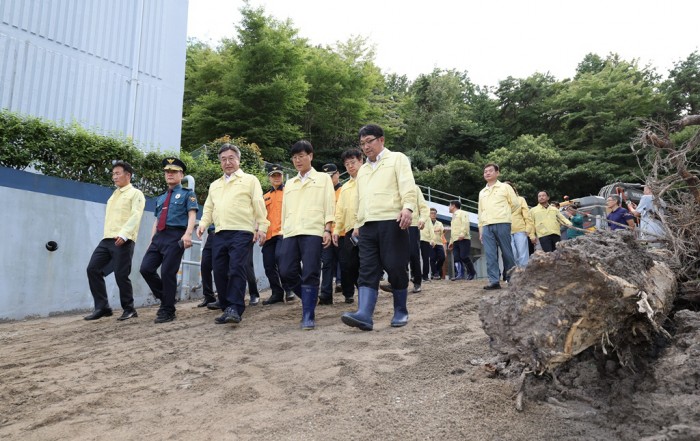 |
| Minister of the Interior and Safety Yoon Ho-jung visits an apartment complex affected by heavy rain in Okpo-dong, Geoje, South Gyeongsang Province, on the afternoon of August 18 to inspect damage caused by soil runoff behind the residential building due to torrential downpours. / Ministry of the Interior and Safety |
The government has decided to inject a total of 71.3 billion won into repairing damaged facilities and supporting residents in 89 cities, counties, and districts across 13 cities and provinces affected by torrential rains last July.
The Central Disaster and Safety Countermeasures Headquarters announced on August 19 that, following deliberations during its meeting on August 18, it finalized the property damage from the July heavy rains at 30.9 billion won and decided to allocate 71.3 billion won for recovery funds.
According to the headquarters, heavy rainfall battered the country from July 8 to 24 as a stationary front fluctuated north and south between a cold upper trough to the north and the North Pacific High to the south, inflicting damage across 98 cities, counties, and districts nationwide.
Private property damage was found to include five destroyed or damaged residential structures, 376 inundated households, 900 hectares of agricultural and forestry crops, 32 hectares of farmland, and 231 affected small businesses. Damage to public facilities totaled 71 river cases, 208 small stream cases, 33 road cases, 5 water supply cases, 48 irrigation facility cases, 203 small-scale facility cases, and 46 landslide cases.
Of the 71.3 billion won recovery fund finalized by the government, 6.4 billion won is allocated to disaster relief grants to support private facility damage, and 64.9 billion won is designated for public facility restoration.
Disaster relief grants provided to residents suffering from residential inundation amount to 3.5 million won per household according to standards stipulated in relevant regulations. Affected small business owners will receive 3.0 million won per enterprise. Recovery costs for agricultural and forestry crops as well as agricultural and forestry facilities will be calculated and paid based on damaged surface areas. The government decided to apply the same payment criteria even to areas with relatively small-scale damage that fell short of the threshold for state subsidies.
In addition, indirect support will be extended to affected residents. In general disaster zones, 25 types of assistance will be provided, including deferrals of national tax payments, extensions of local tax deadlines, exemptions from national pension contributions, disaster recovery loans, emergency business stabilization loans, and reductions or exemptions on water and sewage utility bills.
Furthermore, additional support will be provided to four townships declared special disaster zones on August 7: Iljik-myeon, Namseon-myeon, and Imha-myeon in Andong, and Danchon-myeon in Uiseong County, North Gyeongsang Province. Thirteen additional relief measures, including reductions in national health insurance premiums and discounts on electricity, telecommunications, and city gas rates, will be granted.
To receive indirect natural disaster relief, a disaster damage certificate is required, which can be issued by the local government where the damage occurred. However, in cases involving casualties, residents should obtain the certificate from the local government of their registered address rather than the incident site.
Minister of the Interior and Safety Yoon Ho-jung stated, "The government plans to swiftly disburse national subsidies in accordance with the finalized recovery plan and work closely with local governments to rapidly distribute disaster relief grants to affected residents."
Kim Bo-young
Most Read
-
1
Celltrion nears additional contract with major U.S..

-
2
Putin proposes trilateral U.S.-China-Russia summit..

-
3
U.S. weighs dropping MOAB, world's most powerful n..

-
4
"Aren't those foreigners on welfare?": M..

-
5
Houthis launch successive attacks on Saudi airport..

-
6
Saudi Arabia, Iran hold first diplomatic talks to..

-
7
Attention centers on APEC for possible Trump-Xi-Pu..

PEOPLE






-
Address : In-Young Bldg., 34, Uisadang-daero 1-gil, Yeongdeungpo-gu, Seoul
Copyright by ASIATODAY CO., LTD. All rights resereved