



Seoul Mayor Oh slams government's real estate policy
Jul 16, 2026, 10:12 am


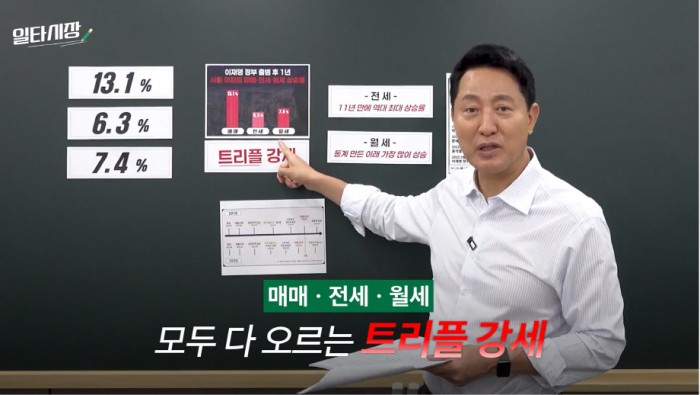 |
| On the 15th, Seoul Mayor Oh Se-hoon appeared in a video titled "Star Instructor Mayor Oh Se-hoon—The Story I Couldn't Finish at the Cabinet Meeting: Analyzing the Root Causes of the Lee Jae-myung Administration's Real Estate Hell," which was released on the official website of the Seoul Metropolitan Government and its social broadcasting platform, Live Seoul. |
Seoul Mayor Oh Se-hoon pointed out that the real estate demand-suppression measures implemented during the first year of the Lee Jae-myung administration have led to a triple spike, driving up buying, lease (jeonse), and monthly rent prices simultaneously. He concluded that a series of government regulations served to destabilize the market instead.
The Seoul Metropolitan Government released a video titled "Star Instructor Mayor Oh Se-hoon—The Story I Couldn't Finish at the Cabinet Meeting: Analyzing the Root Causes of the Lee Jae-myung Administration's Real Estate Hell" on the mayor's official website and its social broadcasting platform, Live Seoul, on the 15th.
According to the data presented by Mayor Oh, over the past year, buying prices for apartments in Seoul rose by 13.1%, lease deposits by 6.3%, and monthly rents by 7.4%. Notably, lease prices marked their highest rate of increase in 11 years, while monthly rents recorded the sharpest rise since related statistics were first compiled.
He attributed this triple spike to the government's heavy focus on suppressing demand through six real estate packages over the past year, which centered on limiting mortgage loans, expanding regulated zones, and imposing heavy capital gains taxes on multi-home owners.
Comparing the policies of the Moon Jae-in administration with those of the current government, Mayor Oh remarked, "The overall flow—starting from loan restrictions and announcements of public rental housing supply to designating speculative zones and strengthening capital gains and property holding taxes—looks remarkably similar".
He also argued that these demand-suppression measures inadvertently stimulated housing prices in the outer districts of Seoul. According to Mayor Oh, after the June 27 measure capped mortgage loans at 600 million won, buying demand did not vanish but rather shifted toward apartments priced under 1.5 billion won. Indeed, following the measure, 78.1% of all transactions in Seoul were concentrated in apartments under 1.5 billion won, which fueled price hikes in non-Gangnam districts.
"Measures designed to cool down housing prices in Gangnam ended up driving up prices in non-Gangnam districts, the Han River belt, and the outer areas of Seoul," Mayor Oh said. "There was only a temporary lull immediately after the announcement, but the overall price trend has continued on an upward trajectory".
The Seoul Metropolitan Government is expected to release a follow-up video shortly, detailing policy shifts, the city's own countermeasures, and solutions recommended to the central government.
Lee Soo-il
Most Read
-
1
Celltrion nears additional contract with major U.S..

-
2
Putin proposes trilateral U.S.-China-Russia summit..

-
3
U.S. weighs dropping MOAB, world's most powerful n..

-
4
"Aren't those foreigners on welfare?": M..

-
5
Attention centers on APEC for possible Trump-Xi-Pu..

-
6
Saudi Arabia, Iran hold first diplomatic talks to..

-
7
China tightens grip on boosting domestic demand an..

PEOPLE







-
Address : In-Young Bldg., 34, Uisadang-daero 1-gil, Yeongdeungpo-gu, Seoul
Copyright by ASIATODAY CO., LTD. All rights resereved