



Grid demand surges with mega-projects, but specialized workforce and materials fall short
Jul 16, 2026, 10:08 am


 |
While the 12th Basic Plan for Electricity Supply and Demand (BPE), which incorporates the government's mega-projects, is currently under review, shortages of specialized construction personnel and key materials are expected to hinder the swift execution of these grid expansion projects. Concerns are mounting in the field that shortages of contractors, transmission technicians, transmission tower manufacturing capacity, and critical logistics resources—such as cableways and helicopters—could disrupt the timely expansion of the national power grid.
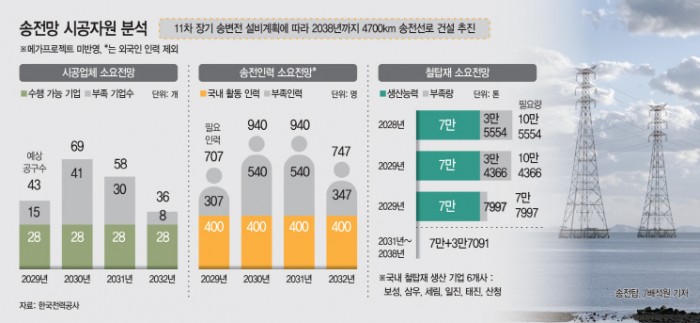
According to industry sources, including Korea Electric Power Corporation (KEPCO), on the 15th, the volume of overhead transmission line construction currently reflected in the 11th Long-Term Transmission and Substations Plan (2024–2038) spans 394 projects nationwide, totaling 4,700 kilometers. Based solely on this volume, KEPCO established a master plan late last year to secure construction resources for the timely expansion of national grid infrastructure, anticipating a massive concentration of construction work between 2029 and 2033.
The primary obstacle is the shortage of resources to execute these projects. Currently, only about 28 domestic companies possess the capacity to undertake transmission line projects valued at 10 billion won or more. Although more firms could theoretically participate, the bidding process employs a comprehensive evaluation system that strictly assesses the possession of skilled workforce and track records on equivalent projects. Under current conditions, between 8 and 41 construction sections are projected to face execution deficits annually from 2029 to 2033. In response, KEPCO is pushing to ease screening criteria, including lowering required construction track records.
Securing highly skilled transmission technicians is also an urgent issue. During the three-year peak construction window from 2029 to 2031, the industry is projected to face an annual shortage of 300 to 540 line workers. Currently, the active pool of certified transmission line technicians in the industry is estimated at just 400. While KEPCO has secured around 190 foreign workers as of July, the supply-demand gap could widen further if mega-projects are added to the pipeline.
In addition, a bottleneck in the supply of steel towers threatens project timelines. Demand for transmission towers is expected to exceed 100,000 tons between 2028 and 2029, but the combined annual capacity of South Korea's six major domestic manufacturers (Bosung, Samwoo, Serim, Taejin, Sancheong, and Iljin) is capped at around 70,000 tons. KEPCO is discussing collaborative production frameworks among these manufacturers to smooth out peak-period delivery backlogs. Logistical constraints, such as a shortage of cableways and heavy-lift helicopters required to transport massive tower components to rugged terrain sites, are also cited as risks.
Long-term transmission and substation plans are formulated based on the BPE. KEPCO's internal assessments of resource shortages only reflect demand prior to the announcement of the government's major mega-projects. If the government incorporates new energy sources, such as nuclear power and liquefied natural gas (LNG) plants, into the 12th BPE, the required scale of construction resources will have to be completely recalculated.
"The 12th BPE will outline demand forecasts that include mega-projects, AI data centers, and semiconductor clusters, which will subsequently shape the transmission facility plan," an official from the Ministry of Climate, Energy and Environment said. "While it is premature to provide specific figures, we must work closely with KEPCO to resolve policy and systemic hurdles through inter-agency consultations."
Bae Seok-won
#Grid
Copyright by Asiatoday
Most Read
-
1
Samsung Bioepis and PROTEINA partner to develop AI..

-
2
Iran's IRGC launches airstrikes on U.S. military f..

-
3
Trump imposes new Iran blockade and 20% Hormuz tol..

-
4
Netanyahu requests Trump to halt F-35 sales to Tur..

-
5
Khamenei's two-day funeral: Three sons spotted, su..

-
6
Samsung Electronics sets record with 89.4 trillion..

-
7
Chinese and Russian navies launch joint naval exer..

PEOPLE





HEADLINE NEWS

-
Address : In-Young Bldg., 34, Uisadang-daero 1-gil, Yeongdeungpo-gu, Seoul
Copyright by ASIATODAY CO., LTD. All rights resereved